
Jane Austen was born almost two and a half centuries ago, and yet she lives on in 2025—that is, through her stories. Heartwarming, witty windows into English women’s lives in the 19th century, Austen’s novels are timeless in their representations of empathy, female strength and, of course, romance. The most famous of Austen’s works, “Pride and Prejudice,” is the focus of the special event, “Austen 250: Four Fridays with Jane,” hosted in collaboration by the English, Film and Global Nineteenth Century Studies Departments to celebrate Austen’s 250th year.
Every other Friday for the remainder of the fall semester, four film adaptations of Austen’s “Pride and Prejudice” will be shown in the aptly antique theater of Blodgett Auditorium, including the irreverent modern rom-com, “Bridget Jones’ Diary” (2001) on Nov. 21 and the Bollywood take, “Bride and Prejudice” (2004) on Dec. 5. The series of screenings will culminate in a final celebration on Dec. 12 with Joe Wright’s “Pride & Prejudice” (2005) and an obligatory birthday cake, just before Austen’s official semiquincentennial birthday on Dec. 16. Each screening will be prefaced by a 10-minute talk presented by a professor from the sponsoring academic departments. They will provide historical context and information relevant to Austen and each film, as well as their own research.
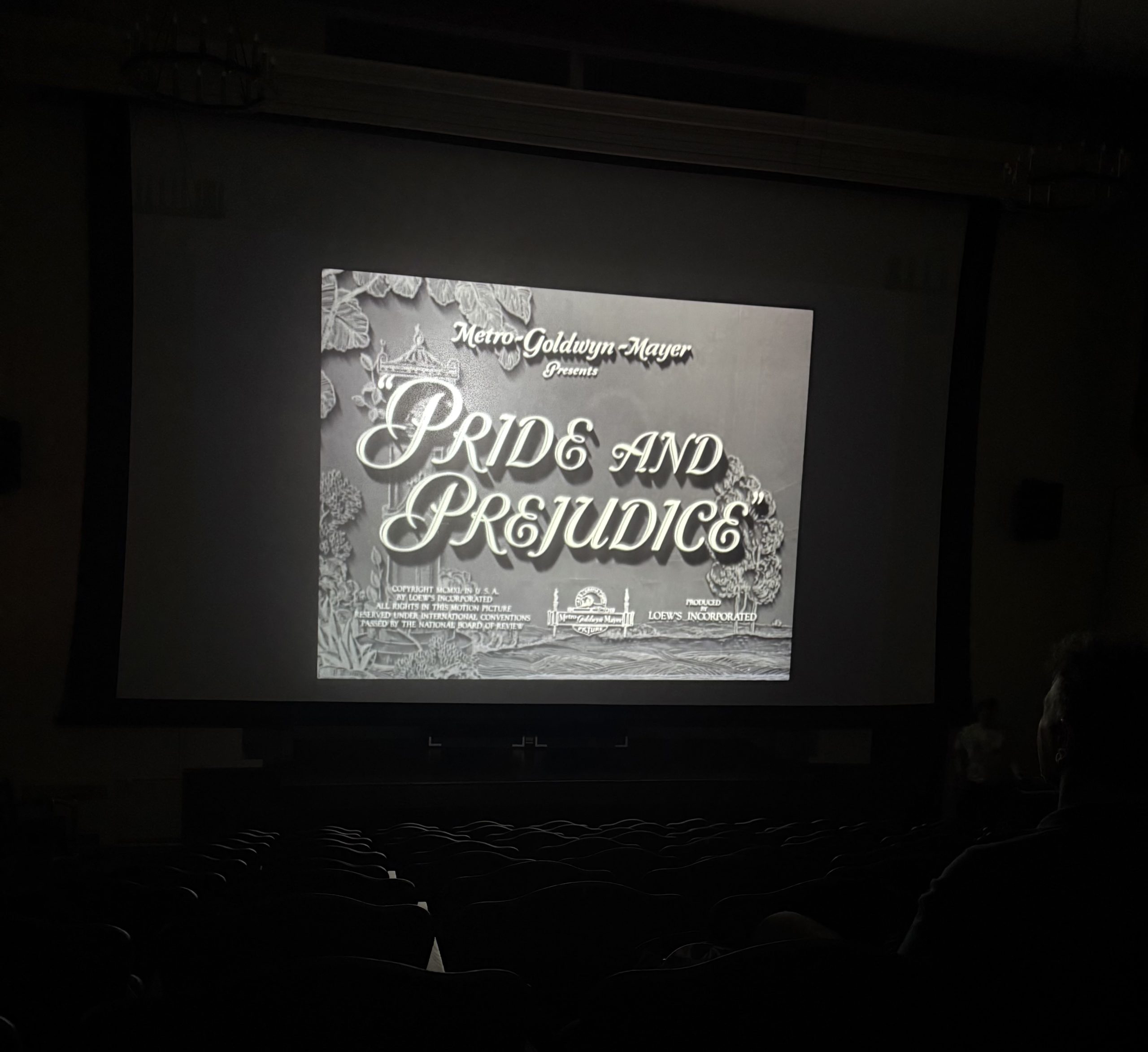
The event kicked off last Friday, Nov. 7, with a screening of Robert Z. Leonard’s 1940 film “Pride and Prejudice,” starring Greer Garson as Elizabeth Bennet alongside Laurence Olivier as Mr. Darcy, with an introduction from Professor of Music on the Mary Conover Mellon Chair Kathryn Libin. Libin helped to spearhead the organization of this eight-week-long event alongside Professor of English on the Mary Augusta Scott Chair, Susan Zlotnick.
The warm chandeliers of Blodgett and a table of popcorn and black and white-themed treats—to match the black-and-white film—welcomed a mixture of students, Vassar staff, professors, community members and their loved ones as they emerged through the double doors like Matthew Macfadyen from the misty evening.
Though that particular reference would have to wait for December, because last Friday’s Mr. Darcy (Olivier) would be seen riding through the sound stages of MGM Studios rather than the rolling hills of the English countryside. As explained by Libin, this “Pride and Prejudice,” the first surviving film adaptation of Austen’s best-known novel, faced obstacles even before filming began. Its production and plans to film on-site in England were interrupted after a certain world war broke out, principle actors like Clark Gable and Norma Shearer were lost to other notable films of the time, and, after the release of Victor Fleming’s “The Wizard of Oz” (1939), MGM Studios no longer had the budget to make it a Technicolor film.
On trend with contemporary products of Hollywood’s “Golden Age,” Libin also explained in her introduction that this “Pride and Prejudice” did not intend to be Regency period-accurate—not in its unabashedly Victorian costume design and certainly not in its score, done by lesser-known “The Wizard of Oz” (1939) composer Herbert Stothart.
“I’m always very intrigued by how the film adaptations use music to support the narrative in various ways, or highlight aspects of particular characters,” described Libin in written correspondence. She continued, “You can hear him [Stothart] borrowing little fragments of music that the audience already knows and weaving them in to create certain associations; for example, the bit of Elgar’s processional ‘Pomp and Circumstance,’ which we’re used to hearing at commencement ceremonies, accompanies the haughty aristocrats when they enter the assembly room.”
So, despite a rough start to production, with the help of an elegant, sweeping score from Stothart, Oscar-winning art direction and a talented cast of actors—even if they were not the producers’ top picks—the charming film managed to stand strong. Even today, it continues to hold its own alongside its many modern successors.
“I was very excited to see the 1940 version again, and it did not disappoint.” Libin continued, “I had forgotten how very faithful it was to the original novel, even with a few added scenes and a general look that evoked the 1830s rather than 1813.”
As for Libin’s interest in bringing what has become a worldwide celebration for Austen’s big day to Vassar, she explained, “First, there are several of us who love Jane Austen, and teach Jane Austen. I have a course called ‘Jane Austen and Music in the Domestic Sphere’ that is cross-listed between MUSI and GNCS. I’ve also been very involved with the Jane Austen Society of North America for many years, so have been well aware of big plans to celebrate Austen’s 250th birthday literally around the world.”
As for how the event was brought into being, she explained, “Susan Zlotnick and I started talking about this at the end of the summer, and decided that we really wanted some kind of recognition or celebration of this at Vassar, so we lined up some other colleagues to help introduce films with ‘Ten-Minute Talks,’ and talked with our chairs about financial support, and our colleagues in Media Resources about tech support, and there we are.”
The event’s cozy atmosphere, the film’s quality and the foreword from Libin on her area of expertise certainly did not disappoint. As a die-hard fan of the 2005 adaptation and score (highly recommend for studying ambience) and as someone who was not aware that a 1940 adaptation existed before I saw news of this event, Libin’s insight was invaluable not only to appreciating this film’s place in cinema and music history but how its beautiful settings and satisfying performances, with plenty of the all-important chemistry between Olivier and Garson, continue to live and breathe through the centuries. I, for one, am looking forward to seeing how this is further explored, as Austen’s source material is passed between generations in adaptation after adaptation at the event’s next three screenings.
“This is the beginning of a wartime, a time of real struggle, a time of intense anxiety and, increasingly, a time of austerity […],” explained Libin in her final remarks about the 1940 film. “They [MGM] had those two huge blockbusters that came out in 1939, both used enormous resources. This is a much more modest production, and I think this was seen as an opportunity to pull back, to still give people entertainment but make it light, gentle, comedy-romance in black-and-white—a domestic drama, not an epic drama. It’s lower budget, lower stress, and as so often, it’s Jane Austen as a kind of panacea, a comfort in troubled times. I think we can all appreciate that.”
I only have one request: Can we include “Pride and Prejudice and Zombies” (2016) for Austen’s 251st?