
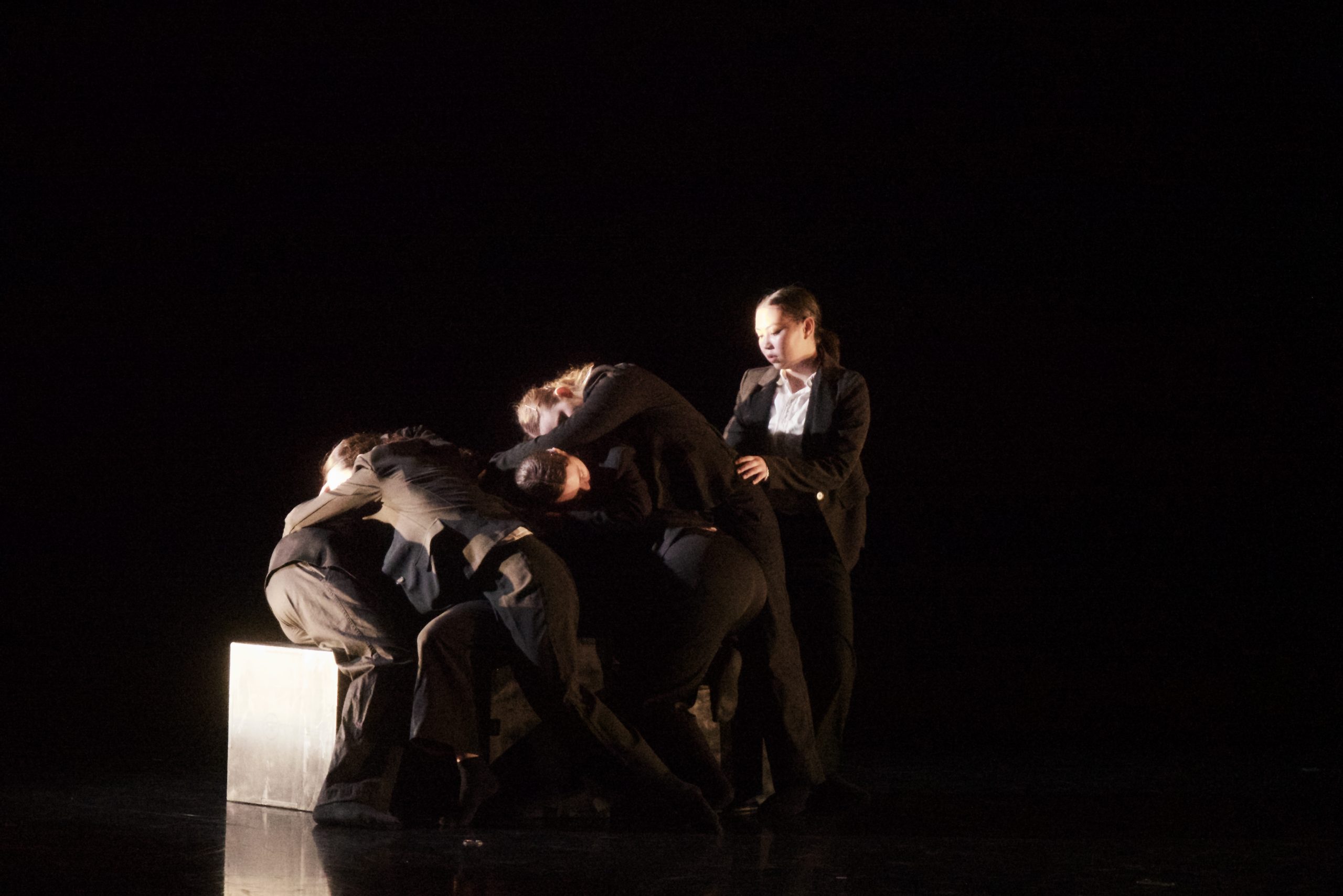
On April 26, 2024, four Vassar seniors presented original full-length choreographic works in an evening dance performance titled “Why We Are.” In promotional material for the event, the choreographers explained, “In ‘Why We Are,’ we move to understand ourselves and traverse the complex terrains of identity, vulnerability, and societal constructs.” These culminating projects not only showcased these choreographer’s personal visions, but also how they have developed their artistic skill set through their time in the Vassar Dance Department.
The show kicked off with a piece by Courtney Spero ’24, “Processing,” an exploration comparing human and computer memory. Next was “I dream in the color blue,” by Yoshi Sanders ’24, which traversed the journey from boyhood to manhood and investigated the tension between social expectations and individual authenticity. After a brief intermission, the show continued with “∀∃ (For All There Exists)” by David Shively-Ertas ‘24, which cycled through depictions of waking and dreaming to ask how one processes the knowable and unknowable. The evening concluded with Camryn Spero ’24’s piece “It’s Not That Serious,” an exploration of personal sensitivity, performance and dramatics.
All four choreographers developed these works as part of the semester-long course DANC-378: “Choreography, Performance and Production (CPP)”, advised by Professor Leslie Sachs. The course was piloted in 2022, and the choreographers noted that watching and being a part of those works their sophomore year inspired them to commit to creating their own full-length work. Camryn Spero ’24 added, “It also felt like something that would be a challenge and the perfect conclusion to my Vassar experience of just pushing my choreographic inspiration and abilities to a feat that’s not possible through any other course.”
The course began with an open audition for dancers to perform in each work at the end of the fall semester. Starting in the spring, choreographers had four hours of rehearsal with their dancers a week, weekly one-on-one meetings with Sachs and weekly group meetings to talk through their process.
This course—along with the resources provided through the Vassar Dance Department—offers a unique opportunity to produce a dance performance at the professional level. Sanders said, “When else am I going to be in a space where I have all these resources, all these other creative people to collaborate with, and an incredible stage? That was really special.”

Although all four choreographers had already created works for Vassar dance organizations, including Vassar Repertory Dance Theatre (VRDT) and FlyPeople, the CPP course provided a much bigger canvas. While their previous works were all under 10 minutes, the CPP works ranged in length from 19 to 33 minutes. The choreographers utilized lighting, props, screen projections and costume changes to enhance their production.
This longer format offered new opportunities and challenges to the choreographers. Shively-Ertas said, “Part of what made this feel so different from my other work is just because my cast was so much larger. And that was by design, because so much of how I think of dance is very spatial and geometric and very formational, and I wanted to have the permutative power that comes with a large cast in terms of formation work.”
For Sanders, the course provided a chance to try the opposite, and he chose to work with just four dancers. “I think I kind of purposely wanted to challenge myself by doing this smaller cast to go out of my comfort zone and instead really focus on creating material that is very unique and authentic to the dancers that are performing it,” he said.
In tailoring his choreography to his dancers, Sanders ended up creating most of his movement alongside them instead of preparing everything ahead of time. He said of this approach: “It helped me learn a lot about what I value in my creative processes and how I feel about collaborating in creative processes.”
Camryn Spero also commented on embracing the process of generating choreography in rehearsal, saying, “I feel like that was very scary for me just because it was so out of my comfort zone.” Yet the CPP course allowed more time for creation, and with time came opportunities to experiment.
Camryn Spero said the added time also gave the dancers more of a chance to shine. “I love seeing the dancers internalize their interpretation of the choreography. And I feel like this work really allowed room for that, because there was more time and just more content for them to chew on,” she commented. In addition, the choreographers said that one of the biggest highlights of the process was the time spent with the dancers. Courtney Spero commented on how her cast of five grew together, saying, “It’s just super beautiful to watch because they came out of that process such good friends beyond the stage, and you could tell when they were dancing, just how tight of a group it is.”
All four choreographers noted that they’ve been conceptualizing their pieces for a long time—for some, nearly two years. Courtney Spero’s ideas stemmed from reflections on her coursework, personal interests,and a MOMA exhibit on technology. Sanders’ piece was built around a solo he created during study abroad Fall 2022 that explored masculinity and authenticity. Shively-Ertas’ discussed how a period of intense meditation and learning about himself inspired the themes in his work. Camryn Spero looked for themes in her past choreographic works to inform her, as well as building a playlist of inspiring music. All together, Courtney Spero explained, “You could see in all four works, that there’s such personal importance and just how much of a crescendo it is in terms of our own personal growth as dancers and as people.”
Shively-Ertas commented on this growth, explaining how his experience at Vassar has expanded his relationship with dance, exposing him to new styles and cultivating his choreography. He said of the CPP project, “It just felt like a very wonderful and natural progression, like everything that I was working on was building upon everything else that I have learned before.”
Sanders also noted how the CPP course is emblematic of the trajectory of the dance department, with a correlate sequence being added last year and talks of a major brewing. He said, “Even though it’s not a major, we still approach it with the same level of rigor and seriousness that we would approach any of our other academic subjects.”
Camryn Spero additionally commented on the interdisciplinary nature of the project, noting how themes in her piece connected to her work in Cognitive Science, Media Studies and Film Studies courses. “It’s basically a combination of not only my time in dance, but my time as a fully fledged Vassar student,” she said.
Building upon both their rich dance experience and academic growth, the CPP project demonstrates the importance of academic study of dance at a liberal arts institution. Sanders added, “I think, you know, we’re setting a good example for what dance students at Vassar can accomplish, especially in their senior year.”
