
[Correction (Friday, Oct. 25): The original version of this article stated: “These agreements included a statement that the Vassar College Board of Trustees would vote on an endowment divestment proposal from weapons and surveillance companies during their October 2024 meeting, among several other initiatives.” This article has been updated to clarify that the Vassar College Board of Trustees did not promise to vote on an endowment divestment proposal, but to meet and consider the student-submitted proposal.]
In a memo sent to the Vassar community on Oct. 10, President of the College Elizabeth Bradley updated the campus on the status of the agreements that were negotiated between students and administration last spring, which led to the disassembly of Vassar’s Gaza solidarity encampment. These agreements included a statement that the Vassar Board of Trustees would meet and consider an endowment divestment proposal from weapons and surveillance companies during their October 2024 meeting, among several other initiatives. This email followed the start of Vassar Students for Justice in Palestine (VSJP)’s Week of Rage, which was organized in conjunction with a call to action by the national chapter of SJP. Across the country, the Week of Rage placed pressure on institutions to divest from military technology and weapons manufacturers.
This past spring, VSJP organized an encampment on Library Lawn, in solidarity with Gaza and in demand for Vassar’s divestment. Vassar’s encampment corresponded with demonstrations on nearly 150 campuses across the country. It lasted from April 30 to May 4, when an agreement was signed by student representatives and the Office of the President. One of the key points of the agreement was the promise that President Bradley would support students in presenting a divestment proposal to be reviewed by Campus Investor Responsibility Committee (CIRC) and Trustee Investor Responsibility Committee (TIRC), after which it would be reviewed by the Board of Trustees in October. The calls for divestment central to the Week of Rage were therefore marked by a particular sense of urgency, as it now appeared likely that the divestment proposal would not be reviewed during the Board’s meeting scheduled for later that month. In email correspondence with The Miscellany News, Marianne Bergmann, Dean of Strategic Planning and Academic Resources and Associate Professor of Chemistry, explained this delay, writing, “After TIRC reviews and considers, they may make a recommendation to the full Board, which would likely vote after discussion. As CIRC forwarded the proposal to TIRC in mid September, TIRC will need time to review and consider. Thus, it is most likely they will make a recommendation to the full Board in February, at the next Board meeting. The board meets only three times a year—Oct, Feb, and May.”
President Bradley acknowledged the frustration that had emerged from this delay, writing in an email to the community, “I am aware this process has taken longer than some desired; however, the time reflects the importance of a deliberate process, which follows the Governance, and reflects engagement of differing voices coming to agreement.” VSJP, however, expressed how the multi-step process has made the goals of the agreement increasingly difficult to achieve, writing in an email to The Miscellany News, “The bureaucracy that prevents the proposal’s agreed upon timeline is an administrative tool used to petrify any movement toward divestment.”
VSJP further emphasized the urgent nature of divestment: “These manufacturers are directly responsible for the suffering of millions, including the people of Palestine, Lebanon, Yemen, and victims of the military industrial complex. By passing the proposal, we will ensure that Vassar does not fund or profit from militaristic violence.” In a Sept. 22 statement posted to their Instagram, VSJP stated, “The people of Gaza cannot afford any delays in the process of divestment, nor can Vassar justify its continued blatant disregard for the suffering in Palestine, Lebanon, Sudan, and all other victims of the military industrial complex.”
President Bradley’s email came three days after the anniversary of the Hamas-led attack on Israel, where more than 1,200 victims were killed and taken hostage. Shortly after this attack, Israel declared war on Hamas. The subsequent ground invasion and air strikes have killed over 40,000 Palestinians, including a large number of women and children. College administration and various student organizations planned multiple events and demonstrations throughout the week of Oct. 7, aimed at honoring the lives lost in Israel, Palestine and Lebanon.
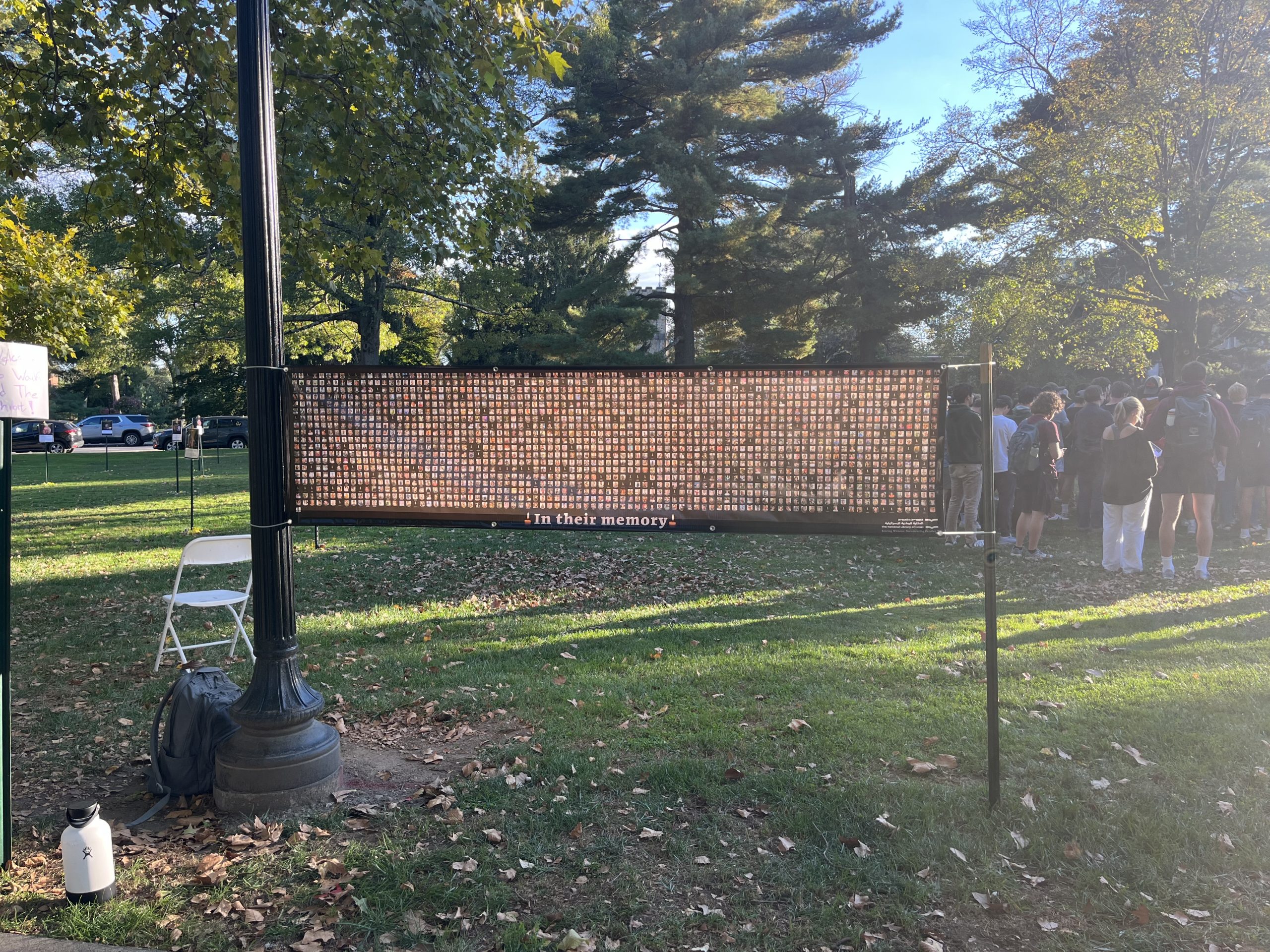
Vassar Against Antisemitism (VAA)—a new organization which has described itself as a group of students, faculty, alumni and allies centered around supporting activism that avoids antisemitism and dehumanization—organized a memorial exhibit to recognize the lives lost at the Nova Music Festival in Israel. In a written statement to The Miscellany News, VAA wrote, “On October 7th 2023, we witnessed the worst massacre of the Jewish people since the Holocaust. 1,200 people were slaughtered, and while the victims were largely Jewish and Israeli, a wide range of nationalities and religions were counted among the dead. 251 people were taken hostage, 101 of which are still held captive in the Gaza Strip. Monday, October 7, 2024 marks the one year anniversary of this horrific attack. Vassar Against Antisemitism seeked to unite in community on October 7, 2024 to mourn and commemorate the lives lost and pray for the return of the remaining hostages.”
The exhibition was open on Library Lawn from 9:30 a.m. to 8 p.m. on Monday. Signs encouraged passersby to walk through the exhibit, where pictures and information on the victims created a path across the lawn. Students and faculty tabled throughout the exhibition, giving students space to discuss and process. In written correspondence with The Miscellany News, VAA leadership explained, “This exhibit was structured to allow for individual mourning, honoring those lost and still held captive.” They continued, “There were yahrzeit candles and other prayer items on site for those who wished to use them. A student greeter was there to assist people as they entered the memorial. At 5 p.m., a prayer service and rally mourning the lives lost and calling for hope and coexistence took place on the lawn near the exhibit, co-led by students, faculty, and clergy.” VAA reported there had been an estimated 120 attendees.
VAA further described the reaction from students and faculty, writing, “Students have responded with unequivocal support and shared how meaningful and special it was to be able to share humanity and sorrow together, while focusing on light and hope despite the difficult and painful situation on the ground at this current time.” They added, “We hope the Vassar community will continue to support coexistence, peace and dialogue, without the need to dehumanize or cause harm to any community on this campus.”
The Office of Religious and Spiritual Life and Contemplative Practices (RSLCP) also recognized the Oct. 7 anniversary, holding a support space in Pratt House that afternoon. Staff from RSLCP, Counseling Services and Restorative Practices for Engaged Pluralism were all available for those looking to process their thoughts. Additionally, the support space offered attendees art materials, journaling prompts, narratives from peace activists and spaces for quiet contemplation. Various administrators and religious officials on campus emphasized the importance of taking advantage of the multiple ways that community members might need to grieve and process their emotions. In an Instagram post addressed to the Vassar community, Rabbi Bryan Mann, the Rachlin Director of Jewish Student Life and Associate Director of RSLCP, wrote, “You may need to focus on one aspect of your prayers, hopes, and grief related to October 7th and that is okay. You may have the capacity to hold it all. You may need to completely dissociate and ignore the day entirely. There is no one correct way to mark October 7th.”
VSJP marked the start of the Week of Rage in a statement posted to their Instagram, writing, “October 7th marks one year since the Al-Aqsa flood, after which israel began its genocidal campaign in Gaza. This is a continuation of seventy-six years of occupation, apartheid, and colonial violence.” The statement continued, “In our walkout last October, we reported the estimated death toll to be over 10,000 and today the official death toll of 41,000 does not even account for those bodies under rubble and indirect deaths from devastated health, food, and other public infrastructure. Some studies estimate a death toll of 186,000 people. While israeli operations in Gaza, the West Bank, and Lebanon escalate, the United States government sends billions of dollars in military aid, and American academic institutions refuse to divest from the military industrial complex.”
The first event held on Sunday Oct. 6 was a teach-in organized in conjunction with the Working Student Coalition (WSC). The teach-in discussed the history of labor activism in support of Palestine before the featured speaker Larry Goldbetter, the president of the National Writers Union (NWU), a sister organization to Palestinian Journalists Syndicate, joined via Zoom. Goldbetter presented on unions that protest in support of Palestine and spoke of NWU’s work protecting journalists on the ground in Gaza, Palestine and the U.S.
VSJP organized a student walkout and march on Monday Oct. 7 at 11 a.m. on the CDF Quad. Roughly one hundred students met on the Quad where VSJP displayed Palestinian flags and handed out signs calling for a ceasefire now, divestment from the military industrial complex and for the liberation of Palestine. Marshalls handed out masks and bottles of water to attendees as well as handouts including the Walkout Guidelines and the chant list. Students marched from the CDF Quad to Noyes Circle with numerous community members joining the march as it moved through campus. Several passersby held fists in solidarity as students chanted, “Free, Free Palestine!”, “Disclose! Divest! We will not stop, we will not rest!”, “From the river to the sea, Palestine will be free” and “We will honor all our martyrs, fathers, mothers, sons and daughters.”
In the evening of Oct. 7, The Vassar Muslim Student Association (VMSA) and VSJP held a vigil and Janazah in absentee that was open to campus members of all religious backgrounds on Chapel Lawn.They stated in a written correspondence: “The Janazah in absentee, which is the funeral prayer for Muslims, and the vigil, open to all backgrounds and faiths, was held to grieve for the martyrs in Palestine and other conflict zones.” The statement continued: “The use of the word ‘martyr’ for Muslims includes those who have died in battle, under oppression, in worship, from disease and childbirth, etc. All of these apply to those killed in Gaza, the West Bank, Lebanon, Sudan, Afghanistan and in every other place there is continuous violence.” VMSA requested The Miscellany News not report further on this event due to safety concerns for attendees.
On Tuesday, Oct. 8, VSJP hosted a die-in on the President’s Lawn, where students laid on the ground while each displaying the name, face and biographical information of an individual Palestinian healthcare worker killed during the war. VSJP wrote of this event, “No business as usual during a genocide. We demand an end to Vassar’s silence and complicity!”
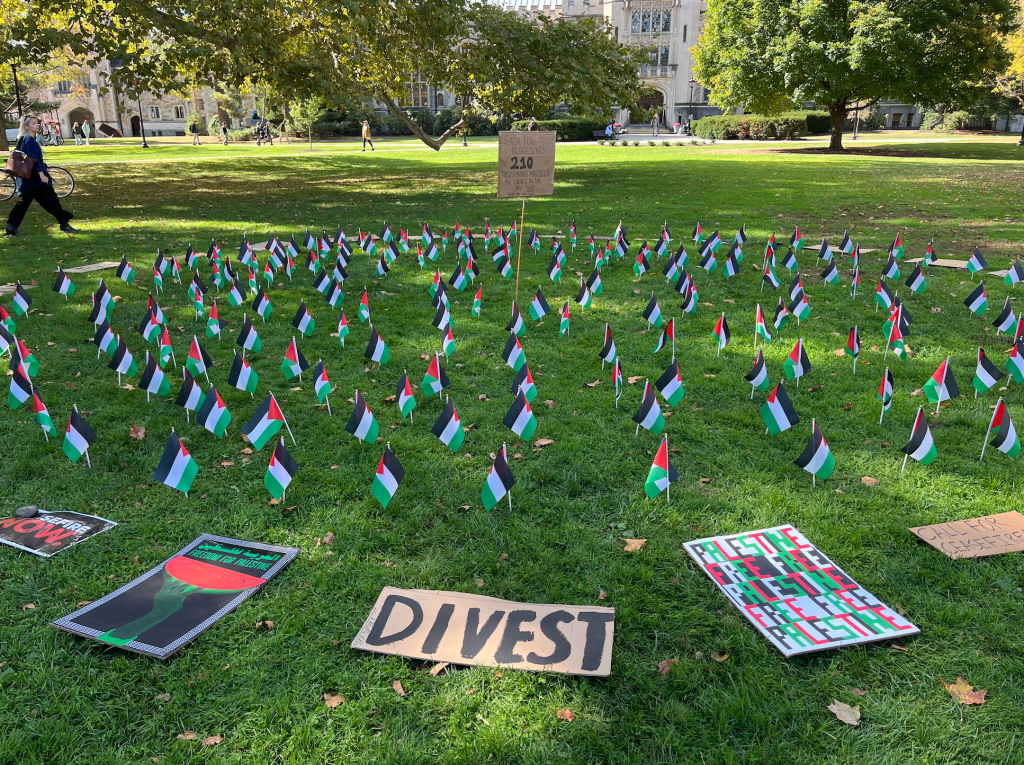
On Oct. 9 and 10, VSJP created a memorial installation on Library Lawn to commemorate the Palestinians killed since the war’s start. Palestinian flags were placed across the Lawn, along with signs calling for an October divestment vote. In a statement posted to their Instagram, VSJP wrote, “We have 200 flags representing 210 martyrs for the 42,000+ killed by israel’s genocidal siege…We implore all who visit this space to keep in mind that while the flags tally the numbers, we must remember to think of the individual Palestinians the numbers represent.” The final event of the week was a film screening followed by a discussion of the documentary. VSJP shared, “Finally, on Thursday, October 10th, VSJP held a discussion of the recently published Al Jazeera Documentary which details the investigation into war crimes committed by the Israeli army in Gaza since October 7th.”
In correspondence with The Miscellany News, VSJP wrote of the campus’ response to the Week of Rage, stating, “The response on the part of students has been very supportive, which is reflective of the demographic popularity of our movement among young people across the political spectrum.”
As the October Board of Trustees meeting approaches and Israel’s war on Gaza enters its second year, the Vassar community has continued to grapple with the various challenges posed by this conflict. It remains to be seen whether VSJP’s divestment proposal will be discussed during the upcoming October Board meeting, or if it will be pushed until February.