
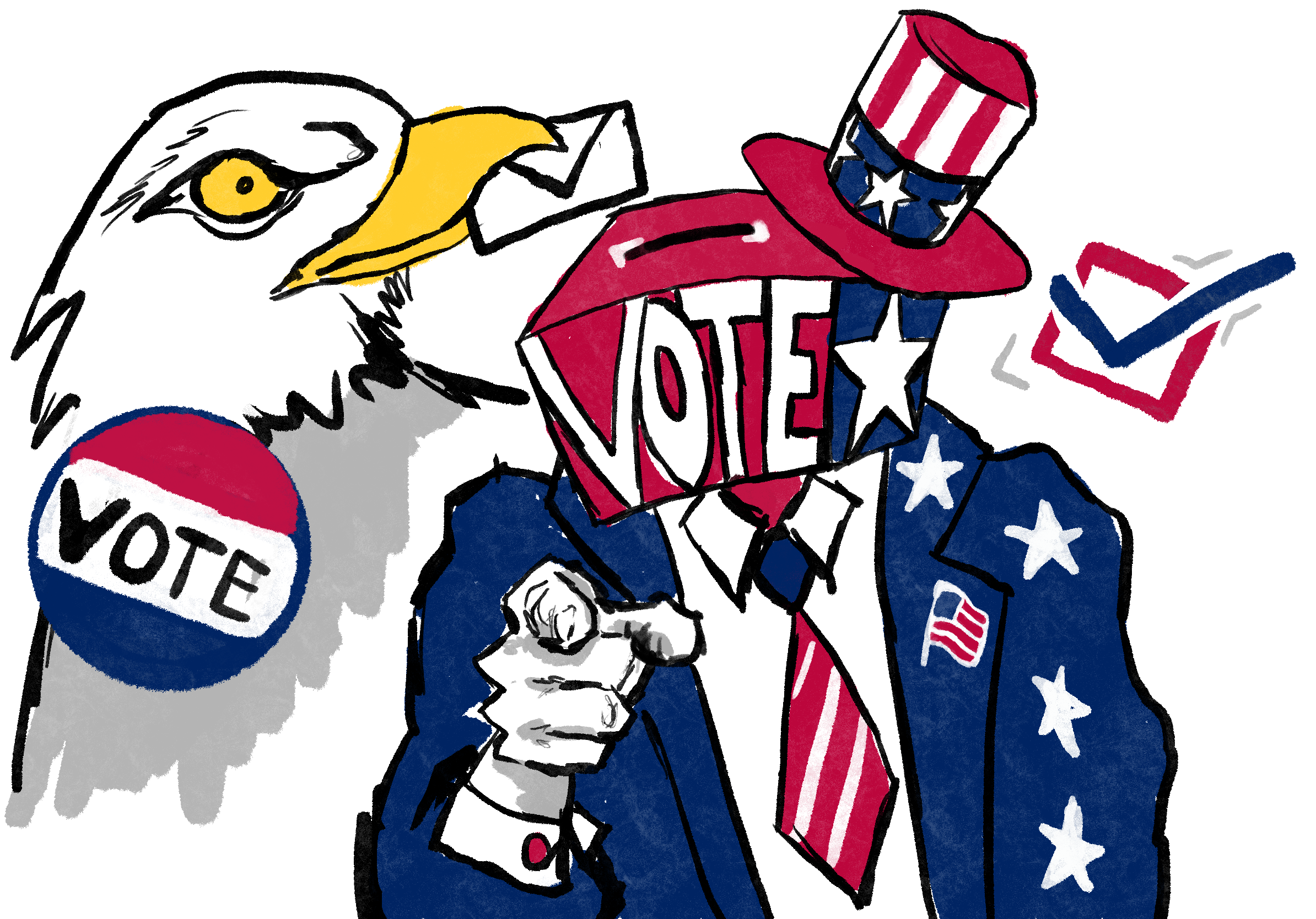
For the first time in Vassar’s 163-year history, students will vote in a general election at the on-campus poll site, which was created in 2022 after a lawsuit brought the county to court over the violation of state law. As Nov. 5 approaches, students are utilizing the resources on campus to educate themselves and register to vote. This semester alone, more than 150 students registered to vote with their campus address, adding to the few hundred students that were previously registered, according to the Office of Community-Engaged Learning (OCEL).
Student activists, like those who are part of VassarVotes, have spent the last few weeks tabling in dorm buildings and at different events on campus in an effort to bring resources to as many students as possible. VassarVotes is a nonpartisan commitment by the OCEL to empower Vassar students in the democratic process, according to a written statement from Associate Director of OCEL Jean Hinkley.
Calder Beasley ’26, a Dorm Voting Advisor (DVA) for VassarVotes, wrote in an email correspondence, “We answer any questions related to voting, help students register and assist in absentee ballot requests and returns.”
Because Vassar students are able to vote as either a New York resident or a resident of their home state, Beasley emphasized the importance of Vassar students knowing their options.
He added, “As a college student, you have the right to choose to vote with your home or campus address. You can register online for most states, but to vote on campus, you should fill out a paper registration form. Check registration deadlines specific to your state.” Beasley added that the New York state registration deadline is Oct. 26. VassarVotes made available a guide with all dates, deadlines and ballot tracking information.
DVAs not only engage voters but ensure students are aware of their voting rights and understand important issues. Hinkley said, “Our mission is to ensure that every Vassar student has the resources and knowledge to actively participate in civic life.”
For students registered with their campus address, in the sixth Ward, second and third election districts of the Town of Poughkeepsie, the importance of having a new polling site cannot be understated. Hinkley added, “Students and community members in these election districts vote at the Aula. Previously, there were multiple polling places for campus voters. Having one central and accessible location supports campus voter access.”
“I imagine having the polling place on campus causes less planning and time involved in transportation to and from the polling site,” Hinkley added. “For example, in 2020, VassarVotes worked with Safety and Security to offer shuttles and to the polling locations off campus.”
Associate Professor of Political Science Taneisha Means, one of the plaintiffs in the 2022 poll site lawsuit, sought a hopeful outlook on student political engagement in the future.“This is partly the result of the polling site on campus, but I would argue the culture around campus is helping too.” She continuedd, “Numerous student-led and institution-led efforts are mobilizing students to register and vote, such as VassarVotes.”
The League of Women Voters of the Mid-Hudson Region first filed the lawsuit with help from local activists and lawyers representing Means and Magdalena Sharff ’26 as plaintiffs. The lawsuit alleged that the Dutchess County Board of Elections, specifically Republican Election Commissioner Erik Haight and Democratic Election Commissioner Hannah Black, failed to abide by New York Election Law § 4-104, which mandates the selection of a designated poll site on all college campuses housing more than 300 registered voters. As of 2022, Vassar had more than 1,100 registered voters, according to The Poughkeepsie Journal.
College-age students, being the newest members of the U.S. electorate and with higher levels of education, are more likely to participate in politics than those with lower levels of education, according to Means. “These facts, taken together, shed light on why college-age students are targeted politically,” she said.
Means continued, “As a House Fellow who resides in Lathrop House and votes locally, I knew a polling site on campus would make voting more accessible for me and other voting-age family members, making it much more likely and easier for us to vote. And as a political scientist and active community member, I understand the importance of working together to increase access to the ballot box for the Vassar and its contiguous community and encourage broad political engagement and participation.”
The fight for the poll site on campus, according to Means, is reflective of the frustrating and messy local political systems. She said, “Still, despite how frustrating and messy they can be, I believe there is an increasing awareness of the power of participating in politics. If we pay close attention to voter disenfranchisement, it becomes easier to understand the power of voting. There would be no opposition if Vassar students’ voices and political engagement weren’t politically influential.”
Beasley wrote that it is important to research all elections—at national, state and local levels—as well as any amendments on your ballot, to make sure you are fully prepared to vote. He explained, “It’s important to make your voice heard, and voting is one of the easiest ways to do so. We fought for a polling location on campus, so let’s make sure we use it!”
Hinkley added that DVAs will be leading an event “Voting Together” the morning of Election Day, as well as “Bagels and Ballots,” with more details to be released on their Instagram.
“Thanks to the Dorm Voting Advisors, VassarVotes is able to support voter engagement and outreach efforts. The DVAs build capacity for VassarVotes to be able to engage in efforts like tabling, classroom visits, 1:1 voter support, voter communications, and more,” she wrote.
VassarVotes is not the only organization on campus providing students with resources this election cycle. Hinkley added, “This semester, campus collaborations also expanded VassarVotes capacity for voter engagement. The ALANA Center supported us in hosting a voter registration support station in their community room.”
Additionally, Restorative Practices in Residential Living Team is facilitating election circles in residential houses for all students from Oct. 30 through Nov. 8.
Since the establishment of a poll site on campus, Means and Hinkley have both noticed a bigger focus on local voting. Means said, “Students are generally curious about becoming involved and engaged in the local area. Voting provides one precise, convenient, and impactful way.”
engaged despite efforts to prevent their full incorporation into the local political system. Still, despite how frustrating and messy they can be, I believe there is an increasing awareness of the power of participating in politics. If we pay close attention to voter disenfranchisement, it becomes easier to understand the power of voting. There would be no opposition if Vassar students’ voices and political engagement weren’t politically influential. And the stakes are high in every single election. I cannot think of a single local, national, or global issue that does not have a political connection or tie to public policies. Thus, every ballot cast has the potential to change who is represented in office and the policies emanating from our policymaking bodies. I hope students can resist becoming apathetic about voting and understand its great potential.
The future of political engagement on campus is promising, and we should expect our students to participate increasingly in electoral politics, including in our local Poughkeepsie community. This is partly the result of the polling site on campus, but I would argue the culture around campus is helping too. Numerous student-led and institution-led efforts are mobilizing students to register and vote, such as Vassar Votes. I hope Vassar students and other youth recognize and exercise their voting rights to change the system and society as they see fit since they are affected by it and will be living in it much longer than their older counterparts.