
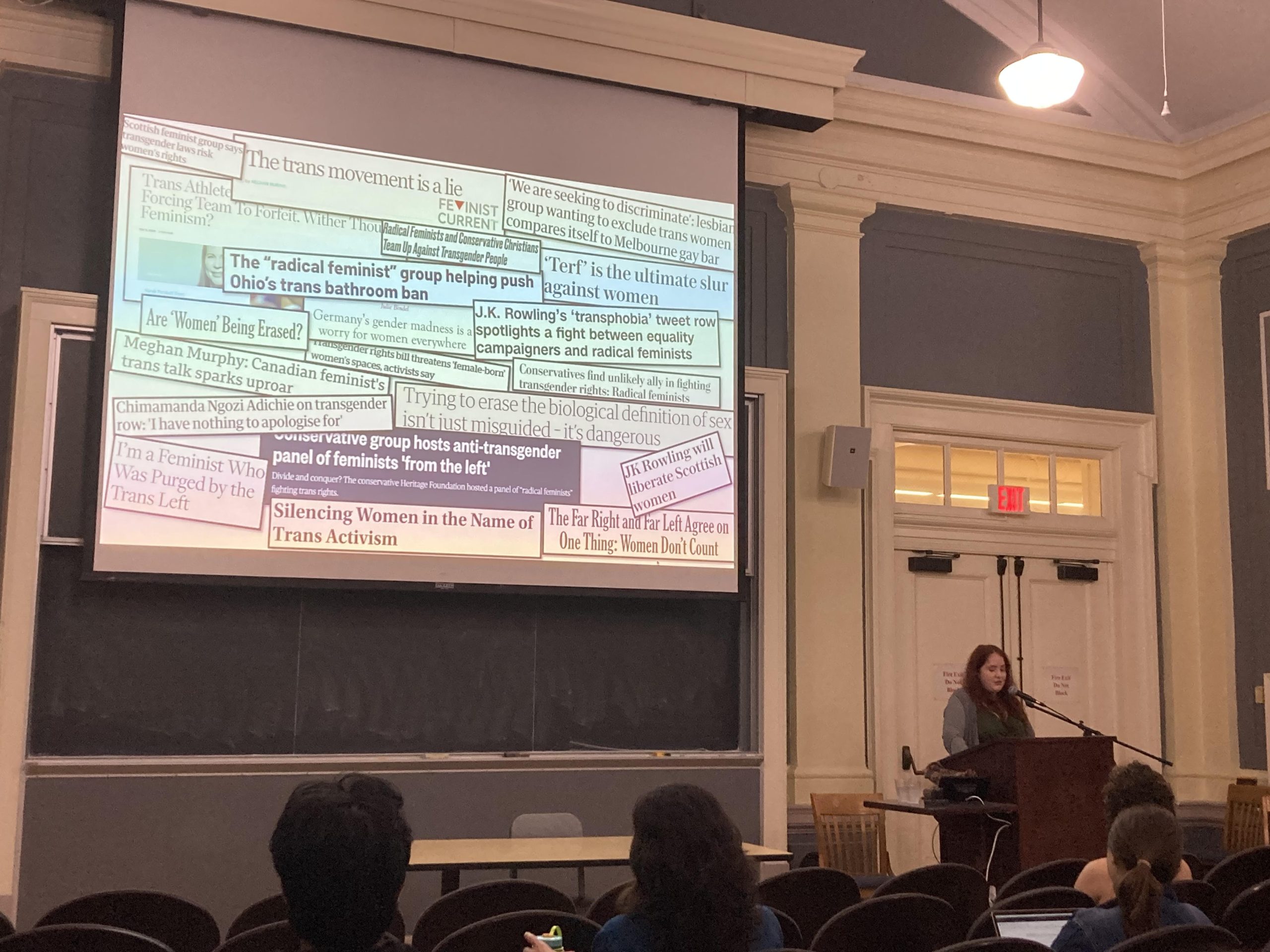
Sophie Lewis is one of those unique thinkers whose work seems to unilaterally enrage people—at least at first. Lewis, who currently holds a position as a visiting scholar at the University of Pennsylvania, and teaches online at the Brooklyn Institute for Social Research, describes herself on her website as a “writer, speaker, teacher, and recovering academic”. At this year’s first Philosopher’s Holiday Lecture, Lewis visitedVassar on November 6th to give a talk entitled “TERF Island Comes to America: Buried Histories of the Feminism of Cisness,” a dissection of trans-exclusionary radical feminism (TERF) ideology and whether or not we should consider bigoted feminism feminism at all. This lecture comes as a preview for Lewis’s upcoming book, “Enemy Feminisms: TERFS, Policewomen, and Girlbosses Against Liberation.”
Lewis began her lecture with a history lesson on the modern political origins of TERFs and transphobia within feminism. She painted a sobering picture, one of violent exclusion and vitriol present in second-wave feminism towards transgender women. But she pushed back on the idea that second-wave feminism was intrinsically transphobic, telling stories of the divisive presence of Beth Elliot, a trans woman, at a West Coast Lesbian Conference and the solidarity many of the women showed her. As she continued forward into the 21st century, she highlighted how TERFdom manifests today. From JK Rowling’s tweets to the ecofascism of The Deep Green Resistance, TERF ideology has taken many forms as it seeps into the mainstream. She discussed the widespread nature of TERF ideology in British feminism, and its less prominent but growing manifestations in the US as the GOP sinks deeper and deeper into anti-LGBTQ+ politics.
Lewis then turns to the question at the core of this discourse: Do we exclude these movements from the category of feminism? Or, if we agree that they are feminists, is it prudent to abandon the label “feminist” altogether in search of something better? Lewis’s answer to both of these questions is no. She admits she is partial to the label of “feminism,” and resists the idea that we abandon it, especially regarding the second-wave TERFs. She argues that we should not cede the second-wave of feminism to the racist, sexist, transphobic and bigoted women that in part constituted it—not when there was so much important feminism being done by women of color and trans women in particular alongside them. She asks us to recognize that there are many forms of feminism; fascist feminism, while fascist, is still discussing the emancipation of women to an extent. She suggests we recognize these “enemy feminisms” as feminist: “We do not need to say that all of this is ‘not feminism’ in order to fight it,” said Lewis.
The Vassar student body was fortunate enough to have more than one opportunity to engage with Lewis’s work during her visit. Lewis has published two books previously, “Full Surrogacy Now: Feminism Against the Family” and “Abolish the Family: A Manifesto for Care and Liberation.” At the core of much of Lewis’s work is the idea of family abolition. The Context for her work is crucial: When she discusses abolition, she does not mean a complete annihilation of all the connections we hold dear. Rather, she conceives of it as being a three-step process: to destroy what holds us back, preserve what is good and useful and create a new system that could benefit us all. She advocates for a communized style of living, one where we are collectively caring for each other, regardless of what bloodline we are born into.
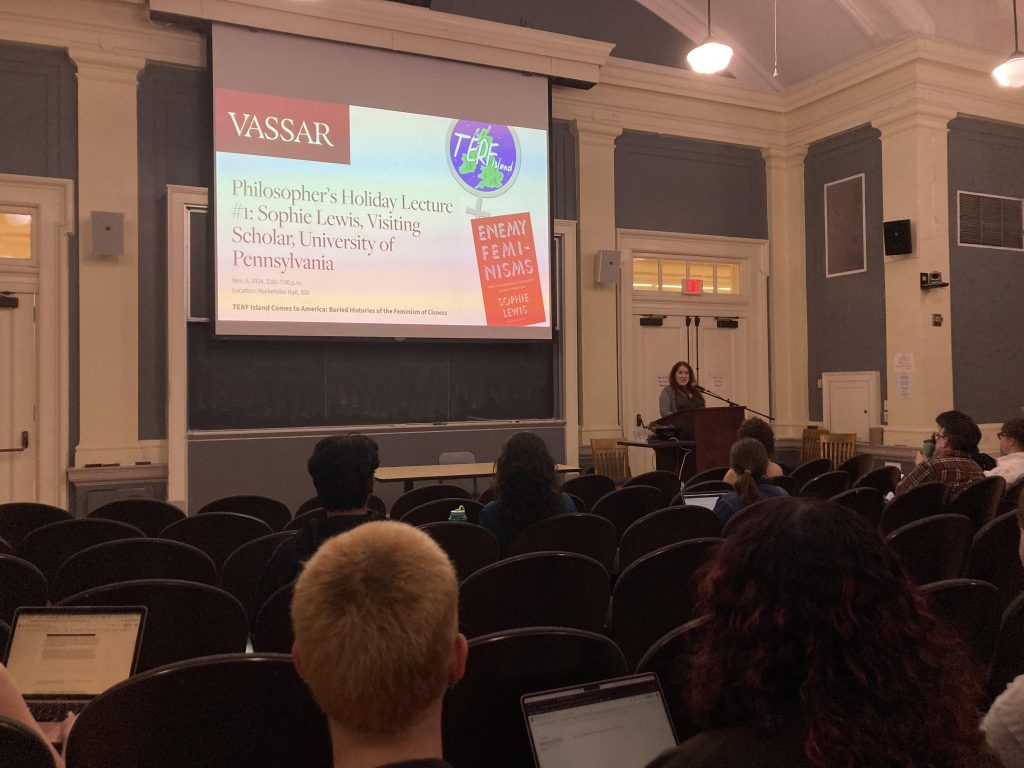
Image courtesy of Aurelia Harrison ’28.
Visiting Assistant Professor of Philosophy Rachel Silverbloom’s class PHIL 106: “The Feminist Ethics of Vulnerability and Care” had the opportunity to be in direct dialogue with Lewis. After the class read her book “Abolish the Family” over October Break, Lewis visited classes for a group discussion. I am fortunate enough to be enrolled in this class and found the conversation to be a particularly enriching one. Her style of answering questions is distinct: She takes a long pause and delivers an explanation with a level of detail and context that marks her as a true expert in her field. Her prose is rich with humor, accessible without sacrificing complexity—Professor Silverbloom is a particular fan of her description of the family as a “disciplinary, scarcity-based trauma machine.”
Additionally, the Philosophy department selected an essay by Lewis in preparation for the talk— “Mothering against motherhood: doula work, xenohospitality and the idea of the momrade”—for their biweekly reading group run by Assistant Professor of Philosophy Kathryn Pendoley and the Philosophy department interns Caris Lee ’25 and Harry Malone ’25. The discussion was wide-ranging, but what stayed with me was the idea of utopia. What is the place of utopian thinking, of a fantasized “better world” in political activism? I posed this question to Lewis in our class discussion. She disagrees with the use of the word “utopia” as a pejorative: For her, imagining a world better equipped to care for all its inhabitants requires that we not form these ideas as though we are starting from scratch. “Utopia is not an immature rejection of what is: it’s also holding on to what has been taken from us,” said Lewis. She argues that things do not have to be this way: We do not have to abide by the scarcity-producing social constructs we build our lives around.
After Lewis’s talk, I was invited to a Philosophy department dinner at Spettro, where I had the opportunity to get to know Lewis a little better. The way Lewis reflects on her own work is fascinating: When questioned, she openly admits she may have phrased something too strongly, or too generally. She is unafraid to assert something weighty, and she is equally unafraid to admit her own errors. She possesses a wealth of knowledge that is apparent even in informal conversations, as we discussed everything from the French language to “The Silence of the Lambs.” Delivering such a radical and well-articulated talk the day after the election was a feat of strength on her part—I do not know that I could have stayed as strong as she did. Lewis’s ideas of recreating our world to be better equipped to care, of holding complexity within ourselves and of being unafraid to fight the good fight feel especially important right now. We can stand to learn a lot from thinkers like Lewis, about ourselves, our world and each other.