
We are living in the most incohesive era of fashion yet. Whereas the past 10 decades are each distinguishable by shoulder pads, rhinestone-coated sweatsuits, beehives and greasy hair, latex catsuits, ballet flats and gogo boots, beadwork, perching hats, pant rise, skirt length and eyebrow width, today’s fashion is “all of the above.” The lifespan of fashion fads has shrunk, as has their return rate—rather than recycling every 20 years, trends are becoming nostalgic after five. It is fitting, then, that the 2024 Contrast Fashion Show was structured around “Archival.”
For the past 14 years, Contrast, Vassar’s student-run style and culture magazine, has held a fashion show in the Loeb witheach show revolving around its own theme; this year, members of Contrast consulted past issues of the magazine to construct a total of 15 pieces, each modeled by students.
“We found shoots that had a very tangible aesthetic that we thought was reminiscent of the year it was from,” said Emma Raff ’26, one of two Contrast Style Directors. “Then we went online, found photos of high fashion shows of the same year, and then combined them in a mood board. The idea was to combine the Vassar fashion world with the high fashion world of New York City.”
The resulting effect was an impressive tribute to the past several years of fashion.
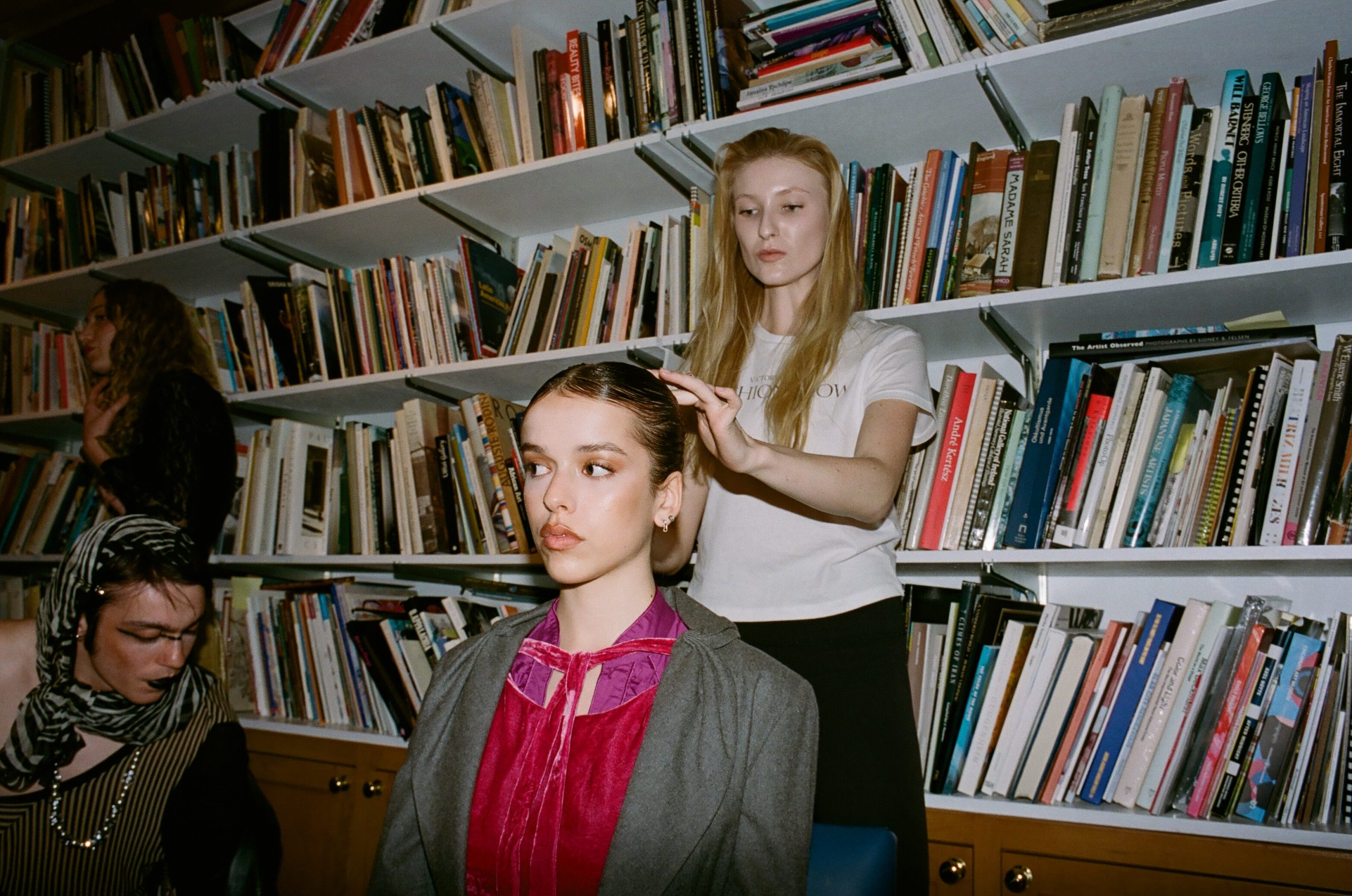
Repurposing the Reproductive: Health, Fertility, Agency exhibit as a green room (a choice of convenience but linguistically on-theme regardless), students lined up in anticipation to strut the “runway,” the main hallway running through the Loeb’s collections. Even waiting in place, each model maintained their glowering pouts, barely breaking character to shimmy in time with the jazzy background track. They wore plaid kilts with Adidas superstars, sparkling shawls, leopard-patterned slips and zebra-patterned headscarves, tiers of tulle, velvet blouses, leg warmers, sweater vests and layered denim. They matched their lipstick to their socks, their bangles to their skirts. They flung jackets over exposed shoulders and glared through wraparound sunglasses.
“My look is inspired by Spring 2011 John Galliano,” said Contrast model Maria Milovanovic ’27, who wore an enormous hat evocative of a 17th century lampshade, or cake. “It’s a top hat,” she explained. “And then we draped lace and some fabric over ribbons.”
“The lace and beading is actually from my canopy in my room,” said Raff.
Prior to the show, Maegan Jenkins, a textile cataloger at the Smithsonian National Museum of African American History and Culture (NMAAHC), delivered a presentation via Zoom about the work of archiving fashion. Jenkins was hired by the NMAAHC during her third year of graduate school to catalog the Black Fashion Museum, a curation of approximately 2,000 garments first collected by designer Lois K. Alexander Lane in Harlem in 1979 but now resides in Washington, D.C “What’s interesting about all the garments in this collection is that they were either worn and owned by a Black person or created by a Black person,” Jenkins said, gesturing to a dress made by Rosa Parks.
While many of the garments in the collection were created by designers such as Stephen Burrows and Anne Lowe, the NMAAHC also holds pieces made and owned by “everyday people,” each functioning as miniature records of history. “One of my favorite aspects of cataloging is finding evidence of life in objects,” Jenkins said. She pulled up a photograph of a hat formerly owned by Precola DeVore Parks, sister of Ophelia DeVore-Mitchell, one of the first Black fashion models in the United States. The front two ties of the hat were smudged with a generous amount of foundation.
After reviewing some more pieces, Jenkins paused. “Nobody freak out,” she said. “I normally don’t use gloves when I handle garments.” It can be deemed unusual to not wear gloves when dealing with vintage pieces because the oils on our fingers will transfer to the material. However, Jenkins only uses bare, clean hands when examining pieces, unless dealing with old metal or vintage fur, which could corrode or deteriorate, respectively. Ungloved, raw touch is helpful in determining the material type, she explained.
Jenkin’s talk concluded with a Q&A session and a roar of applause. The clacking sounds of high-heeled boots and the gradual swell of drums and saxophone signaled that the show was about to begin. As 338 spectators—the largest crowd to attend a Loeb event, ever—clustered around the runway, we were reminded to be wary of our surroundings and not touch any of the art on display.
At the front of the room, one model stood and flipped through an issue of Contrast, a decision made by Creative Director Wyatt Keleshian ’26. “The idea was that as he flipped through the magazine, the old issues of Contrast would walk out—he’s looking through the history of the magazine,” Keleshian explained.
“This year, we were trying to be a bit more performative and include more of a performance aspect in the show,” said Carissa Kolcun ’25, Contrast’s Editor-in-Chief. “This was definitely one of the best turnouts in the time that I’ve been here.”
They added that the next issue of Contrast will provide a behind-the-scenes perspective of the Fall 2024 fashion show. “We’ll be really digging into the archival aspect,” they said.
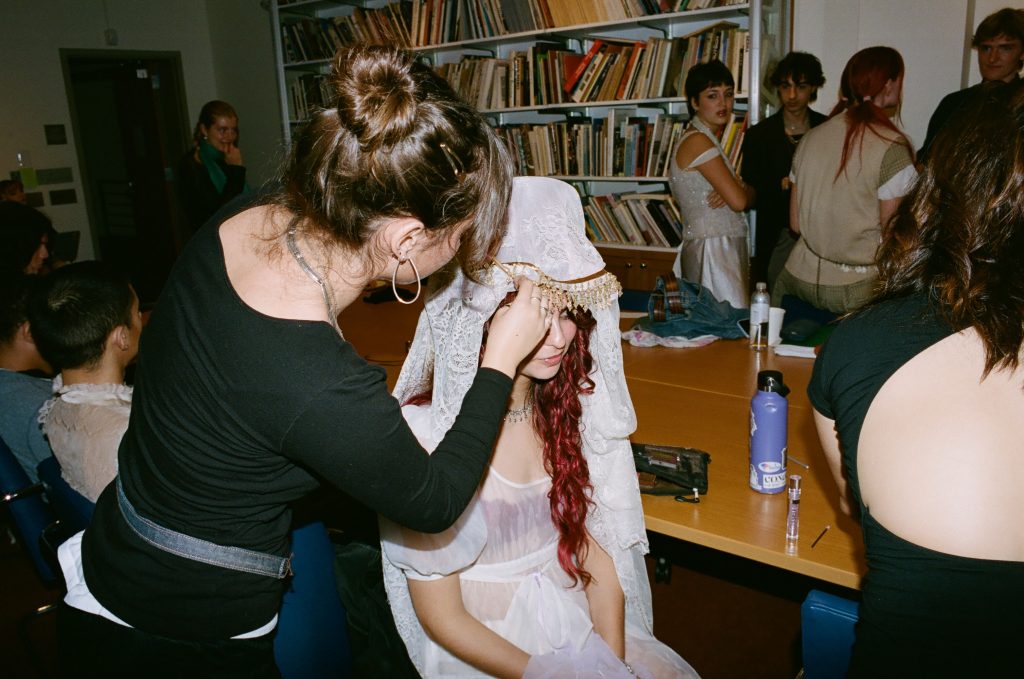
Image courtesy of Leo Kogan ’28.