
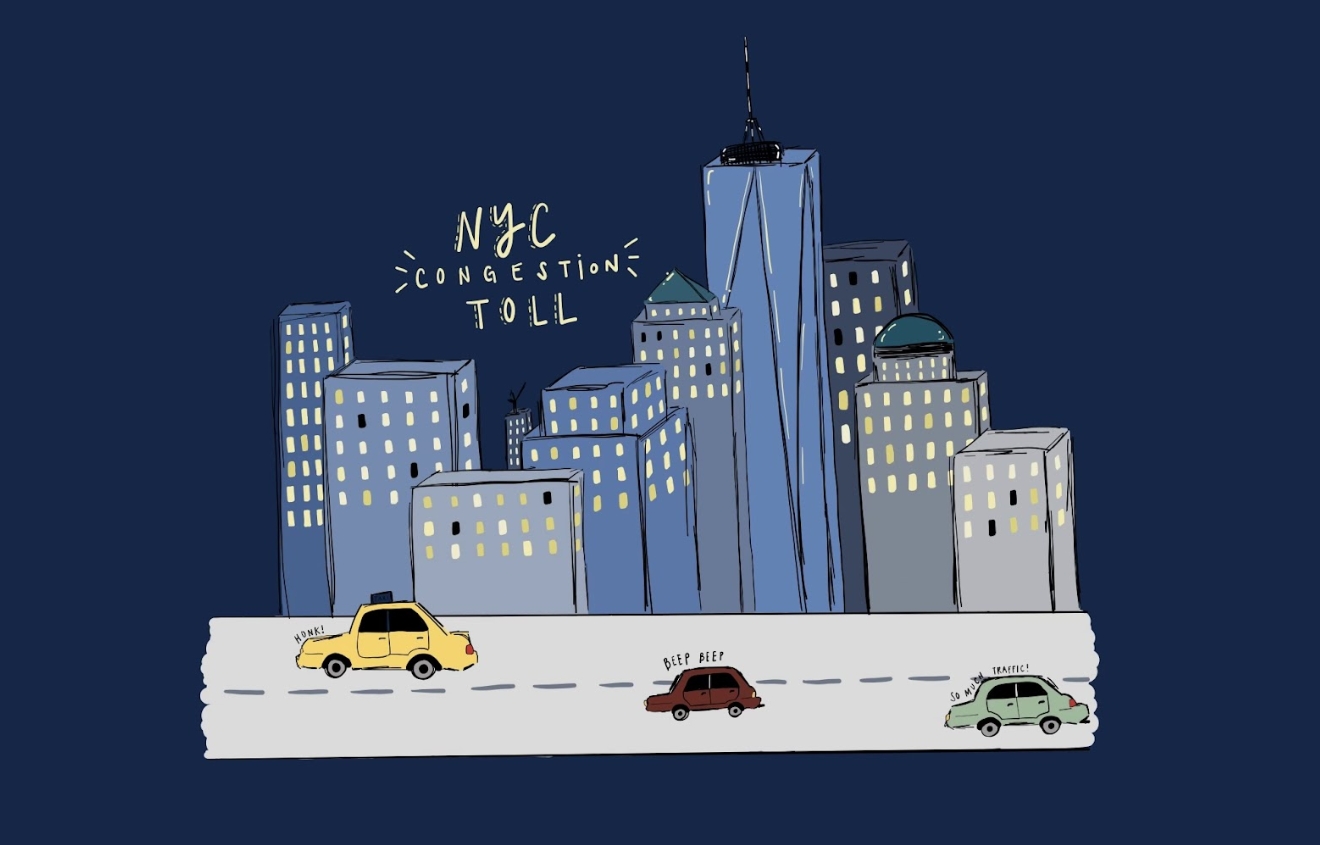
On Nov. 14, 2024, New York Governor Kathy Hochul said she will reinstate a $9 Congestion Toll on the majority of drivers entering Manhattan’s Congestion Relief Zone, identified as anywhere below 60th Street, to raise money for the Metropolitan Transportation Authority (MTA), starting Jan. 5, 2025. Some Vassar community members are adamant that the toll creates new obstacles for commuters, while others say the toll could benefit the broader well-being of New York City residents.
The initial program was originally set to begin last June at a $15 toll rate, but paused just weeks later due to pushback from government officials and residents, according to CBS News. Hochul says the plan would lower the number of cars on crowded Manhattan streets and improve air quality while raising money for the city’s MTA, according to The New York Times. President-elect Donald Trump has vowed to terminate the program when he takes office, bringing new urgency for Hochul to re-implement the program before his inauguration. In her latest attempt, Hochul faces strong resistance from New Jersey Gov. Phil Murphy, among others, who denounces the “shadow tax” as millions of Americans still face economic strains, CBS News reported.
Annie Brewer ’25, who lives just north of the Congestion Zone, said she is in favor of the toll, saying it prioritizes pedestrian travel. She argued, “I think the toll is a really great decision because it, for one, makes pedestrian life easier, and I think the thing that’s really beautiful and important about New York is the way that pedestrians are prioritized and I think that is one of the greatest charms of the city.”
Brewer added, “The other reason I think it’s really good is because it’s encouraging people to make use of public transportation, which is a really important step in combating the climate crisis.”
Some students, however, are against the toll, like Isabel Yu ’25, who commutes regularly to and from her home in Gramercy for breaks and long weekends. She said the toll makes it more expensive for her parents to help her move in and out each break and semester. She said, “I live inside the zone, and my dad owns a car, and that is the only way he commutes anywhere. Anytime he leaves the house, it’s going to be at least a $9 toll.”
She added, “Every single break, it’s just going to be adding fees, unfairly placing the burden on locals. You can’t just not go anywhere. It’s really hard to move all your stuff on the Metro North.”
Yu also stated that Hochul will not achieve her goals with the toll. She said, “I don’t think it’s going to significantly decrease the amount of cars in the area at all. People of a certain socioeconomic status will not be affected by the toll.”
In addition to socioeconomic factors, marginalized groups are also sometimes forced to pay for ride-shares, according to Yu. “As a young woman, there is a gender disparity between who is safe to walk home at night and who is safe to take public transportation,” she stated. “If you are out after a certain time and present your gender in a certain way, you are seriously limited by the options for getting home.”
Brewer said she was in favor of exemptions for certain cars. She added, “I think that New York City yellow taxis should be exempt from the toll because that’s an important business and they’ve really been screwed over by Uber and other stuff.”
Taxi cabs will have to charge a 75¢ surplus, while rideshares will charge a fee upwards of $1.50. The new toll also includes a discount for any car owners making under $50,000 a year, who will be able to have all trips after their first 10 in a single calendar month discounted by 50 percent to $4.50 according to the New York Post. But Yu said this still could have quite an impact. “The people who are going to decide not to drive because of the $9 toll are already not the people you should be taxing and are already hurting financially.”
While Yu said she thinks the toll will raise money for the MTA, she said, “I believe that it’s not coming from the right place. The city is desperately trying to find money, but they are refusing to examine their internal budgeting structures critically enough to see that they are egregiously overfunding the NYPD.”
“I think people who have drivers or can afford to take ride-shares everywhere won’t stop. I do see how there could be a slight decrease in the amount of cars, but I don’t think it’s going to significantly help congestion or pollution.”
Other students, like Michael Hiciano ’25, who lives in Washington Heights, north of the Congestion Relief Area, said there could be some benefits from the toll: “I think a lot more people will be encouraged to take the train, which is a more sustainable and faster route to navigate the city.”
New York City has been rated the world’s most congested city to drive in for two years in a row, according to Bloomberg News. However, Hiciano said, “The city’s always been congested.”
In a written statement, Director of International Studies at Vassar, an economist and Urban Studies faculty member, Tim Koechlin, wrote that the plan will surely raise revenues for the MTA and reduce automobile traffic into lower Manhattan. Koechlin also said, however, that commuters from New York, New Jersey and Connecticut will pay more or have to make adjustments.
He said, “Some policies are ‘win-win.’ Not this one. There are clearly some ‘winners’ and some ‘losers,’ A caveat: I’m not an expert on this policy, or New York politics, but… I am an enthusiastic supporter of this plan, but it seems to me that Governor Hochul is taking a big political risk. Many commuters—many of them suburban Democrats in NY and NJ—will find this congestion pricing annoying and costly, and it’s easy to imagine how the Republicans (and lots of opportunistic Democrats) will make this into a story about how the intrusive state makes things worse.”
Hiciano, too, sympathized with those who live below 60th Street: “I do feel bad because a lot of people have to live in those areas, whether they are living paycheck to paycheck or for commuting purposes,” he said. “The toll makes them pay for the people actually congesting the city.”
Yu concurred that the toll will disproportionately affect the wrong people. She added, “I think it places the burden unfairly on people who have built their livelihoods in Lower Manhattan, some of whom have been here for generations and are a vital part of their communities, without which the city would not have the cultural appeal that draws so many people in the first place.”
According to Hiciano, there are other ways of reducing congestion, arguing against Hochul’s last-ditch effort to implement the toll. He said, “I believe the MTA, along with other city agencies and departments, need to reassess how they allocate their funds, given their track record of mismanagement. Post-pandemic, many people are uncomfortable relying on the MTA, and the toll has become unaffordable for some and burdensome and strenuous for many more. However, it does target specific demographics who contribute to unnecessary congestion, and their responsibility to address this has been long overdue.”
The future of Hochul’s Congestion Toll is unclear; according to Curbed, several pending lawsuits and Trump’s tendency to halt infrastructure projects, as with the Gateway Tunnel Project in 2017, means it is now or never for Hochul’s congestion pricing.
Koechlin summarized his views by stating, “This policy, its timing and its implementation are not perfect, for sure. And it will be annoying and costly for lots of people. And, as we imagine better, more equitable, more walkable, more democratic cities, and as we imagine how we might save the planet from an accelerating environmental disaster, this policy is a tiny drop in the bucket. But this plan, and this debate, centers some issues that are enormously important—making our cities more livable, improving air quality and reducing our reliance on fossil fuels.”