
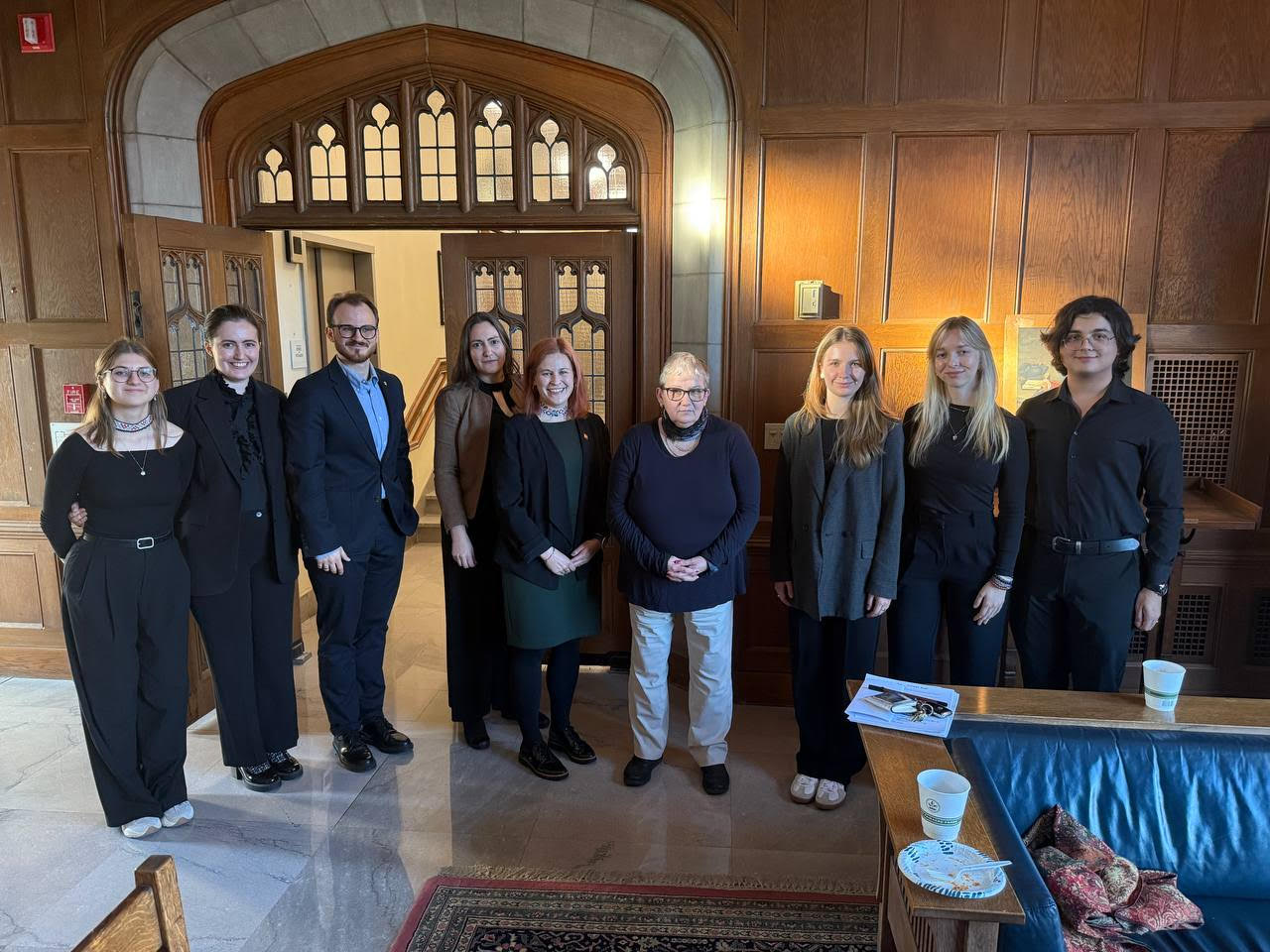
On Nov. 18, the Vassar Alliance for Ukraine commemorated the 10-year anniversary since the start of the 2014 Russian invasion of Ukraine, with an educational panel titled, “A Decade of War and Displacement: Humanitarian Consequences of Russian Invasion of Ukraine.”
Valerie Malykhina ’25, one of the four Ukrainian members of the organization, said in a written correspondence, “We’d like to have more support, but the interest in Ukraine has unfortunately died out.” On behalf of Ukrainian students on campus, she added, “It was essential to use this opportunity to highlight how war and prolonged displacement disrupts lives, reshapes communities and demands deeper understanding and complex holistic action.”
Malykhina explained that the Vassar Alliance for Ukraine wanted to highlight the war’s toll on the millions of Ukrainians since 2014, not just since the full-scale invasion in 2022. Both Malykhina and her co-host for the event, Zheka Chyzhykova ’25, have been forcibly displaced from Donetsk by the Russian occupation since 2014.
“Having fled my home in 2014 due to the Russian invasion, it was deeply important for me—and for other Ukrainians—to share the challenges faced by forced migrants and refugees,” Chyzhykova said. “These challenges include discrimination, difficulty obtaining necessary documents, and the immense mental toll of leaving one’s home behind, often with no possibility of return. It felt incredibly meaningful to make our stories visible and heard.”
Yevhenii Monastyrskyi, one of the panelists, is a Harvard University PhD student and a History Lecturer at the Kyiv School of Economics. Monastyrskyi left Luhansk in Eastern Ukraine in October 2014 as a result of the Russian occupation and has since participated in the resistance movement and spent time in captivity. He has worked across international organizations in Ukraine dealing with internal displacement and frontline communities, becoming a historian of the Soviet Union and migration, and serving as the lead researcher at the War Childhood Museum Ukraine since 2020.
Monastryskyi said the Vassar Alliance for Ukraine invited him to participate in the panel dedicated to the 10 years of war and displacement, both internally and externally, for Ukrainians. “It is not an easy task to bring scholars from different institutions to one place for a single panel,” he remarked.
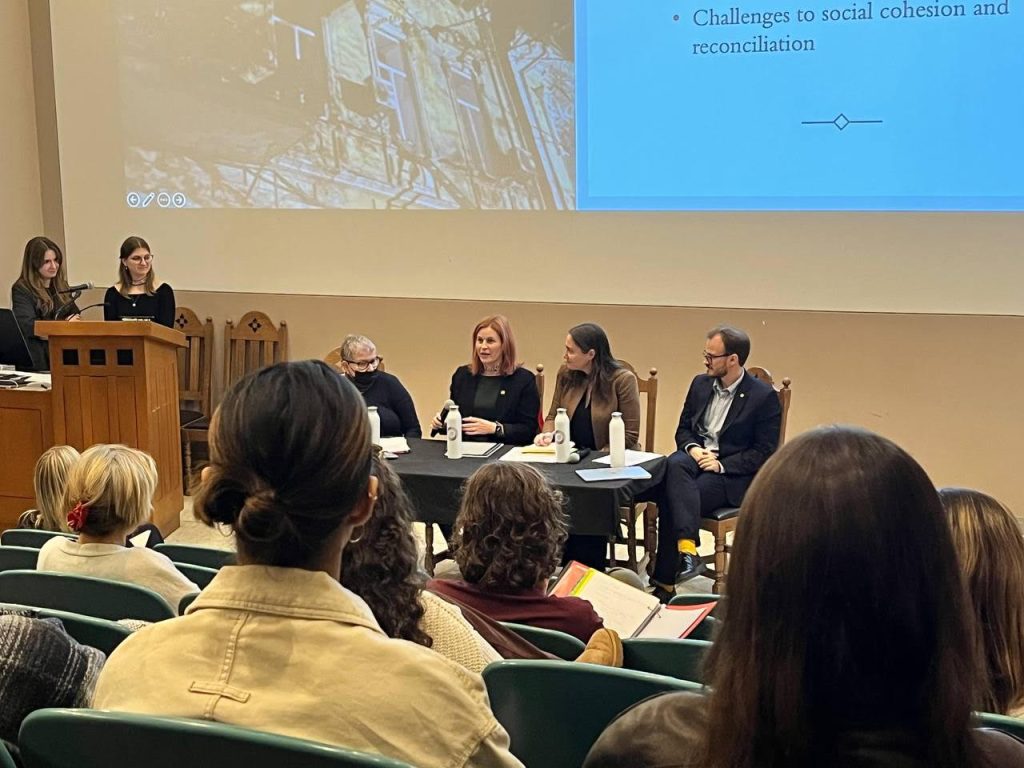
Monastryskyi praised his co-panelists, Director of the Temerty Contemporary Ukraine Program at the Harvard Ukrainian Research Institute Dr. Emily Chennell-Justice, Assistant Professor of History at the University of Connecticut Dr. Sara Silverstein and Associate Professor of History at Vassar College Michaela Pohl. “I believe we managed to touch on most aspects of the topic in less than two hours, covering issues from migration to humanitarian aid, grassroots mobilization of civil society, and historical parallels with other genocidal wars of Russia and its peoples,” Monastryski said.
Malykhina noted, too, that the event held special impact given the many voices in conversation. She said, “What made the event unique was that it brought together both personal narratives and academic perspectives. It’s quite unusual for a small college to have two displaced students from Donetsk, and that gave us a compelling platform for an insightful conversation on the issue.”
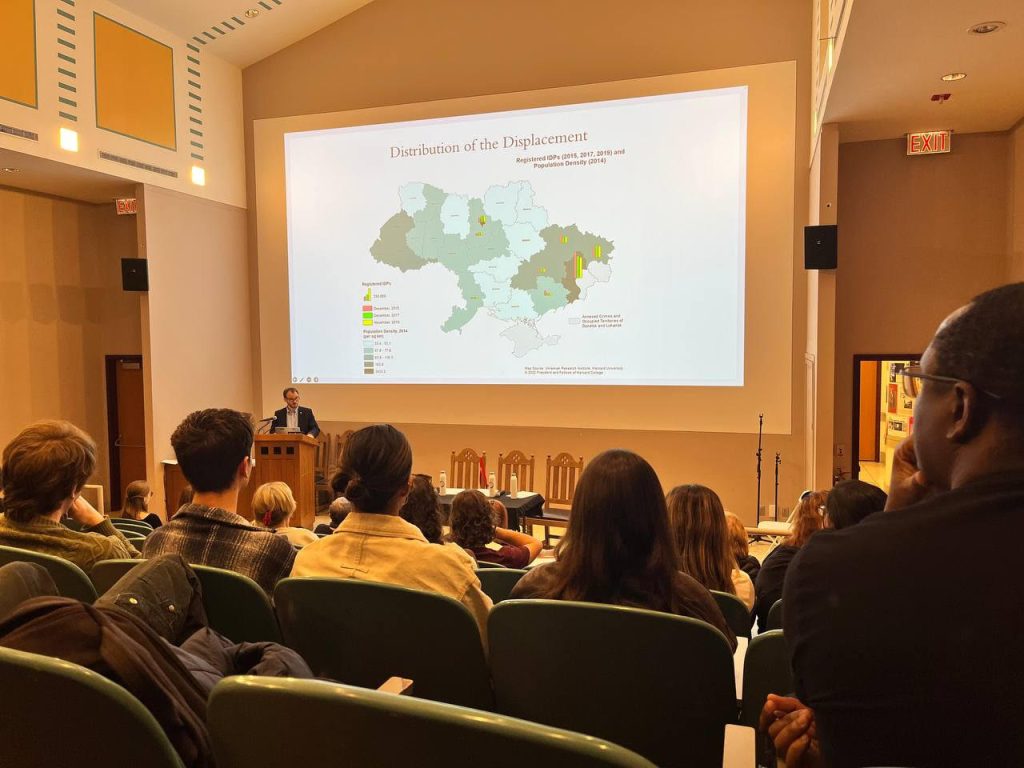
Malykhina has lived in Kyiv since 2017 and travels there during breaks. She majors in neuroscience and behavior, focusing on psychological trauma and public health. She spent this past summer at the Superhumans Center in Lviv, Ukraine, an innovative rehabilitation and reconstructive survey center for Ukrainians who endured amputations and facial injuries in the war. “In Ukraine alone, there are over 3.5 [million Internally Displaced People], many of whom have been unrooted for over 10 years and experienced repeated displacement,” she said. “By hosting this panel, we aimed to amplify the voices of displaced individuals and foster a greater awareness of the humanitarian challenges that persist in Ukraine and beyond.”
The panel expanded to engage audience members in conversation. Monastrysky, appreciative of the opportunity, said, “Not only did we receive straightforward questions, but even challenging ones resonated with me.” The question of corruption in Ukraine shed light on the Russian information war, according to Monastrysky: “They offer a ready-made opinion, like processed food, denying Ukraine’s sovereignty because ‘it is a failed state.’ People often do not look beyond these narratives.”
Chyzhykova, too, agreed that the question raised important answers: “First, you can always research the organization of your choice and build a personal connection with them,” she said. “Second, if you believe the Western world is immune to corruption and Ukraine is the ‘best’ at it, you are gravely mistaken. Justifying inaction to save lives by citing a slim possibility of corruption is simply another way of shirking responsibility.”
Karolina Naidon ’26, another permanent member of Vassar’s Alliance for Ukraine, is from Dnipro City, where she evacuated in March 2022 due to the start of the full-scale invasion. Over the last two years, she has worked at the Embassy of Ukraine to the United States and the Permanent Mission of Ukraine to the United Nations.
Naidon praised Pohl’s contributions to the panel discussion, noting, “She showed that what Russia has been doing in Ukraine for a decade has already happened in other regions. It was a precise moment when the audience understood that the Russian pattern of military crimes and crimes against humanity has been ongoing for decades.” Naidon also thanked Pohl for her actions on campus: “I am genuinely grateful to Professor Pohl for her continuous support of Ukraine on campus, whether through participation as a speaker at our events or by creating a class about Russian-Ukrainian history at Vassar.”
Jannette Swanson, Director of External Engagement in Vassar’s Center for Career Education, attended the event, both to support students she has worked with and to stay informed about the ongoing conflict. In a written correspondence, she acknowledged the challenge of understanding the history of global conflicts, emphasizing, “Events like this help make this understanding possible and provide me with an opportunity to pause and reflect a bit more on this subject.” She added, “They’ve hosted a number of different speakers and fundraisers and I am always in awe at what our students are able to do in addition to being full-time students ( particularly our students who are from or have family in war-torn countries).”
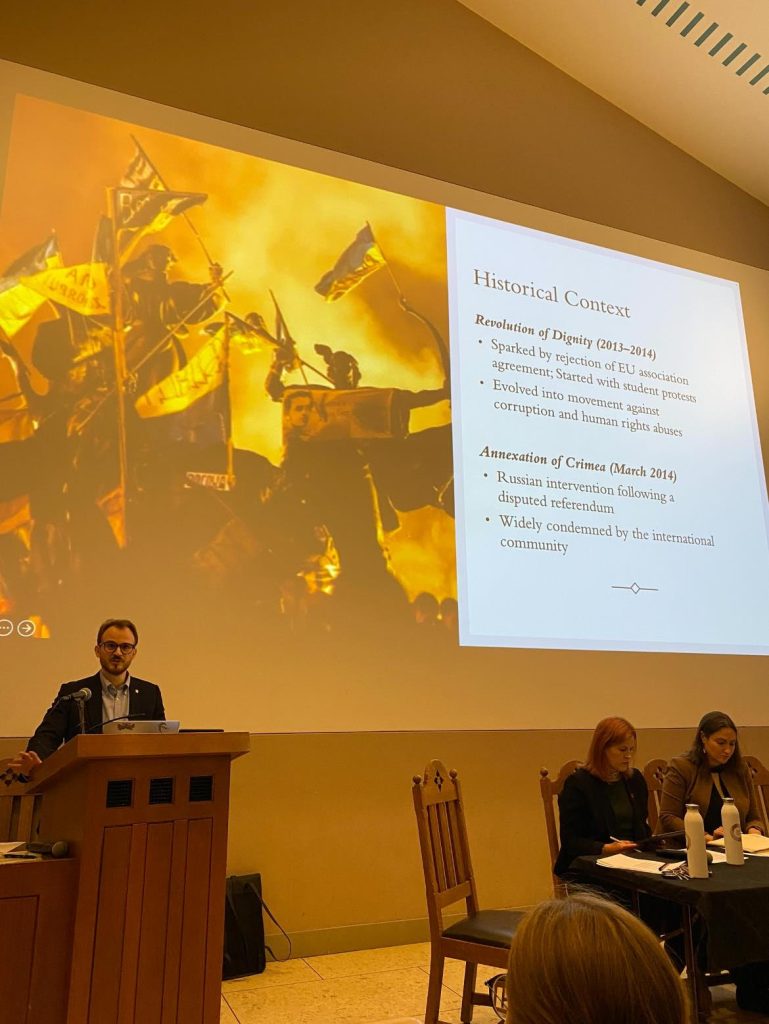
“I particularly enjoyed how it started with a brief presentation from one of the panelists that provided a historical overview of conflicts that have impacted Ukraine and the impact those conflicts have had as it relates to displacement,” Swanson wrote.
Monastryskyi, the panelists and many in the audience were left gratified by the evening’s events: “While the Vassar Alliance for Ukraine is a small group, organizing something like this demands significant energy from each member, not to mention the effort needed to persuade university administration to support it,” he said. “In my experience at Yale and Harvard, where the Ukrainian undergraduate body is 5 to 10 times larger, it is an amazing achievement that the Vassar Alliance for Ukraine managed to organize such a great panel.”
Images courtesy of Vassar Alliance for Ukraine.