

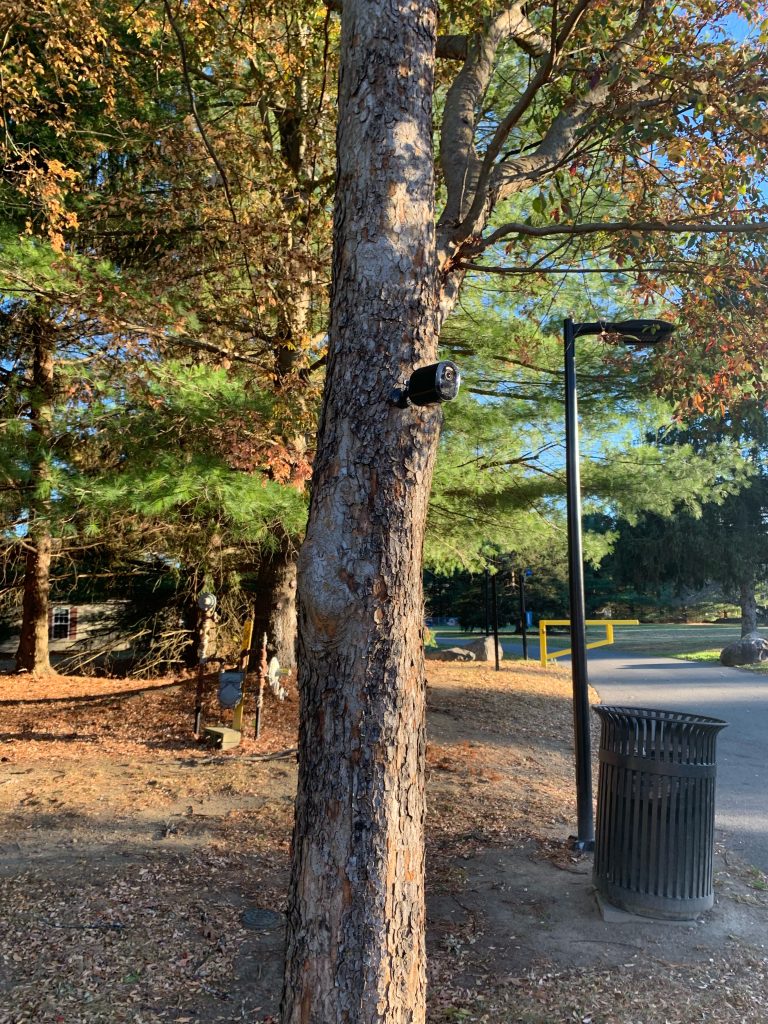
Over the past couple of months, some Vassar students have noticed new security cameras around campus, including in spaces between Noyes House and Gordon Commons, as well as areas by the Thompson Memorial Library and Rockefeller Hall.
Dean of the College Carlos Alamo confirmed in a written correspondence with The Miscellany News that the College has incrementally increased security camera coverage since the armed break-in of a Town House (TH) in 2019. He wrote that this semester, the College has received reports of unknown individuals loitering around the Terrace Apartments (TAs) at night. “Cameras are considered a basic and essential investigative tool, especially as it relates to our ability to address harm when it occurs on our campus.”
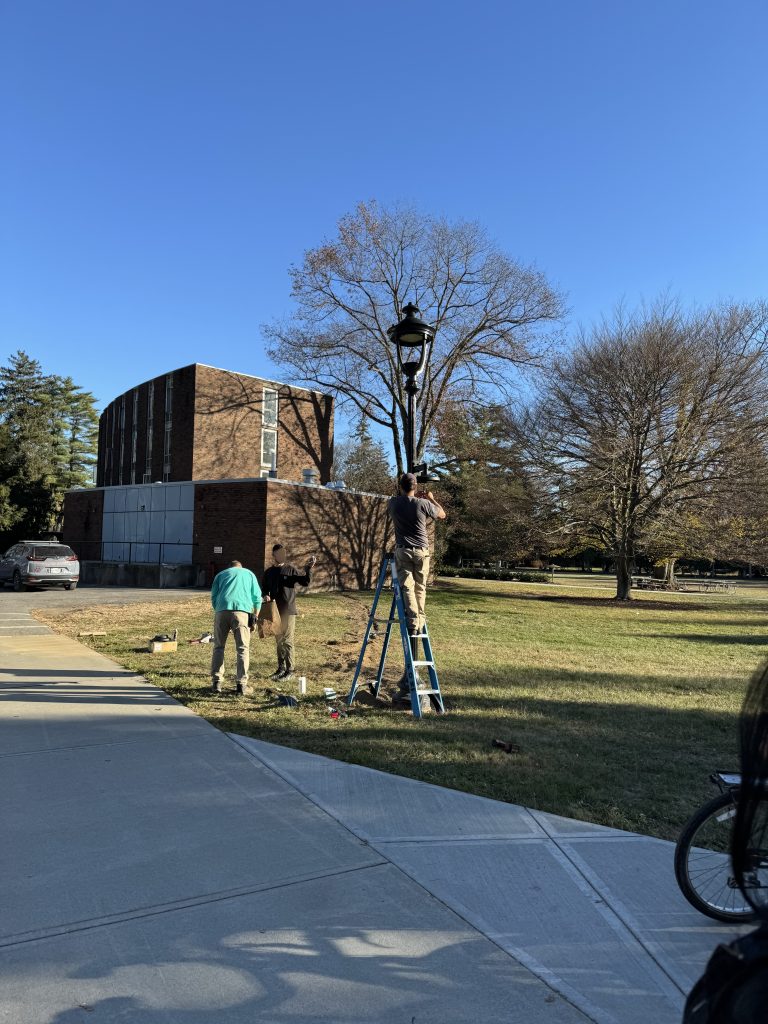
Some students, however, have expressed concern regarding the lack of transparency around the use of security footage. Simon Lewis ’25, who witnessed workers installing a camera outside of Gordon Commons in November, thinks that the College should inform students about the increase of security cameras on campus. “I don’t remember seeing any emails or any communication about this, which makes it feel, to me, like it actually is eroding trust between students and admin,” he said in an interview. “In order to move forward in a trustful way and repair some of the tensions between students and the administration right now—putting up a bunch of cameras without telling anyone isn’t really a smooth way to do that.”
Currently, there are 304 cameras across Vassar’s 100 buildings and 1,000 acres of land. In comparison to peer institutions, Vassar has comparable or fewer cameras on campus, Alamo wrote. He added that the College added 19 cameras last summer and 21 in Summer 2023.
Over the Winter Break, the College installed eight cameras inside Gordon Commons, in response to the Oct. 5, 2024 vandalism that flooded the kitchen, bringing the total number of cameras in the dining hall to 23, according to a written correspondence with Director of Dining Services Chris Mongeon. The perpetrators stuffed the floor drains in the kitchen with trash bags, smashed the dishwasher and vandalized the break room, he explained, racking up tens of thousands of dollars in damage. Mongeon wrote: “After that incident, nearly a dozen employees said they felt unsafe and thought we should get more cameras.”
Mongeon added that, following Winter Break, three Gordon Commons employees expressed satisfaction with the camera installation. He also wrote: “One dining employee, who does not work in Gordon Commons, felt that cameras in Gordon were unwarranted.”
Vassar’s “Campus Safety Video Camera Policy,” published in the College’s online library, provides an outline of surveillance privacy, placement and limitations for use, listing loading docks, storage rooms, residence house doors and the Thompson Memorial Library, among others, as camera locations. Signage is permitted but not required. Only authorized personnel can access security footage, though footage may be given to local law enforcement agencies to support investigations if the College requests an external investigation. Security footage may not be used to enforce minor violations of the student code, like carrying an open bottle of alcohol.
In the past, footage has been used to identify unknown individuals harassing Vassar community members—such as entering student housing uninvited or looking in student housing windows, Alamo wrote. Mongeon added that by using camera footage from Gordon Commons, “Campus Safety was able to prove an inappropriate encounter between two individuals following an initial complaint.”
Recently, footage has been used in an ongoing investigation of the vandalism incident on Dec. 13, when buildings around Vassar, including Gordon Commons, the Thompson Memorial Library, Rockefeller Hall and New England, were spray-painted with the phrases “free Palestine,” “blood on your hands,” “land back now” and “Intifada.”
On Sunday, Feb. 2, Vassar Students for Justice in Palestine (VSJP) and Vassar Popular University (VPU) published a joint press release on their respective Instagrams that claimed that Vassar’s investigation into last December’s graffiti included repressive and intimidating tactics. The post read: “This week, officers from Vassar’s Campus Safety appeared unannounced at two students’ dorms and demanded to escort them to a meeting with the campus investigator and former detective with the Poughkeepsie police, Joseph Chorba.” It added that the students were not granted a chosen support person nor given prior notice. By the Students Bill of Rights, students are entitled to adequate notice and to be accompanied by an advisor of choice.
In an email to The Miscellany News, Alamo wrote: “The SJP posts contain several factual inaccuracies, including a failure to properly distinguish an investigation from the Community Expectations process. Specifically, in an investigation, there is no requirement for advance notice or requirement that there be a support person.” He added: “Nevertheless, in this case, when students have asked for a support person, we have worked with the student to offer that.”
Under the condition of anonymity, a member of VPU told The Miscellany News that the number of students approached by the administration regarding December’s vandalism has since increased to four.
Vassar Student Association (VSA) President Emily Doucet met with Alamo and President Elizabeth Bradley after the posts were published to communicate constituent concerns about the policy. She said students should be given ample notice before being approached by administrators: “We want to have it be mandated that in any circumstance, if [the administration] is going to be seeing an audience, let’s say with a student, you’re going to tell them at least 24 hours ahead of the time you’re going to be trying to do that.”
Doucet respected that the College did not involve law enforcement in the investigation against students but acknowledged the difficulties of an internal investigation. “That’s a good decision to make, but I also feel like they need to continue with that follow through of having a better enumerated process in how to handle these internal investigations if you’re not going to bring in the authorities, which they shouldn’t be doing,” she said.
The College should release a list of the locations that have security cameras in them, Doucet said: “Just so people are aware that, like, ‘Hey, when you’re walking into the Deece [Gordon Commons] right there, there’s a security camera, just so you know,’ and kind of have that information.”
Doucet could not recall a time when the VSA aided the College with security camera policy or placement in the past few years.
While visiting the Campus Response Center desk in Main Building, which houses the closed-circuit television monitors connected to cameras around campus, Lewis realized there were cameras pointed at some common spaces in academic buildings. “I had no idea there were cameras there,” he said. “The fact that there’s no open conversation about that makes me trust the administration less.”
In response to student concerns about camera usage, Alamo, the VSA, the Office of Restorative Practices and Campus Activities hosted two “Listening Sessions on Camera Usage and Student Privacy” on Monday, Feb. 17 and Thursday, Feb. 20. The invite was sent to all student org presidents and treasurers with an invitation to share with anyone who might be interested in attending.
Director of Student Activities Will Rush wrote in an email to The Miscellany News, “The sessions were designed based on feedback from student organization leaders who have shared concerns with the VSA about various topics in their roles as leaders on campus. The goal was to keep sessions to a manageable and conversational size.”
Rush added that he hopes to work with the VSA and College on putting together a fact sheet for the greater student body on common questions following the second session.
The role of security footage on a campus such as Vassar’s is complicated, Doucet said. “On the one hand, we do have a very open campus,” she explained. “But I’m also not too keen on using that resource [cameras] on members that are within the Vassar community.”
Lewis mentioned he is interested in learning more about what other kinds of surveillance methods Vassar uses. “The fact that we all use Vassar emails, we all use Vassar WiFi…it’s unclear to me what kind of surveillance can happen through that,” he said. In a follow-up email, he wrote: “If Admin will not give straight answers about cameras—which they have put up in the open on sunny Friday afternoons—I wonder what other kind of surveillance is quietly happening.”
As for alternate responses to the December vandalism, the anonymous VPU student suggested the College pay attention to the message the student vandalizers sought to send. “We should have a culture of mutual respect and trust,” they said. “It would be nice if [the administration] would be like, ‘Oh, there’s students vandalizing property. Maybe we should give the land back. Maybe we should divest.’ That’s an ideal.”