
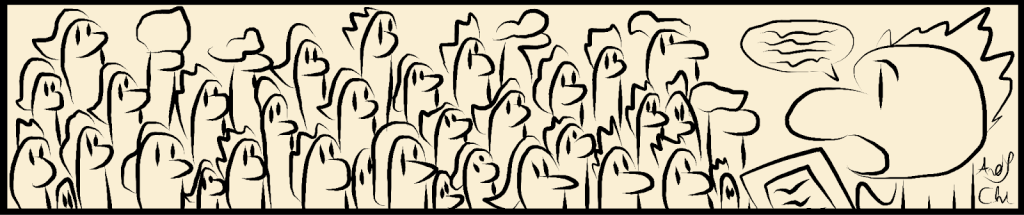
It was a speech that sparked the powder keg leading to the Revolutionary War, the fall of the Berlin Wall, and brought America into World War II, among other historical events. Speeches, though overlooked, are deeply ingrained within American culture and history. It is then unfortunate how they have fallen by the wayside for short, simple, social media posts. Most recently, a tweet and a “truth,” respectively, incorrectly announced the death of two national guardsmen and the closing of Venezuela’s airspace. Two historical events that were given the same platform as a fancy dinner or a funny meme. Even when historical events are given the respect they deserve, the speeches given in their wake often fall flat and are not remembered, such as Donald Trump’s remarks at Charlie Kirk’s funeral or Joe Biden’s condemnation of the assassination attempt on Donald Trump. While both events garnered an Oval Office Address, you would discover it hard to find anyone who remembered what was said. Speeches are becoming rarer and rarer and, when they are given, they are uninspired and lack memorability.
This is not to say, however, that speeches are no longer important. It is not a post that will turn the gears of change, but a speech. Speeches are now more important than ever. As America slowly peels back its civil liberties, it is not a tweet that will shine a beacon of hope. As great as tweets are for spreading information—and misinformation—they fail to allow the reader to feel like part of a crowd. As more and more political figures chose to make historic announcements over X, they chose to let their movement fizzle and die. When Nancy Pelosi chose to announce her retirement over a video distributed over X, she chose to let her historic, decades-long career end with a sputter. Instead of gathering a crowd or talking on the House floor, she chose to go silently into the night. When Donald Trump ignited the flame that led to the January 6th Insurrection, he did so through an in-person rally because, in the moment, the fire was sparked. When he finally told the rioters to “go home,” he did so over a video released on X. He lit the fire through a speech, then extinguished it through a tweet, further cementing the power and lack thereof of both mediums.
It is with a speech that a presidential bid begins or ends. Yet, within recent history, it has only ended them. The last time a speech truly launched someone onto the national stage was Barack Obama’s 2004 Democratic National Committee speech, in which he declared, “There’s not a liberal America and a conservative America; there’s the United States of America.” It was with this sentiment that he became the first African American president, since this idea, a more united America, became the focal point of his candidacy. It is then unfortunate that the next presumed Democratic candidate uses posts mocking Trump’s style to launch himself into the national spotlight. While it is true that California Governor Gavin Newsom has done a lot to resist the Trump administration, such as suing them and “Trump-proofing” the state, it is words that will be remembered, not actions. People will not remember a tweet in all caps. Most people could not tell you how FDR directly supported the American people through the Great Depression, but they could tell you that “the only thing we have to fear is fear itself.” They could not tell you about the science behind how America got to the moon, but they could tell you that “We choose to go to the Moon. We choose to go to the Moon… We choose to go to the Moon in this decade and do the other things, not because they are easy, but because they are hard.” If Gavin Newsom truly wants to win the election, he must get his platform into the mainstream, not through tweets but rather by organizing rallies, making speeches and uniting crowds.
Gavin Newsom will not be blazing the trail; however, he will follow in Bernie Sanders’ and AOC’s footsteps. Bernie Sanders’ and AOC’s joint “Fighting Oligarchy” tour cleared the forgotten path for Democrats—a path not used since 2004. While no one speech of theirs was necessarily historic or memorable, they remain as proof that speeches work. They helped unite the Democrats in a way not seen since before the pandemic. It showed that there was power in a crowd and that a speech can still move people even with shortened attention spans. Times have changed, and they will continue to do so, but throughout it all, the ability to rally a diverse crowd around a common goal will remain important. It might have been forgotten, but as we march farther into Trump’s second term, what we need will become clear—a great speech.