
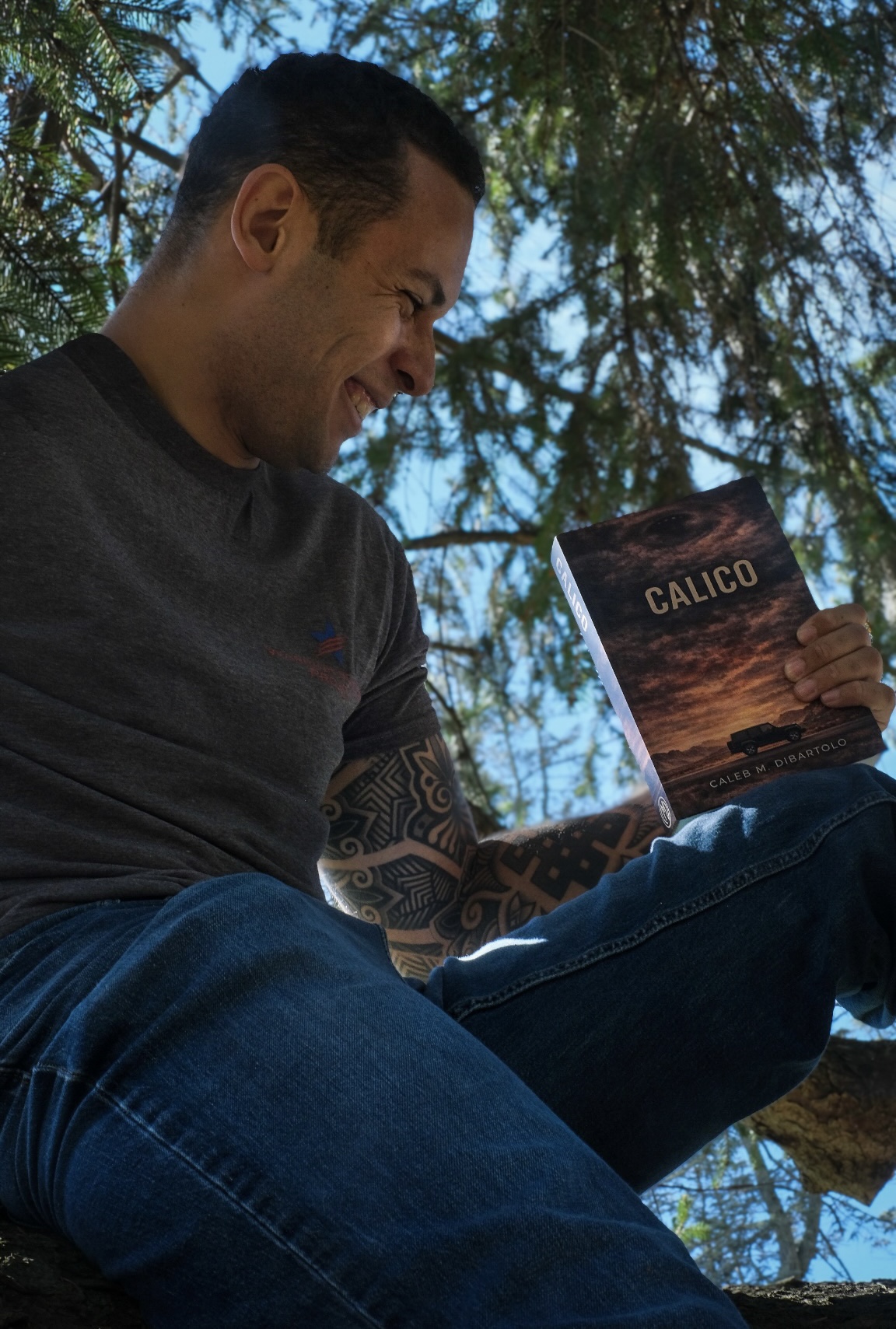
Picture this: You want to start anew. Longing to create real, meaningful connections after a lifetime of short-lived friendships, you ironically run to the dry deserts of southwest America—where the unforgiving, arid climate might lead you to believe that nothing substantial could grow. But you find this diner, and this diner brings you to a motel and then to the town of Calico. At first, it seems like any small, sheltered, tight-knit community. But as you start to build connections, you start noticing that the desert is not all that it seems…
If an introspective yet thrilling science fiction novel sounds enticing, then I have just the book for you. “Calico” by Caleb “D” DiBartolo ’26, recently published on March 6, follows 33-year-old narrator Marc in a transitional period of his life as he searches for meaning out in the desert. Marc is perceptive and witty—exactly the kind of main character you would want for digging up the rich mysteries of a sci-fi novel.
But more on the student who brought this story to life: Other than recently becoming a self-published author, DiBartolo is a Russian Studies major with an Analytic Philosophy correlate. Prior to attending Vassar, he was in the U.S. Army for eight years and now acts as president of the Vassar Veterans Association. Additionally, he is co-chair of the Founder’s Day Wellness Committee, a proud member of the men’s rugby team and a founding member of the Vassar Combat Arts Club, where he teaches boxing fundamentals to faculty and fellow students.
DiBartolo has been wanting to write and publish a novel for a long time. “At first, it was more just trying to challenge myself to do something that I’ve seen,” DiBartolo told me. Many of his close friends and professors had written books, and he wanted to see if he could do it himself.
For a couple of years, DiBartolo was unable to write. He attributed this struggle to a lack of time or focus. But finally, when he came up with the idea for “Calico” last year, he knew he had to follow through. “It clicked after a few chapters,” he remarked. “I was all like, ‘This is fun!’ It got to the point where I was excited to see what happened next.” DiBartolo started writing “Calico” in January 2025 as part of his New Year’s resolution. He finished writing in November 2025—just 11 months after he began. Now, he feels confident in the self-publishing process, and “Calico” can be bought just about anywhere, including his website.
Although intimidating for some, the sci-fi genre came naturally to him as his ideas grew over time: “At first, it was really just a guy in the desert, just trying to start something new. And then I was like, what if there was something going on? What if it wasn’t just his story? What if this encapsulated the whole town? What if this encapsulated the world? What if it encapsulated everything? You know, the best genre for encapsulating everything is sci-fi.”
For DiBartolo, the writing process was illuminating in a multitude of ways. He recalled that inspiration had struck way earlier than he first realized—influenced in middle school by authors like Ned Vizzini, novels like “Incarceron” and “Sapphique” by Catherine Fisher and, recently, games like “Cyberpunk 2077.” Inspirations like these informed the reflective narrative style of his novel. In fact, Marc’s internal monologue is a key feature of “Calico.” “The thought process that the main character goes through for a lot of the things in the book is kind of how I think on a normal basis,” DiBartolo shared, “and it gave me more clarity on myself while I was writing.”
Lots of things pushed DiBartolo to keep writing, but most of his motivation came intrinsically. Once he started telling the people in his life that he was writing a book, he knew he had to commit to his goal: “I was going to have to follow through, because you can’t just make false promises for a year and then come up with nothing.” DiBartolo often worked on his novel at Underground Coffee & Ales across the river in Highland, New York, where he became a recognizable regular; he recalled to me how the employees were surprised when he actually came in with the finished product one day.
He also felt compelled to continue because the harder he worked, the more his ideas came to life on the page. “When I finally figured out how to make them [altercations in the story] match exactly what I was trying to see in my head, that would give me tingles sometimes,” he shared. “I almost teared up!” Magical moments like these allowed him to feel more connected to his characters and gave him a sense of pride in his work.
DiBartolo is only going up from here. In the fall, he will be starting a master’s degree program at Cornell University in Industrial and Labor Relations. Though he will be busy with his master’s, novel-writing remains in his future: He plans to release two sequels to “Calico” by 2028, with “Mastiff” being the second book in the trilogy.
Despite being excited for the future, DiBartolo’s time at Vassar will always hold a special place in his heart. “Vassar itself has probably aged me in the way that I thought that the Army would change me originally,” DiBartolo said. “It was like I never needed a direction because [the Army] was always there for me. And when I got here, I realized that it was me thinking for myself. And after I started really thinking for myself, that’s when I started being involved in everything—wanting to be involved and meeting people and doing stuff. And now it’s like I don’t know why I ever thought I couldn’t.” He continued, “I feel like every chapter of your life could be written in one way or another. I think this is my way of showing how far I’ve come.”
So if you see Caleb “D” DiBartolo around, walking his dogs Jack and Rosie, you should absolutely say hello. And if you want to publish a book yourself someday, DiBartolo is proof that you can do anything you put your mind to. “I believe anybody can do that,” he told me. “Just start telling people you’re gonna do it. Just start putting it out into the universe so that you know that you can do it.”