
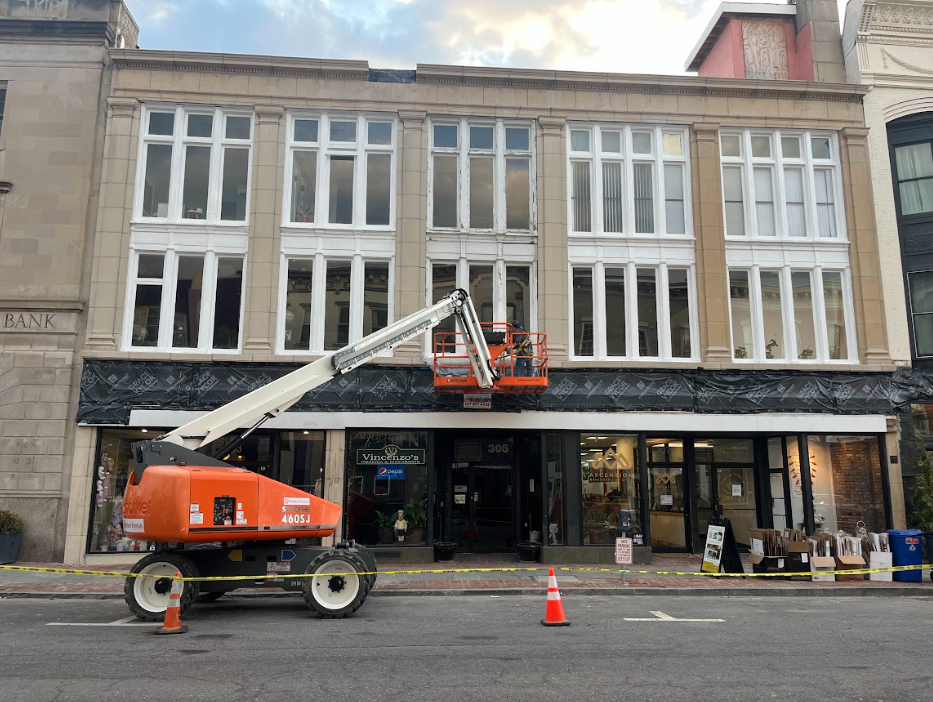
The architecture of uptown Kingston, New York, has undergone a historic change. From January to March 2026, Kington’s Stockade District was filled with construction crews working to take down the Pike Plan—the canopies and awnings extending from the storefronts to the street. The demolition has seen a broad range of responses from businesses, residents and building owners in the City of Kingston. Thirty-six of the 44 buildings in the Stockade District with canopies have reached settlements with the City to carry out the demolitions.
The Pike Plan was introduced to the City of Kingston in the 1970s to counteract the negative impact of suburban shopping malls on downtown Main Street. The intention was to make the streets of the Stockade District feel more like an outdoor pedestrian mall in the style of a Western frontier town, with the hope that the canopies would attract more economic activity. The commemorative plaque for the Pike Plan at the corner of John and Wall Streets reads: “[The] talented designs defeated urban blight and preserved the character of an older era for all to enjoy.”
Former Ulster County Deputy Director of Planning Jennifer Schwartz Berky offered a different perspective on the legacy of the Pike Plan. Berky explained in an interview with KingstonCitizens.org, “I contacted the National Trust for Historic Preservation, and their experts told me — in no uncertain terms — that they consider these 60s and 70s canopies across the country to be, by and large, detrimental to the functioning of commercial districts. What began as a response to competition from malls ended up as blight, and they expressed surprise that we hadn’t taken ours down yet, citing numerous examples of business districts that revitalized in part because they took theirs down.”
The City of Kingston has officially decided it is time to let the awnings go. In July 2024, Kingston Mayor Steven Noble issued a statement announcing the City’s decision to remove the Pike Plan, arguing that the canopies were of “declining structural integrity and deteriorating condition.” In January 2026, following litigation and pushback, construction companies began to tear down the canopies.
Local businesses and residents down Wall Street and Front Street remarked on the benefits to visibility and accessibility that removing the Pike Plan enabled. Dominick Vamacore, owner of the North Street cafe and hair salon Dream Weavers, told The Miscellany News, “Now that it’s gone, I can’t attribute one positive thing to the Pike Plan. Right now I hate it more than I did before, because I realized what it was actually obstructing, just walking outside, the openness of the neighborhood.”
Sean Weeks, the owner of Buns, a burger restaurant on the corner of Front and Wall Streets, also spoke positively of the Pike Plan removal: “It’s more open, there’s a lot more light. I think the signage and the overhangs previously just made it really difficult to see.” He said of the Plan when it existed, “It was just clutter.”
Damon Ely, a Kingston resident who lives near the Stockade District, spoke about what he thought of the prospect of losing the Pike Plan before the demolition began. “Leading up to it there were lots of feelings about it because [the Pike Plan] was such a hallmark of Kingston…and they were nice because they provided shade and they gave it a cozy kind of feeling when you walk around uptown,” he said. “But since they’ve been gone I’ve actually been presently surprised… I’ve never seen that facade down there at the end before, just hadn’t noticed it. And suddenly it’s like, ‘Wow, it really opens up the street.’ So, [I am] already kind of liking it more than I thought.”
Sabina Galli, a Stockade District resident, had a different perspective on the process of demolition. Galli lives on the second floor of a building whose canopy was torn down. Galli told the Miscellany, “I was really impressed with how quickly they completed the project… The noise was not that bad, and I was working from home.”
Neil Bender has filed numerous lawsuits against the city in response to demolition. “The king of Greenwich Village,” as Bender has been called, is the nephew of William Gottlieb, a wealthy real estate owner who made his fortune by acquiring over 150 individual Manhattan properties in the mid-20th century. Bender took control of his uncle’s business and property holdings in 2007, and now controls a real estate fortune that is estimated to be worth over $1 billion. Bender began to use William Gottlieb Real Estate to acquire several properties in Kingston around 2015 and now owns 12 individual buildings.
In total, Bender’s legal team has sued Kingston seven times in response to the Pike Plan demolition, each on behalf of a property owned by William Gottlieb Real Estate. Several of Bender’s lawsuits cite environmental concerns, claims of the City’s negligence and breach of contract and that demolishing the Pike Plan goes against the historical aesthetic of Kingston. Bender’s lawyer, William Hurst, also made harsh criticisms about the demolition process itself. In a comment to The New York Times, Hurst said, “If you were to walk in Uptown Kingston during the demolition, you would have thought that it was Dresden after World War II.”
Noble has been vocal in his disapproval of Bender’s litigation. In an open letter to the City of Kingston, Noble wrote: “I want the residents of Kingston to understand just how much of a burden these endless lawsuits and fishing expeditions cost the taxpayers. How the existing Uptown businesses suffer from having empty neighboring properties, and who live under the threat of constant suing, and watch as any would-be investment in Uptown gets syphoned off in legal battles.”
Prior to the Pike Plan, Bender and his firm, William Gottlieb Real Estate, filed 11 lawsuits against the city to oppose the development of mixed-use retail and housing in Kingston. In his letter, Noble was clear about his long-time frustrations with Bender and the litigation he has brought to the city. Noble wrote, “We have an oligarch infiltrating our community who is attempting to use his deep pockets to break the City of Kingston. Despite constantly losing, he and his attorneys will not stop. They have a seemingly endless capacity to sue, regardless of how many times their claims are tossed or ruled against.”
Kingston business owners also spoke to the Miscellany about their frustrations with Bender’s presence in Kingston. One business owner, who wished to remain anonymous, asserted, “Mr. Bender has done nothing but disrupt uptown Kingston. He’s done nothing but disrupt any efforts we’ve ever made in uptown to make it a better place. And his favorite thing is taking the city to court.”
Another anonymous business owner commented on Bender’s lack of connection to Kingston. They said, “I just believe that the reality of that situation is people play Monopoly from New York. I don’t believe he’s passionately attached to one side. I don’t believe he’s trying to harm anybody. I don’t believe he’s trying to be an advocate for anybody. They’re removed, just like most billionaires in the United States. They’re removed from the reality of the situation.”
Despite Bender’s opposition, the Pike Plan demolition was completed in March. The City has pledged to provide funding for building owners to make necessary repairs, and filed a motion in March to throw out Bender’s Pike Plan lawsuits, as well as file sanctions against Bender’s firm and attorney. The benefits of the Pike Plan ending were clear to the owner of Dream Weavers, who told the Miscellany: “Now, the majesty of my building has been restored.”