
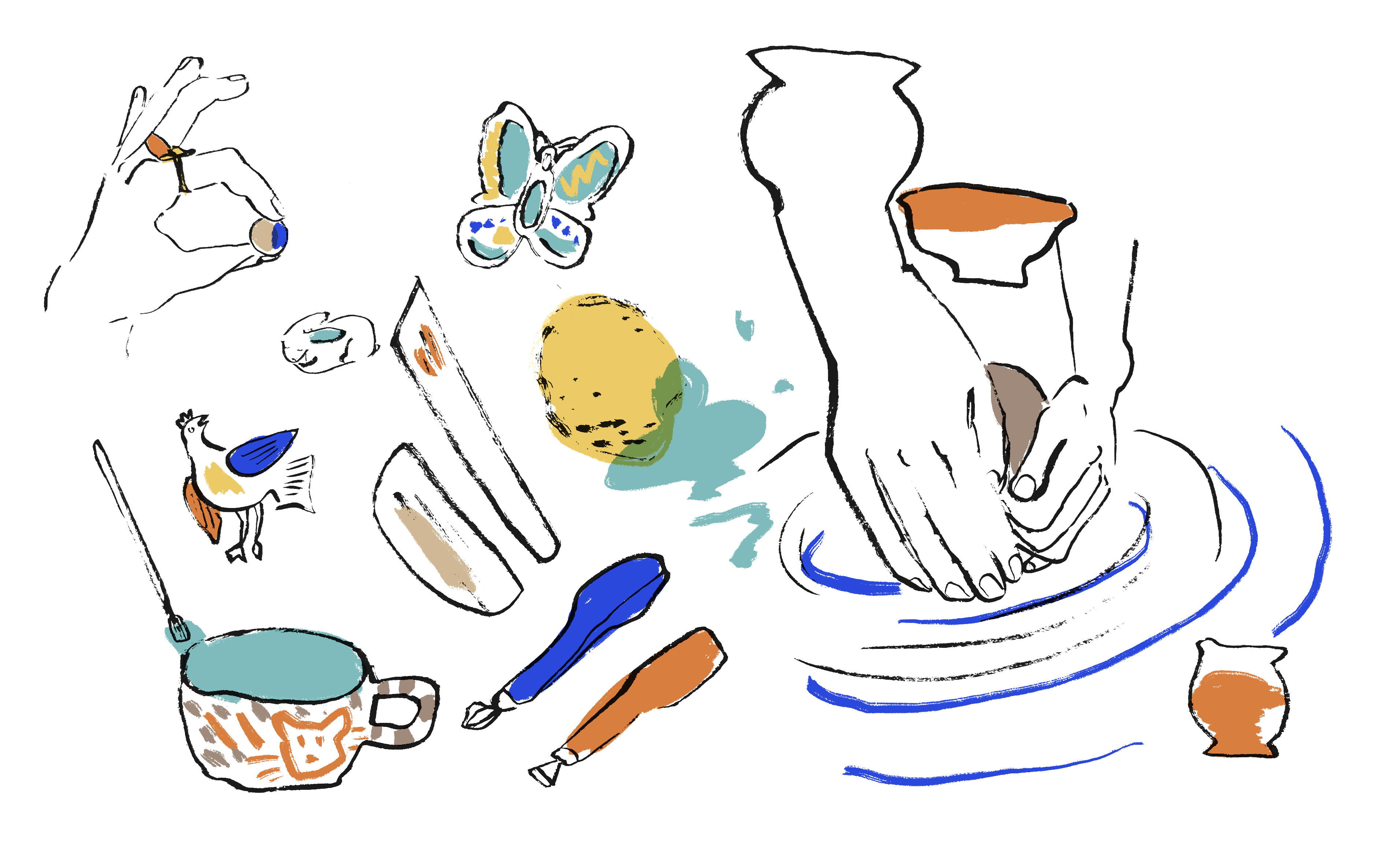
Many of us on campus seldom find an excuse to visit Noyes. Those who have the fortune of residing elsewhere may find little reason to wander the house’s curved halls or gaze through its triangular windows. However, hidden within the damp depths of its basement, Noyes shelters a secret haven. Within resides the ceramics studio, a space no larger than a dorm room yet brimming with potential. Here, Ceramics Club offers weekly office hours, providing free rein over its resources to serve all of campus’ clay-related needs. Unlike other universities, where art organizations require a fee to attend and use materials, Vassar’s studio operates at no cost to students. Ceramics supplies are free, accessible and plentiful, encouraging students to operate creatively without financial barriers. Studio interns offer help to those who, like me, are not as adept in the applied arts.
While the studio houses several potter’s wheels for throwing pieces, hand-building is my preferred mode of working in ceramics. With each press of the hand, every adjustment to the clay, an expressly intimate connection is forged with the material. Here and there a fingerprint is left behind or a scratch blemishes the surface, to me embracing the subtle flaws that the wheel would smooth away. This hands-on approach gives unique satisfaction to the artist, urging patience and an acceptance of the imperfect.
Sophomore year, I regularly retreated to the tranquil cool of the basement studio, obsessively working on a birthday gift for a friend. The desired product, an ashtray shaped like “The Rise and Fall of Ziggy Stardust and the Spiders From Mars” vinyl by David Bowie, took several weeks to come together. Rather than resorting to the time-tested Pinterest arts and crafts mood board, I decided to respect the integrity of the creative space I occupied. Reaching deep into the depths of my mind, I searched to recover any semblance of ingenuity I may have left behind in middle school art class.
To begin with, I tried sketching a rough design, allowing my ideas to take form on paper. Unsatisfied with my drawing skills, I hoped my concept might look better in clay. I started hand building slabs to form my ashtray’s base, employing the famed technique of scratching and scoring to adhere each piece to the other. If you fail to scratch and score the clay when you attach, for example, the handle to a mug, the piece can fall apart as it dries or when fired in the kiln. The technique is simple, only requiring a few gashes across the clay and the application of water—a method that can feel more like mutilating your art than protecting it. After scratching and scoring my piece and adhering the walls to the base, I used small wooden and metal tools to add design. Included were deep lines to mimic the microgrooves that produce the sound of a record, a circular label in the center of the vinyl indicating the album name and several notches on the walls of the piece where a cigarette might lay. Finally, my piece was ready to rest.
Over the following weeks, my ashtray sat on a shelf in the ceramics studio as the clay transitioned from wet to “leather hard” to dry. The piece becomes ready to bisque fire in the kiln, a preliminary firing that renders the clay hard yet porous enough to absorb glaze. It is at this point, I will shamefully admit, that I often forget about my piece altogether, relegating my hard work to the graveyard of forgotten mugs and miniature figurines that sit lonely on the studio shelves. But my ashtray was a gift, and I would be remiss if I failed to deliver for my friend. The pleasure of the glazing process provided added incentive to return, and I was reunited with my newly bisque-fired ashtray.
The studio boasts a wide array of glazes, ranging from stark reds and deep blues to milder pastels. I chose black for the vinyl and a burnt orange to mirror the color featured in the center hole of “Ziggy.” Glazing, much like finger painting, feels hard to fail at. A few swishes of the paintbrush and the clay transforms. At this point, the piece must enter its second and final firing, applying intense heat to meld glaze with clay. It is here, in this penultimate stage of ceramics, where the culmination of effort is realized, where raw clay and vibrant glaze converge to create something wholly new. Unless, of course, your labor explodes in the kiln (always a possibility).
Within the surprising refuge of Noyes basement, I have found a place to explore the creativity I long believed evaporated. Each ceramic creation, no matter how rudimentary, embodies a unique interplay between intention and chance, dependence and volatility. While my mere ashtray was no great technical shake, the process was a gift for me, and the product was a gift for a friend.