
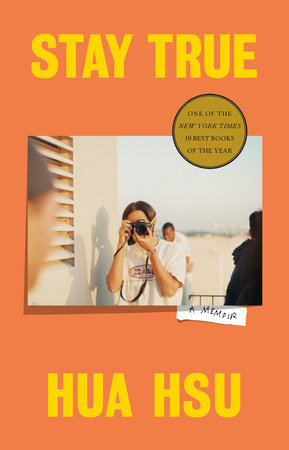
50 years ago, Woodstock, NY, made a name for itself as a charming, vinyl-sided town, home to some of the most brilliant musical and poetic minds of a generation: Hendrix, Bowie, Baldwin—all who sought sparks of inspiration and solitude in its humble beauty. Today, it is the perfect location for a reading of author Hua Hsu’s latest memoir, “Stay True.”
Hsu is a Professor of English at Bard College and a staff writer at The New Yorker. Up until last semester, he was also an Associate Professor of English at Vassar College. Much of his work deals with music culture—everything from chronicles of early hip-hop to reviews of new English synth—but he also writes frequently of his Asian-American identity. His latest endeavor is a deeply personal comingling of the two.
Hsu is the kind of person who shatters your preconceptions of the dull academic curmudgeon. He’s young, rocks Champion sweatshirts, has spiky, haphazard hair, and—in a way that might shock his adolescent self—is probably the coolest guy in the room.
On the drive up to Woodstock, I thought about meeting Hsu for the first time, flipping through the words I would say as we passed stretches of lush forest. How could I prove we were kindred spirits? I wondered what albums had guided him through the perils of freshman year.
After ending up at a series of wrong addresses, I walked into The Golden Notebook, fifteen minutes late. The cafe glowed orange from the autumn sun. An intimate crowd of friends, family, colleagues, and students surrounded Hsu, joined by Professor of English and prolific writer Amitava Kumar. Kumar hosted the reading as an engaging interviewer and fantastic complement to Hsu. The two are also great friends.
“Some friends complete us, while others complicate us. Maybe you feel as if there were nothing better in the world than driving in a car, listening to music with friends, looking for an all-night donut shop,” Hsu writes in “Stay True,” reflecting on his newfound friendship with Ken, a fellow Asian-American student whose wild charisma clashed with Hsu’s self-imposed wall of cynicism. Ken partied with his frat. He loved to swing dance. He wore Abercrombie & Fitch. He had a real earnest, unbridled enthusiasm for the marrow of life, and you got the sense that Hsu was slightly perturbed at how much he truly enjoyed Ken’s company. Their friendship began to blossom over the early years of their college careers, until Ken was killed, senselessly, in a robbery near their campus of University of California, Berkeley.
During the reading, Hsu noted how it took him 20 years to find the voice to tell this story. In the aftermath of Ken’s death, he writes of the obsessive compulsion to grab onto fleeting memories of his friend: the sound of his husky laugh, their string of inside jokes with no identifiable source. “Each of us must protect our memories of him, I said, because it brought a little of him back. It was the only way to bring him with us into the future.” Here, the prose is devastating and precise. Kumar calls it “As clear and simple as the dawn.” For young Hsu, writing became a way of observing not only the new movies Ken would have loved but missed out on, or how the angelic harmonies of “God Only Knows” have since turned sour and bitter, but also his own irrational, imposing thoughts and reconciliations. Had he hurt Ken the last time they spoke? Was there anything he could have done?
There is a moment when the story of Ken’s murder is picked up by a local student magazine, and his life melts into a broader context of rampant Asian-American violence in California. Hsu is confused, almost angry. He doesn’t want Ken to be ripped away from the intimacy of their friendship. He is desperate to hold him close.
Hsu’s engagement with his own Asian-American identity ebbs and flows throughout “Stay True.” At some times, he is canvassing for UC Berkeley’s Asian Student Association; at others, he wonders how he and Ken could be so radically different, despite being dealt the same cards. And yet, there is a universality to the Asian-American experience Hsu writes of with clarity and detail, one rooted in the pursuit of reinvention.
“Maybe this is what it means to live in America. You could move around. You were afforded opportunities unavailable back home. You could refashion yourself as a churchgoer, a pizza lover, an aficionado of classical music or a Bob Dylan.
For Hsu, the experience of first-generation immigrants and matriculating freshmen is one and the same. There is the bright-eyed pursuit of personal reinvention through facets of American culture, the intimidation that comes from stepping into a bustling community with its own rhythm and the fervent, almost desperate, desire to belong. He writes of arriving on the campus of UC Berkeley, eager to prove his coolness by draping himself in vintage polka-dot cardigans and listening to artsy, obscure heavy metal. Just as his father had subscribed very briefly to The New Yorker, before realizing it wasn’t meant for newcomers like him, Hsu finds himself, 20 years later, trying to listen to ska in the hopes of impressing a red-haired girl in his English class.
“Stay True” is a memoir all about in-betweens: bleary-eyed late-night drives to and from 7-Eleven, the awkward misstep from adolescence to adulthood, the distance between being Asian and Asian American. Young Hsu often finds himself caught between a few of these identities—his attempts to reconcile them, often with vulnerability and humor, lie at the heart of his writing.