
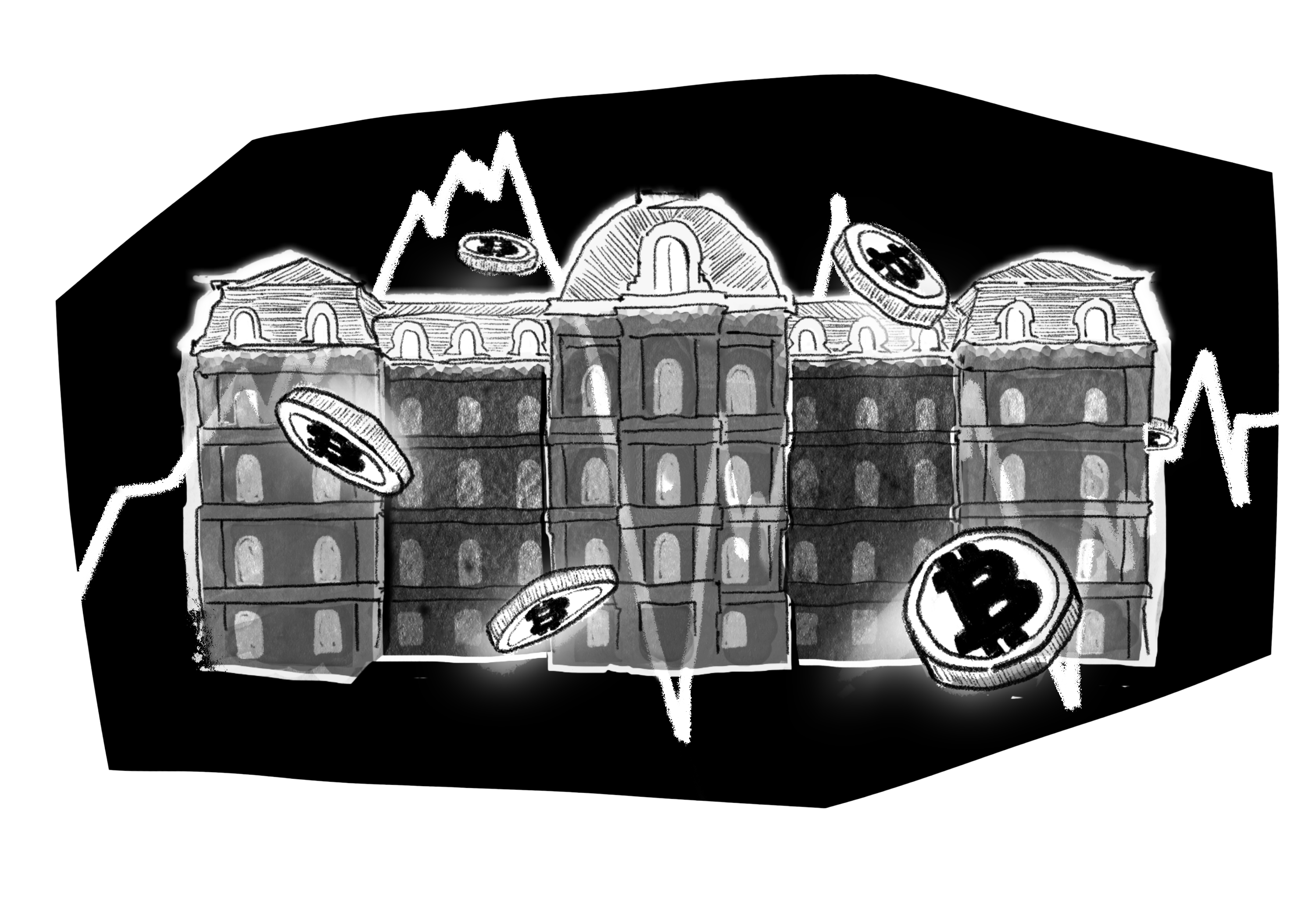
Your college experience is about to get a lot more futuristic. On Monday, Feb. 27, Dean Gus D. Weebuloid—newly-hired chair of Vassar Advanced Payments and Educational Reorientation Services(VAPERS)—announced that Vassar College would be weaving blockchain elements into its educational structure, as well as requiring that all payments to Vassar be sent in cryptocurrency.
“This is gonna be, like, dope, dude,” said Weebuloid, 24 and coincidentally a long-lost nephew of President Elizabeth Bradley. “No, like, seriously, we’re going to the moon with this shizz. I’ve got a bunch of sick ideas for what to do next, and the Board of Directors granted me full executive authority to implement all of them, so, like, hold on to your socks.”
At a chaotic press conference in the Villard Room, Weebuloid enumerated the long list of changes that the College would be making to its educational system beginning in the fall. Among the major shifts that VAPERS will be spearheading is a total transition to distance education. Vassar will be an all-online university, and students will be able to generate NFTs, or non-fungible tokens, through the Learn-to-Earn, Get Internet Thingies (LEGIT) system. However, some students reacted negatively to the proposal.
“I’d say I had no idea what Dean Weebuloid was smoking, but I could smell him from the back of the Villard Room, so I definitely do,” junior Jim E. Jamsworth said. “Why on Earth is this crazy stoner suddenly the king of Vassar? I hate distance learning, and I really don’t get NFTs either. Why should I spend hours in Spanish class just to get a fake Internet image?”
Sources of student concern about the viability of NFTs as a store of value include the current crypto crash as well as the fact that non-fungible tokens are sometimes literally JPGs of stoned-looking monkeys that you can easily just copy and paste. In response, Weebuloid announced two new policies: Vassar will guarantee up to 3.5 percent of the value of each student’s crypto wallet, and all student computers will also be permanently banned from right clicking. However, many students viewed these measures as insufficient.
“I just don’t get it,” first-year Harold Mehta said. “I got a letter from Vassar demanding my next semester’s tuition in Pepecoin, but I just checked Coinbase and it looks like it spiked in value today by 35,499 percent? And now I owe the school almost $25 million? If my parents weren’t rich investment bankers in Park Slope, this would be a real issue for me. Or I guess I could wait until tomorrow, when it will lose all its value again.”
Professors in the Economics Department were especially displeased by the school’s measures.
“I can’t believe that we’re handing over control of our economy to a bunch of Discord moderators who all look like Peter Griffin,” Justine Wing ’83, Junior Professor, said. “And I really can’t believe that people are making billions of dollars doing this. It makes me question the value of everything I’ve spent my life studying and all the life choices that have led to this point—and the whole reason I picked this field over Drama was to avoid that feeling!”
The Miscellany News reached out to the Board of Directors for comment, but received in response only a poorly-photoshopped image of a dancing Pepe the Frog. However, one anonymous Board member could be reached at a public pay phone whose location The Misc pinpointed to a stretch of Route 9 just outside a dark, dank tunnel.
“Look, okay, it’s part of the strategy,” the Board member said, pausing for a long, phlegmy bout of smoker’s cough. “You just have to trust us. Remember when we refused to let you take the COVID courses pass-fail? You know how we’re spending millions of dollars on the donor-stroking Inn and Institute, rather than living wages for student workers? It’s all for a reason. Believe me, Vassar is going to be unrecognizable in a decade—and it’s all going to be absolutely worth it. Just trust the process.”
Meanwhile, some students questioned what was going to be done with the campus buildings if the school is really going 100 percent online. However, at press time, intrepid Misc reporters discovered a file accidentally saved to a public Google Drive named “RaymondLuxuryApartments.pdf.” This may serve as an indication of the future direction of the school, as well as proof that we would all be better off if North America simply sank into the Atlantic Ocean. However, one student seemed unbothered by all the controversy.
“I’m graduating in May, so sayonara, suckers,” Alyssa Willeford ’23, a Misc contributor widely hailed as the Bob Woodward of completely made-up reporting, said. “All these issues are yours now. As for me? I’m going on to bigger things. McDonald’s, here I come!”
Amazing share
As a Vassar alum, I’m both intrigued and skeptical about the college’s shift towards Web 3.0 and crypto. While the idea of integrating blockchain into education sounds promising, the practicality and long-term impact need careful consideration. The announcement has certainly sparked a range of reactions among students and faculty. It’s a reminder that embracing new technologies requires a balance between innovation and addressing concerns. Kudos to Vassar for pushing boundaries, but I hope they ensure that this transition genuinely enhances the educational journey.