

I’ve never been farther West than suburban Houston. You can probably imagine this South Carolinian’s excitement when he managed to get a spot on the Vassar Earth Science Department’s trip to Death Valley and the Mojave Desert.
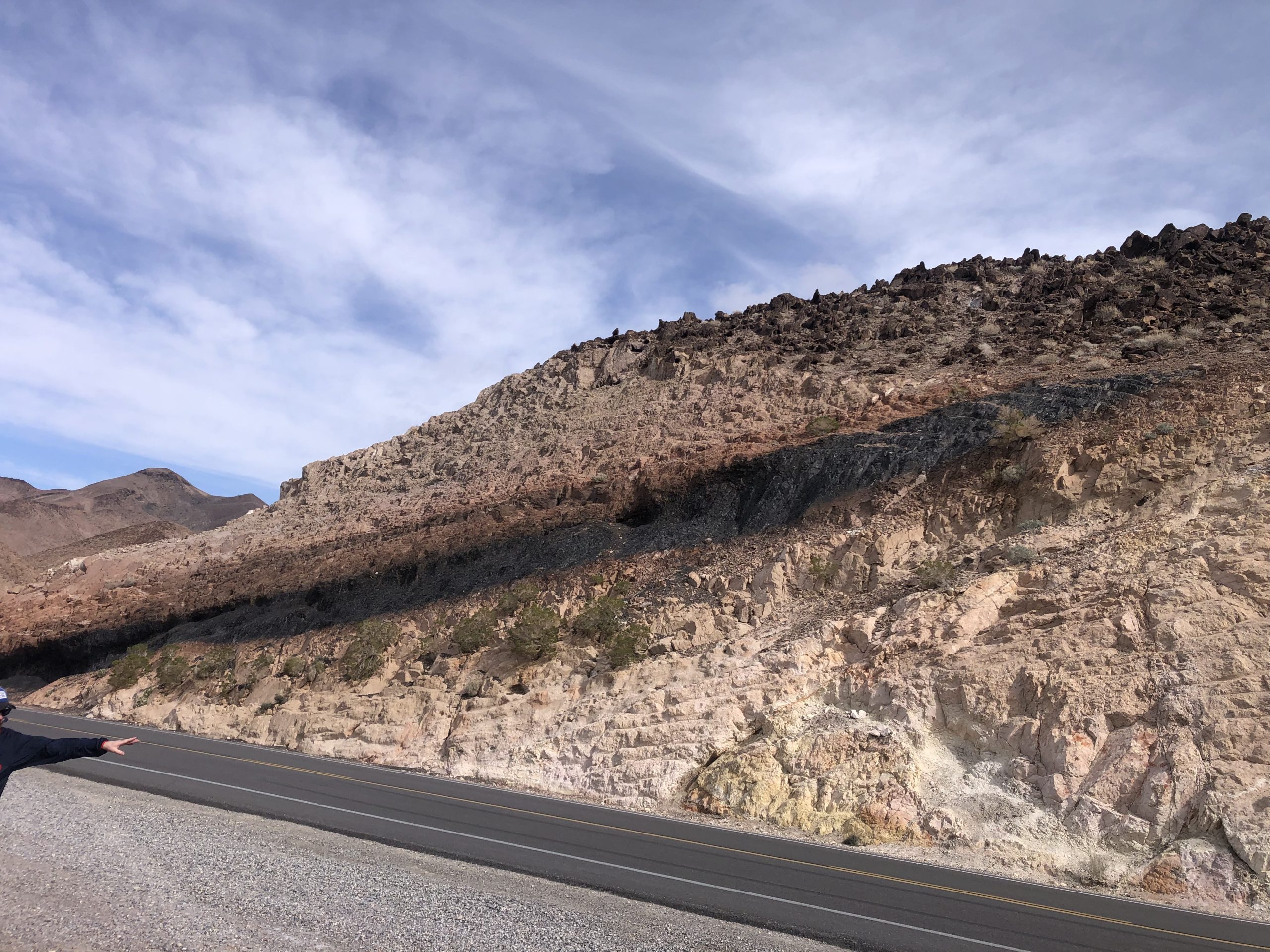
Our group of 16 students and two professors saw a variety of rock features, so I’ll pick my favorites to highlight. Our first stop: the Charlie Brown Outcrop. Named after the Charles Brown Highway directly next to it, The Charlie Brown Outcrop is a beautiful canvas onto which volcanism, metamorphism, faults, tectonic motion and many more geologic forces had a turn with the brush. These forces painted an excellent story of various events over geologic time—from deluges of volcanic ash, fissures in the North American plate, pressure from lava flows, tilting and faulting—all creating a beautiful scar of obsidian and tuff in the mountain side. I am certainly a rock nerd, but you don’t have to be one to recognize it was pretty freaking cool.
Another one of my favorites was the Badwater Salt Flats, famously the lowest point in the United States at 282 feet below sea level. The geologic story behind this wonderful location is all because of tectonic plates, as Visiting Professor of Earth Science and volcanologist John Zayac taught us with his frequent catchphrase: “Let’s talk tectonics!” This chunk of earth got so deep thanks to an upset underneath an unstable portion of the North American tectonic plate. The plate is currently stretching apart in the beginning stages of what eventually (in millions and millions of years) will be a divergent plate boundary, much like the mid-Atlantic ridge. This causes pieces of the ground to rise and fall as the plate fragments, creating faults. The falling pieces make places like Death Valley, and the higher portions make the Panamint Range and Black Mountains on either side of the valley.
The last place that I’ll highlight is Amboy Crater, a dormant volcano in the Mojave Desert that violently erupted about 10,00010,000 years ago. This was a monogenetic eruption—what I like to call a one-and-doner. This means the volcano exhausted the magma chamber that created it and will not erupt again. We got to hike up the volcano and stand in the crater, making observations about what could have happened. We deduced that lava had filled the interior of the crater, causing the wall of the volcano to collapse from pressure and allowing us to hike up into it. The volcano had a beautiful labyrinth in its center, formed from pieces of basalt rubble from the eruption. Also, since it wasn’t a national park, I got to take rocks with me! Why would you buy a plastic gemstone in a gift shop when you can pick up a hunk of vesicular basalt from the very crater of the volcano that produced it?!
While the places we went were awe-inspiring, the community was just as spectacular. We had two vans, lovingly named “Vancano” and “Death Vanley National Park.” I had the privilege of riding in Vancano, driven by Professor and sedimentologist Jill Schneiderman (though when she was driving, we called her Jill Schneidervan). Some of my favorite memories from the trip are “Gimme! Gimme! Gimme! (A Man After Midnight)” or “Voulez-Vous” in Vancano with my classmates. There’s no experience quite like interrupting the chorus of “Mamma Mia” to ogle at a good alluvial fan.
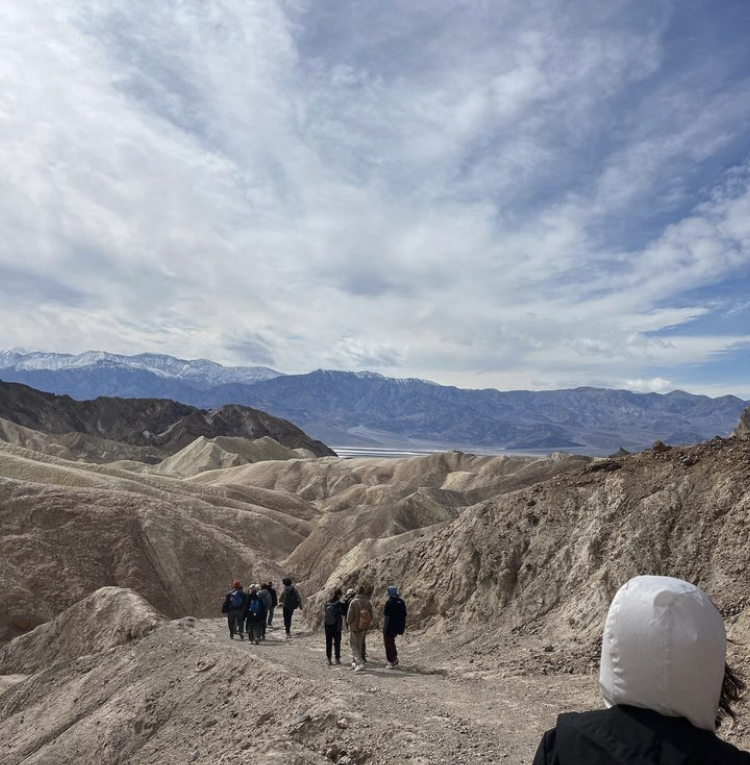
And our community in the vans came together at camp. We were split into three tents of four to five with two people sleeping in the vans. We had a fourth tent, but Murphy’s Law and a wind storm had other plans. Over the course of four nights, we made s’mores by the fire, ate surprisingly good food (Zayac’s plantain and black bean chili is something else) and all became fast friends. People I had previously been entirely unacquainted with have become friends that I now hug on sight around campus. From each gorgeous sunrise to each gorgeous sunset, I felt more at home.
I would be entirely remiss to not mention my extreme gratitude for this experience. I owe my thanks to the Mary Laflin Rockwell Fund and the generosity of the Rockwell family for helping the Earth Science department put on these great trips. As a low-income student, I had no vision of being able to have an experience like this, and it’s thanks to their support that I had such a great time. I hope to go on similar excursions again, reuniting with familiar faces and making friends with the new ones. Who knew that looking at rocks could be just so cool?