
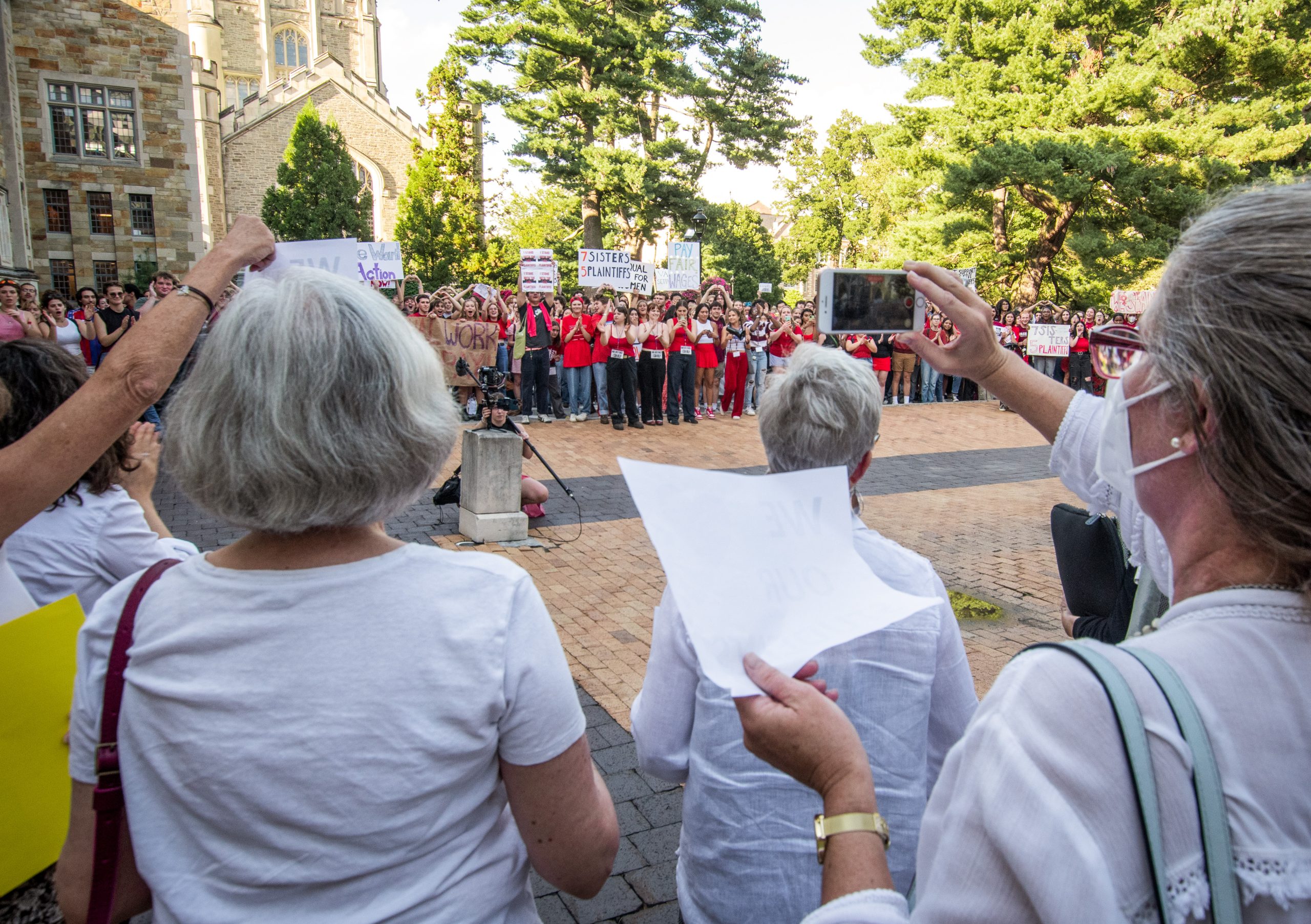
Flocks of students in red shirts flooded Main Drive outside of Taylor Hall last Wednesday, Sept. 13, at the first faculty meeting of the year to show support for the pay inequity litigation against the College. The protest was the first of an ongoing movement started by student-led “HearUsOut” to ensure that awareness of the lawsuit stays in the campus conversation and mainstream media.
“The goal is to put pressure on the school to settle the lawsuit. In their ideal world, they would wait as long as possible while there’s less pressure from the students or the media,” said Tallulah de Saint Phalle ’24, a member of HearUsOut.
The protest started growing around 3 p.m., at the beginning of the first faculty meeting of the year. Not long after, chants of “Equal pay, yesterday,” “Seven Sisters, five plaintiffs” and “Pay people fair wages” rang through the air. Signatories and plaintiffs, dressed in white to show solidarity, held signs reading “We ♡ our students,” taking photos with one another and tearing up at the sight of their students.
Professor of Philosophy Giovanna Boradorri, one of the 36 signatories, attended the faculty meeting. She said of the student protest, “It feels incredible. It feels fundamental to my teaching, to my career and to our career together as women who have been here over 30 years and tried to express our disappointment. Our struggle and the need for justice for 20 years, and we were not heard.” She continued, “To feel the students’ support opens my heart.”
The faculty meeting did not conclude until after 5 p.m., with many students remaining for the event’s entire duration. When faculty exited the building, they were met with loud cheers expressing support. Harriet Simons ’27 commented, “ [I came] to show that we’re here for the professors, that they’re doing something brave for everyone and that we support them.”
According to Solaar KirkDacker ’24, one of the organizers of HearUsOut, said she worked with Gwynne Smith ’24 to organize the student protest. Together, they created a survey to gauge student interest and create an organizing committee. Emails were sent to Vassar organization leaders and over 400 people responded to the survey, with an organizing committee of 15 people.
KirkDacker added, “We spent those five days leading up to the protest thoroughly researching the lawsuit, connecting with attorneys and building our knowledge of the relationship between protest and legal action. A protest pressuring Vassar to settle ultimately seemed like the most effective action students could take.”
The Vassar Student Association (VSA) sent an email to the student body on Monday, Sept. 11, on behalf of the HearUsOut committee, which included information about the faculty meeting protest. The Equity Executive of the VSA Cabinet Traci Francis ’25 served as the VSA point of contact for HearUsOut and said of the event, “I think we collectively agreed that the VSA doesn’t always need to run or be the face of everything on campus. Our role was important but more quiet as we became a resource and provided any support that the organizers needed.”
President of the College Elizabeth Bradley disclosed Wednesday’s meeting agenda, saying in a written statement to The Miscellany News, “There were president remarks, faculty remarks, the consent agenda from CCP, a report from the Dean of Faculty Search Committee about learnings from their listening sessions, a report from the Faculty Policy and Conference Committee on merit reviews and compensation, a report from Admission on the Class of 2027 and the Supreme Court decision, a report on Google storage, and announcements about Community Works and QPR training.”
HearUsOut reached out to The New York Times, who attended the protest on Wednesday, publishing a story on Vassar’s activism in the early morning of Monday, Sept. 18. The article referenced a communication Bradley had with the publication: “Last week, Ms. Bradley said in a statement to The New York Times that Vassar had agreed to allow a faculty committee to hire an independent compensation-analysis firm to examine salaries, and would act on the findings.” Bradley confirmed there are no updates on the lawsuit at time of publication.
KirkDacker and Smith are looking to maintain their momentum, bringing the protest to Vassar admission tours. KirkDacker said, “We are hoping to continue gaining traction and raising awareness about the case. We want to provide accurate information to prospective students about salary inequities.” She continued, “Many students feel this wage disparity as a personal betrayal, too, as Vassar capitalizes off of ideas of ‘gender equity’ and ‘uplifting women in academia’ only to fall short of these claims in their treatment of female professors. Prospective students deserve to know the hypocrisy behind these claims before making their decisions about applying/enrollment.”
Coleman Hunter ’27 shared, “As a [first-year], it’s definitely a little jarring to have this introduction, especially because of my impressions of Vassar and one of the reasons I wanted to attend here was because of the ideas and qualities it was promoting. To find out so early on that isn’t necessarily the case, it only feels right to be here and to support the plaintiffs and to stand up for what I personally believe are the traditions and values that Vassar stands for.”
When asked about the protest, Bradley commented, “We are delighted that the protest was peaceful and did not disrupt the faculty meeting or other college functions. We are glad the students are engaged in important campus issues.”
KirkDacker expressed pride for her College’s activism, saying, “It was wonderful to see how many students felt so passionately about this issue. I hope professors felt the widespread support for their cause and anger towards this injustice.” She added, “It was one of the few times that all professors and administrators would be together. We wanted to initiate the year by showing our steadfast support.”
Having said that, I am sensitive to the amount of tuition we pay at Vassar and other elite schools. I am also sensitive to the atrocious irony of this lawsuit happening at a Seven Sisters campus. These salary increases will cost a lot, but nothing to what they will cost if we don’t pay them.
Congratulations Sarah
For writing such a fantastic article on the contracts that women have in the US. You have genuinely shown how women could move ahead in the country.
– We need to eliminate all men from Vassar boards which have been unfair to women, gays, Trans and LGBT teachers;
– Our female teachers did not know about the disparaging professional environment before they accepted the position and are now victimized to teach at Vassar.
– Some of the productivity differences for women concern the real costs of handing off clients, patients, customers, and so on to the next worker on the shift or to a worker who is covering for the originally scheduled worker who, perhaps, had to take time off during the regular day.
– The male expectations that women demonstrate equal competency on the job are victimizing women from day one on the job; it leaves out our psychological and physical limits, caregiving, hormonal changes and child bearing.
Vassar Alum
Lora
It’s a shame how Vassar treats its employees. The truth should also come out about the way employees with disabilities are treated and discriminated against on campus!