
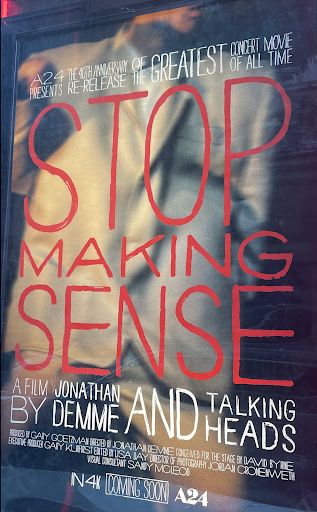
Aching and couch-ridden from a double COVID/flu immunization, I pondered my options for a Wednesday afternoon over break. I could wallow in my misery and drift back to sleep—this seemed to be the obvious choice. Alternatively, I could immerse myself in the bombastic music of the rock band Talking Heads by watching Jonathan Demme’s classic concert film “Stop Making Sense.” My original viewing of this movie years ago led me down a New Wave rabbit hole I have never returned from, and my sickness was making me a little nostalgic. Fortified by ginger ale and broth, a seven-day free Filmbox trial I still need to cancel and ambitions to induce good health through the vivifying music of Talking Heads, I dove headfirst into Demme’s intoxicating cinematic experience.
“Stop Making Sense” has been hailed by Variety as one of the quintessential concert movies, and rightly so. The touchstone film is one of my favorites simply because it demonstrates the joyous connection between music and movement. Talking Heads’ live performance was shot in December 1983 over the course of three nights at Hollywood’s Pantages Theatre. “Stop Making Sense” is now getting a second lap in movie theaters as part of a restoration and re-release by A24 Studios. But why does the world need a new release of a 40-year-old movie featuring a band that broke up decades ago? The answer lies in how the film neatly solves the question that plagues most concert movies—how do you share the experience of music meant to make you dance with a seated movie theater audience? In a virtuosic movement, Demme, best known for the 1991 classic “Silence of the Lambs,” answers by punctuating Talking Heads’ breathless musical performance with kinetic camerawork and subtle storytelling.
The film’s ability to immerse the viewer in the band’s sound and motion is established in the opening shot, where Talking Heads lead singer David Byrne comes onto the stage alone and sets down a boombox, which plays the infectious background of the band’s early hit “Psycho Killer.” Byrne plays acoustic guitar and sings over the minimal beat. This sparse opening is made captivating by the camera’s focus on details—a close-up of Byrne’s tapping foot, then a pan upwards to capture his body’s idiosyncratic, loose-limbed, electric movement as he plays. Demme uses long takes that let the viewer focus on Byrne and his introverted yet frantic energy. Then, bassist Tina Weymouth joins Byrne for a duet on the subdued but beautiful “Heaven,” followed by the entry of drummer Chris Frantz for the snappy “Thank You For Sending Me an Angel.” Finally, guitarist Jerry Harrison joins the band for “Found a Job.” As band members enter the stage for each song, the stage grips amusingly place risers behind the group to accommodate the increased number of players. Is the “assembly” of the group a metaphor for building a band’s aesthetic? “Stop Making Sense” establishes a patient focus on the details of the performance and a feeling of narrative momentum that mirrors the arc of the performance itself, drawing the viewer into the experience.
After the gradual building of the stage, the movie (and the concert) kicks into high gear. The band is augmented by even more guitarists, keyboardists (including P-Funk legend Bernie Worrell) and backup singers. The previously low-fidelity vibe becomes a musical bacchanal as the expanded band runs through the densely-layered songs Talking Heads developed on the albums “Remain In Light” (1980) and “Speaking in Tongues” (1983). The songs are always full of movement, mirrored by Demme’s direction—a kaleidoscope eruption of light, sound and dance as the musicians react to the music individually and collectively. Each player’s movement is framed within dramatic lighting, reaching a fever pitch by “What A Day That Was,” where only harsh floodlights illuminate the performers, overexposing individual faces floating through a dark stage. By the time Byrne comes out in his iconic oversized suit on “Girlfriend Is Better” (the song the film’s title is derived from), the film has overwhelmed and amazed with its rich array of sensory inputs.
Byrne’s performance rides on top of this wave of sight and sound. Talking Heads and their accompanying instrumentalists are undoubtedly exceptional, especially the economy and lyricism of Weymouth’s bass playing, but Byrne is always the star. Even outside Demme’s directorial gaze, viewers cannot pry their eyes off him. We see Byrne in an astonishing variety of expressions and poses—sometimes exaggerating his facial expressions to the music, contorting his body to emphasize the emotions and structure of the song, or playfully diving into antics that are funny and full of strange pathos. Byrne is a paradox: awkward yet electrifying, at the center of the music yet aloof and cerebral and possessing a restless energy that sets the tone for the movie.
“Stop Making Sense” begs endless analysis beyond even the scope of this article. It dispenses with trope band interviews, audience shots and narrators (yes, talking heads!) which often underpin concert films. The magic of this movie, and the key to its pop cultural legend, is the constant attention it pays to movement. Demme allows the camera to organize all forms of motion, both obvious and subtle, within the making of a concert. The choreography of the stage setting, the motion of musicians in performance and the visual interactions of dancing performers on stage all stand in as visual reminders of the incessant frenetic energies inherent to the music world, especially that of Talking Heads. Demme and Talking Heads have created a definitive concert film by inviting the movie audience to the theater to join the party. Now that “Stop Making Sense” is back in movie theaters, you are invited to the party, too.
Nicely done review. Enjoyed reading it.