
[The weekly newsletter mistakenly indicated that this article was written by Jesse Koblin. The author is Madeleine Nicks.]
When thinking about the great monuments, paintings and cathedrals of medieval art, it is oftentimes difficult to think of the humanity that lies behind these masterpieces or how they connect to modern times. Notre-Dame de Paris, one of the preeminent medieval cathedrals in France, is no exception. It has been a longstanding symbol of this period in art and architecture, paving the way to defining the forms and elements that would become synonymous with the Gothic style. In 2019, when a devastating fire broke out in the cathedral and caused immense damage, collapsing a section of the wooden roof and entirely destroying the spire, Notre-Dame took on an entirely new meaning and mission. The fire triggered an intense emotional response from people all around the world; the efforts to restore Notre-Dame have therefore become deeply human ones.
On Oct. 25, the Vassar community had a special opportunity to hear from the very people carrying this responsibility on their backs: chief architects Philipe Villeneuve and Pascal Prunet. Villeneuve was already the chief architect of Notre-Dame before the fire, working on needed restorations and ensuring the continuous longevity of the structure. Prunet was asked to come on board in 2019, leading the rehabilitation of the stone and paint destroyed in the fire.
Villeneuve and Prunet spoke at the College through the Claflin Lecture Series, a longstanding educational program through the Art History Department in honor of the late Professor of Art Andrew Tallon. Tallon’s groundbreaking work helped establish the use of laser technology and imaging techniques, providing architects with a digital model of Notre-Dame and its many imperfections.Villeneuve and Prunet’s immediate concern was supporting the structural integrity of the building, mainly the areas adjacent to where the fire occurred. This meant creating unique bracing for each arch, vault and flying buttress that could have been affected. As none of these measurements are the same, Tallon’s work was essential in securing the remaining parts of Notre-Dame with speed and accuracy. Having the precise data of Tallon’s digital scans of Notre-Dame allowed the architects to quickly and accurately build supports for the remaining structures of the building. This construction was titled the “Safety Phase,” and allowed for Villeunuve and Prunet to focus on reconstructing what the fire had destroyed without being worried about a ripple effect to the rest of the cathedral.
The appreciation and respect that Villeneuve and Prunet have for Tallon was clear, as their lecture and efforts in traveling all the way to our campus was in honor of him and his career, giving Tallon’s family, friends, colleagues, and students a window into the legacy of his work.
Villeneuve began the presentation by carefully working through a detailed description of the damage the fire caused. The audience often responded in gasps and exclamations to the sheer amount of devastation, as access to comprehensive imagery of the fire is difficult to find.
Villeneuve emphasized just how difficult it was to remove the rubble from the cathedral, as it was too dangerous to have people working inside the space. To ensure safety, the architects used a combination of cranes and workers suspended from aerial platforms or ropes to clean the scraps in an almost archeological way, taking stock layer by layer of the remains of the fire. After the rubble was removed, it was essential to dismantle the large amount of melted metal that had been encasing the spire. It hardened after the fire was extinguished, and posed the largest threat to the cathedral. After it was taken out, work could begin on the interior.
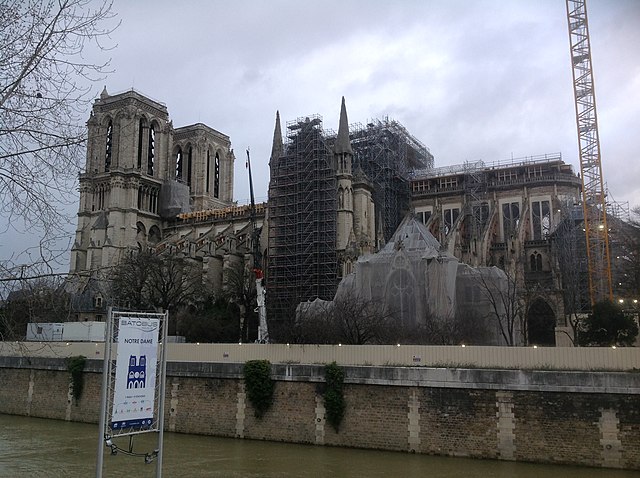
After building a roof covering to ensure there would not be any additional water damage, Villeneuve began installing an incomprehensible amount of scaffolding throughout the cathedral’s interior. Almost every step of this process was incredibly hazardous, as the tension of the scaffolding was a constant concern within the historic cathedral; the effects of that amount of tension and magnitude were entirely unpredictable.
Villeneuve then transitioned his presentation to discussing the spire: a wooden, conical structure that forms the highest point of Notre-Dame. After the destruction sustained by the cathedral during the French Revolution, the spire was rebuilt by Eugène Viollet-le-Duc in the 1850s. This is the main inspiration for Villeneuve’s own restoration project, newly constructing it from the base up. He is reconfiguring the original four-column support that characterizes Viollet-le-Duc’s spire in order to ensure its ongoing fortitude.
The presentation then turned to Prunet’s work on the re-pollution of stone and paint in the building’s interior. After removing the remains of the former paint that was added during Viollet-le-Duc’s time, fixing grout issues and repairing stone decay, Prunet and his team turned their attention to restoring the color of the stones and original paint. Through arduous trial and error, testing different chemical treatments and stain applications, Prunet and Villeneuve achieved a perfect color match to the original stone, creating a seamless transition from the surviving and rebuilt roof. While both men were incredibly humble regarding their immense accomplishments, they did admit to taking specific pride in the fact that the extensive repair would be completely untraceable by any visitors.
Over the next few years, Villeneuve, Prunet and their team of architects, art historians and skilled workers will labor to restore the cathedral to its original glory, slowly but surely dismantling the scaffolding. They noted that they worked especially quickly to unveil one section of the vaults to the world for Christmas of 2022, wanting to see the fruits of their labor and share it with the world in time for the holiday season.
Even while grieving the immense catastrophe of the fire and working diligently to restore the cathedral to its original glory, Villeneuve and Prunet maintained that their relationship with the building does not change. Villeneuve emphasized that, if upon entering the cathedral you do not feel absolutely miniscule in relation, then you have no business being there. This sentiment informs how they both interact with the space: maintaining a large degree of respect while believing that their individual selves have no place in the greater legacy of Notre-Dame.
And yet, there is nobody else who has ever been able to have such a hand in creating a new chapter for this historic monument. Villeneuve and Prunet, though, hold steadfastly to the principle of restoration rather than reinvention. The triumph of Notre-Dame reopening will not be if an infinity pool or greenhouse replaces the roof, but if generations to come experience the same feeling that generations before have. Notre-Dame is a deeply religious space, a home for creativity and soul-searching, and a symbol of many different times in art and history. The cathedral now holds the Gothic style of the 14th century, the travesty and following reconstruction of the French Revolution, and the catastrophic fire and full restoration of our modern time. We are lucky to witness this revitalization, one which reinvigorates our love for this historic monument. And while Notre-Dame will not have changed, the repairs and refreshed aesthetics will bring visitors closer to the way the cathedral was meant to have looked upon its first construction.
This lecture emphasized that even something as huge and magnificent as Notre-Dame is, at its core, driven by people—people who are working tirelessly to continue the thread of history while using our modern tools, minds and advancements to do it.
Villeneuve and Prunet’s commitment to restoring and maintaining the building that they love overpowers the laborious work. It proves that the art is truly sometimes bigger than the artist, or in this case, the cathedral bigger than the architects. And while millions of people will be able to enjoy Notre-Dame for centuries to come without ever knowing about the exact color-matching of the stones or the names Villeneuve and Prunet, they will still be able to feel minuscule in the best way and appreciate this ever-lasting symbol of Gothic architecture.