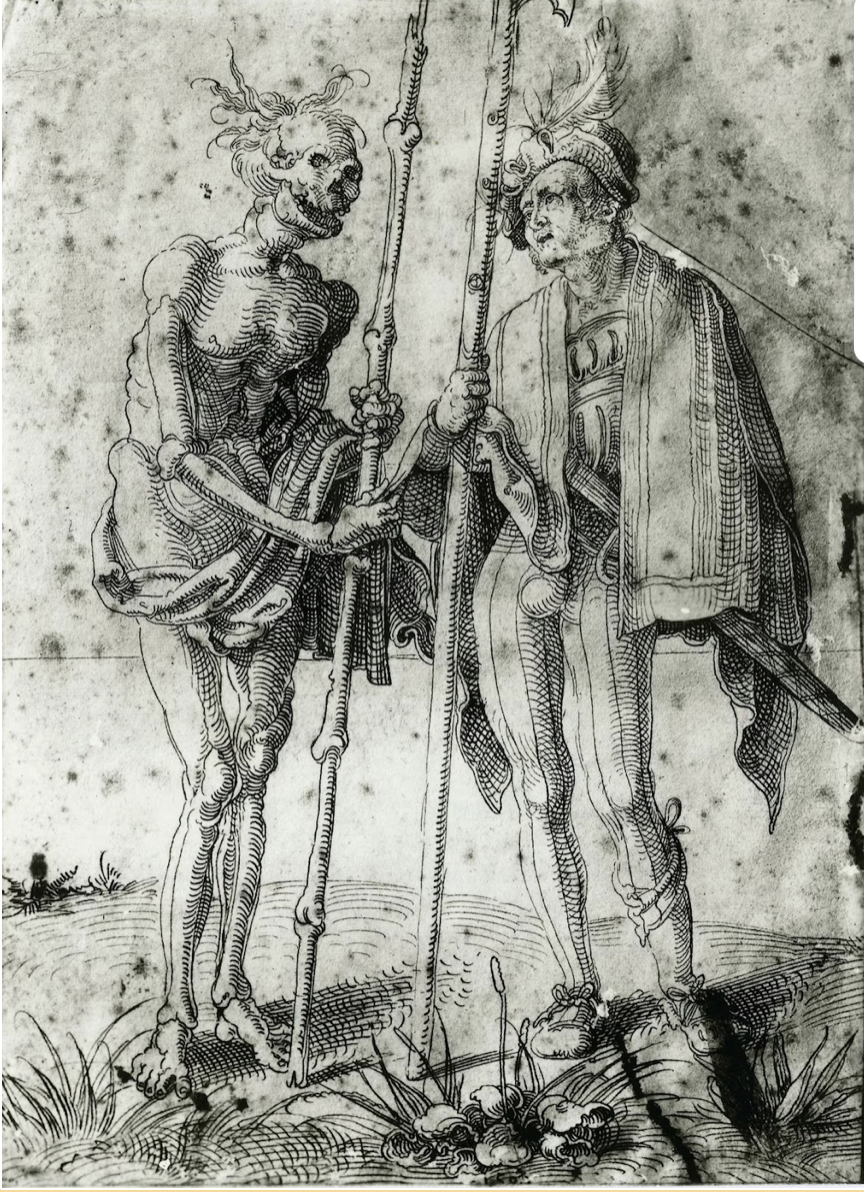
Around this time of year, I often return to an anthology of stories about the undead—“The Penguin Book of the Undead: Fifteen Hundred Years of Supernatural Encounters”—primarily because I find horror stories, especially ancient and medieval ones, to be quite funny. Sure, the myriad of similarities between modern horror stories and ancient ones can feel uncanny, but the differences—that is, the sheer distance we have from the disposition of ancient and medieval peoples—can make these morbid horror stories feel quite madcap, even mildly charming. This is not to rag on ancient and medieval storytellers for being dupey. After all, they would most likely find many modern horror tropes to be absurd. Simply, people from antiquity were scared by different things than medieval peoples, who were scared by different things than we are frightened of now. This historical distance makes reading these stories quite a treat.
The Penguin anthology is organized partially by time period and partially by theme. Within each theme and while moving between time periods, changing temperaments in regard to horror are reflected, and disagreements over the nature of undead things are displayed via the sequential arrangement of texts that argue against each other. In addition to the historical distance the modern reader will surely feel, the anthology sheds light on the difference in beliefs that existed within given time periods and places. These differing beliefs are explained (or left questioned but unanswered) with topics spread across the socio-historical milieu. Sometimes, religion determines differing beliefs on the undead, explored keenly in the section “The Reformation of the Wraiths,” which reckons with the effect of the Protestant Reformation on horror stories. At other times, geographical location is shown to be a determining factor. “Northern Horrors” shows how persistent fear of wilderness, dense woods and the possibility of losing one’s livestock overnight contributed to stories about grotesque beasts and wandering feeders. Debates over the doctrine of new faiths also spills into the realm of the undead, as is found in “The Autopsy of Souls in Late Ancient Thought,” which pits early Christian theologians against one another.
Despite the well-thought-out organization and selection of the content for this anthology, the editors are not trying to tell a single story about the progression of beliefs regarding the undead. There is plenty of storytelling in the anthology, given the fact that stories about the supernatural must necessarily take on a heavy storytelling disposition because their content must be made believable if the teller aims to scare. Medieval writers were keenly aware of their own role as storytellers and could not stop reminding readers of their own position as someone retelling a story. The narrator’s “I” butts in constantly, and they very often dramatically set the tone in a manner reminiscent of the “spooky voice,” adopted by people orating scary stories at night. Additionally, at the beginning of most stories told by medieval authors, the narrator begins by informing the reader where they learned of the story they are about to tell. The origins of these tales often feel a bit dubious; they seem to have been passed along a lengthy chain of previous storytellers. For example, William of Newburgh records the story “Rampaging Revenants” in his book “The History of English Affairs” (1066-1198) after hearing it from his friends who lived in Bukingham who in turn heard it from the local archdeacon. He collected many scary stories from locals in the north of England and believed that Satan himself was animating corpses to rampage through England. His stories follow a very systematic narrative structure. First, townsfolk complain about weird noises at night, which get more and more diabolical. Then, the townsfolk go into the graveyard, remove corpses and hack them to bits, burn them, crush them with boulders, cover them in acid, dismember heads and genitals and scatter the parts. Medieval townsfolk must have really valued their sleep. I feel some sympathy for the animated corpses who often did nothing more than get rowdy at night.
It is interesting to see various historical medical theories at work in these stories. For example, William of Newburgh recounts a story in which villagers fear that an evil spirit who always arises at night with a “pack of loudly barking dogs” is filling the air with a sickening odor. The villagers round up “ten young men renowned for their boldness” who dig up the grave of a recently deceased man, chop up the corpse limb by limb, place the head between the legs and then burn it. Then, “tranquility seemed to be restored to [the village], but then a disease, which originated as a result of the monster, killed a large number of the villagers.” The villagers who told this story to William must have believed in the miasma theory of disease, which held that diseases are spread by foul air—in this case fouled by the stench of the evil spirit’s odor.
Various theories on the existence or nonexistence of ghosts are also played off each other in the Penguin anthology. Bishop Evodius (fifth century) believed that dreams proved the existence of ghosts who “communicated to the living in dreams.” While this feels like a poor argument, his treatise asks some highly provocative questions about the nature of souls. His writings are a great reflection of his community in modern-day Tunisia; he comments on how varying beliefs on the nature of souls can help people cope with the loss of loved ones. Less than trying to prove a singular theory on ghosts, he seems more interested in exploring how different beliefs are determined by people’s life circumstances.
Saint Augustine, one of the most important theologians in the history of Christianity, wrote extensively on ghosts, though he rejected their existence. He believed that souls could not return to the world after death and challenged the long standing belief that souls would benefit if their corpses were buried in proximity to the holy bodies of saints. Compared to the corpse-obsessed peoples of England that William of Newburgh wrote about, Augustine was fairly unconcerned with corpses and even burial.
I have only just begun to unearth the treasures this anthology contains and will not spoil anything for the interested reader. For scores of other spooky stories, treatises on ghosts and underworld ecologies, I highly recommend “The Penguin Book of the Undead.”