
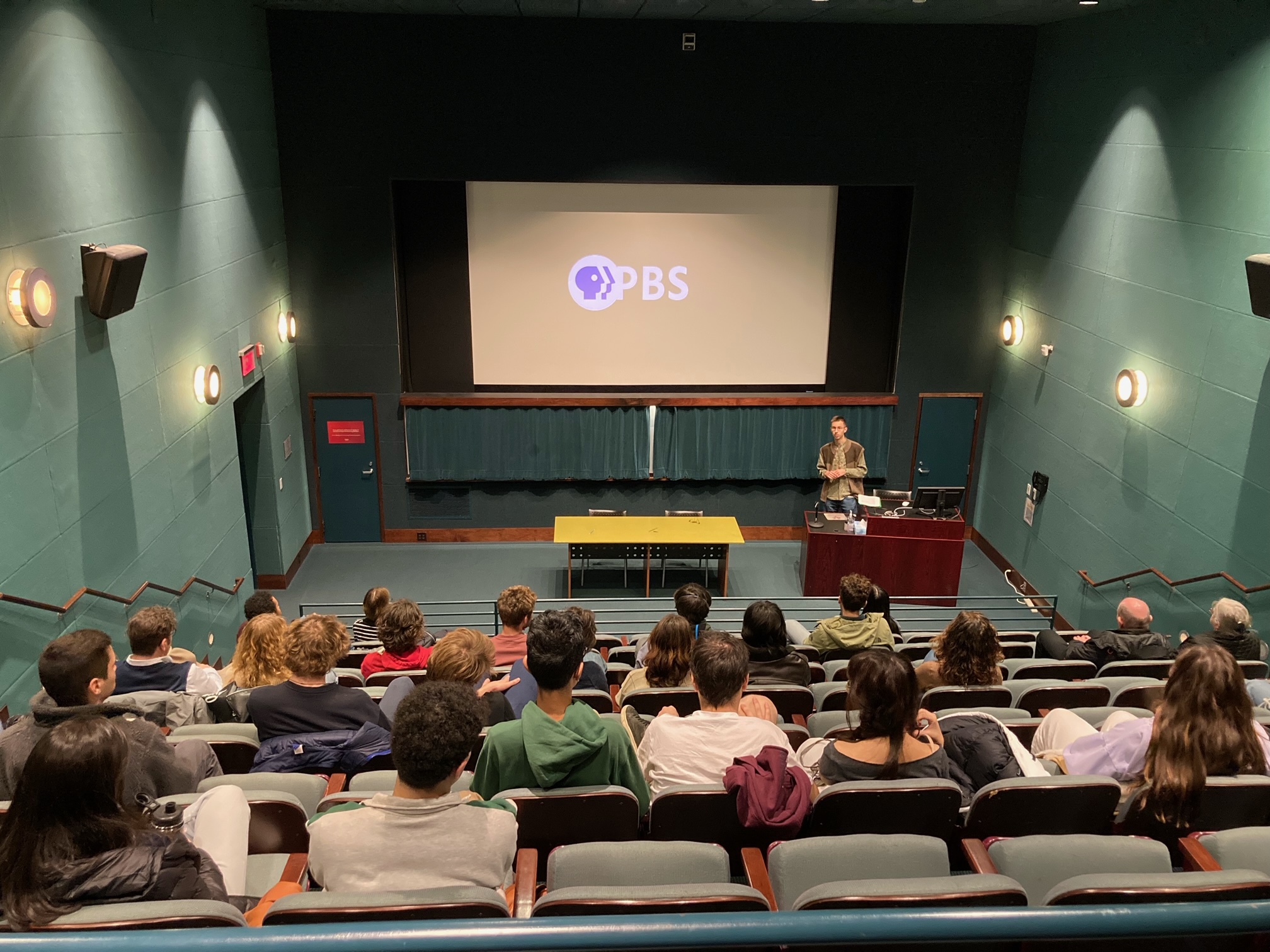
On Nov. 1, members of the Vassar community gathered in the Rosenwald Theater to watch a screening of “20 Days in Mariupol,” a documentary directed by Pulitzer Prize winning photojournalist Mstyslav Chernov. At the beginning of the evening, Igor Martiniouk ’24 [Disclaimer: Martiniouk is Photo Editor for The Miscellany News], who is well-known within the Vassar community for his activism regarding Russia’s invasion of Ukraine, stood at the front of the theater to introduce the film. After a brief introduction, Martiniouk closed by reflexively saying, “Enjoy the film,” but then abruptly stopped. “Just watch, I guess,” he corrected himself, slowly. An hour and a half later, everyone in the audience would understand his hesitation.
“20 Days in Mariupol” documents the Russian invasion of Ukraine during the first weeks of the full scale war. The film opens with a shot that the journalists took from the seventh floor of a building, hiding behind curtains from Russian snipers and tanks. As we take in the smoking ruins of the city of Mariupol, a Russian tank starts to slowly pan its gun towards the journalists. They race to the back of the building, but there is nowhere to hide from the Russians. Throughout the film, everyone in Mariupol is under constant threat, even if they are in hiding; a later scene shows civilians taping the glass in a gym (which served as a shelter) in case they were shelled, so that the glass fragments would not fly at them.
A prevailing point of focus of “20 Days in Mariupol” is the documentation of civilian casualties resulting from the Russian offensive. This footage was intentionally difficult to watch. For a portion of the 20 days, the journalists spent time in two different hospitals, where an unending stream of civilians were rushed in with various injuries caused by shrapnel. For instance, a 16-year-old boy named Illya was playing soccer when Russian shrapnel blew both of his legs off. He died soon after in the hospital from his injuries. Watching Illya’s father cry over the body of his son was excruciating. Babies, too, were gravely injured—one harrowing scene showed doctors performing CPR on Kyrill, only eighteen months old. We could see the tears streaming down their faces as the baby succumbed to his injuries.
I spoke with Martiniouk after the film to make better sense of this footage. Martiniouk referred to a video of a pregnant woman who was killed with her baby when the Russians bombed a maternity ward. I remember this image being circulated at the beginning of the war in 2022—it won World Press Photo of the Year in 2023. “How did the Russians respond to this attack?” Martiniouk said. “They claimed that the pregnant mothers were paid actors, and that they hit a military base.” Anytime one thought things could not possibly get worse in the film, a new horror would be shown to the viewer. After the bombing of the maternity ward, they cut to a clip of a Russian representative at the U.N., Vasily Nebenzya, telling reporters that the footage was fake. It was infuriating, to say the least.
The film also carried a distinct sense of resilience on the part of the Ukrainians, from the doctors to the soldiers to the civilians huddled in cold basements lit only by nearly-dead phone flashlights. “You see doctors continuing to help patients as Russians close in and wreak havoc,” Martiniouk says. “There are many instances where they cannot save the lives of civilians, and that is not an easy thing to psychologically deal with. They continue to treat injured civilians with a low supply of things like analgesics and antibiotics.” I am reminded of a scene in which a man is walking down the street with his life’s belongings hauled in a wheelbarrow. His home has just been shelled. The journalists inquire about how long he has been walking, and he responds that he has been slowly progressing through the city for four hours. He has nowhere to go, nowhere to hide, but he just keeps walking.
At the close of our conversation, I asked Martiniouk what his message was to the Vassar community, especially those who were not present for this heartbreaking film. “We should not brush the war in Ukraine aside,” he said somberly. “Ukrainians want peace more than anyone else involved in this war, but we need a lasting peace. So we need to win. Liberate occupied territory and Ukrainians held in captivity. Defeat the Russians and hold them accountable for their crimes.”
The film does not show a defeat of the Russians, but rather the beginning of a harrowing conflict that has destroyed the lives of countless Ukrainians over the last year and a half. But what it does with quiet fervor is hold Russia accountable. There was not a dry eye in the theater when we quietly exited into the peaceful night, where Poughkeepsie felt like the safest place in the world in contrast to the ruins of Mariupol, the sounds of shelling still ringing in our ears.