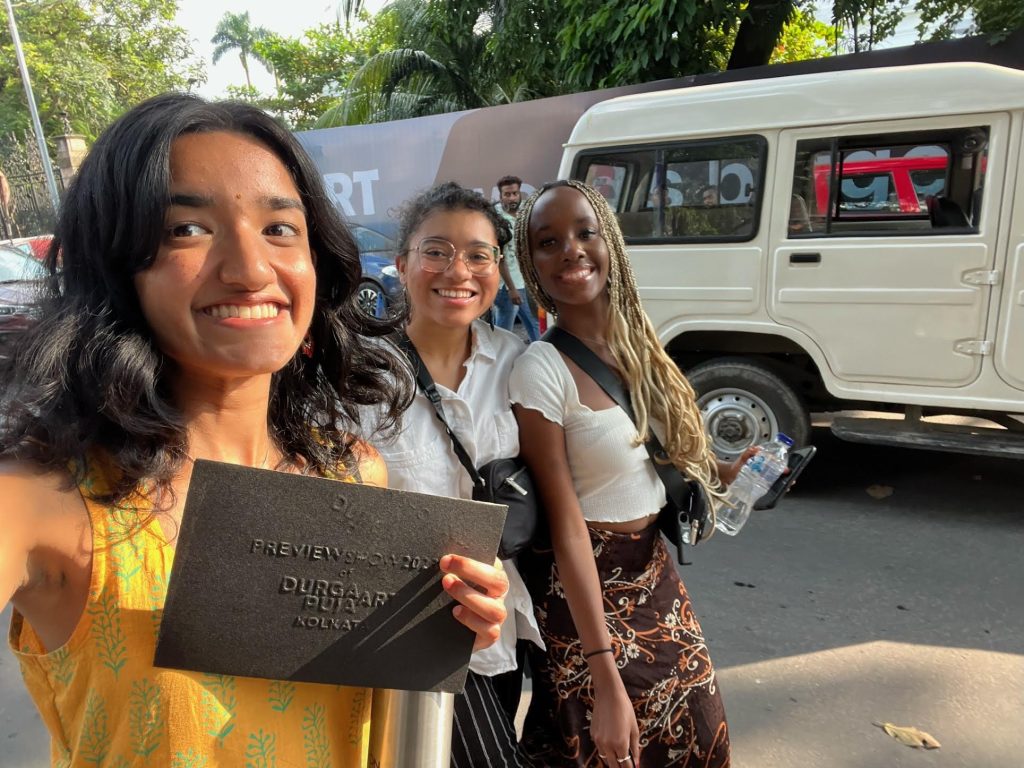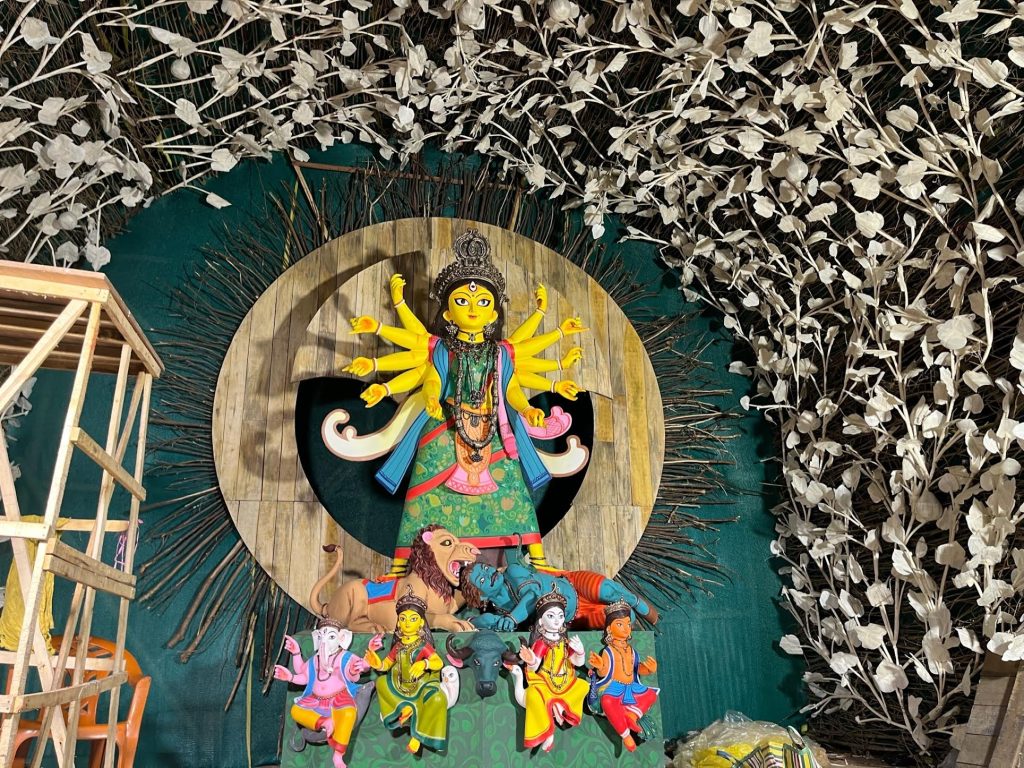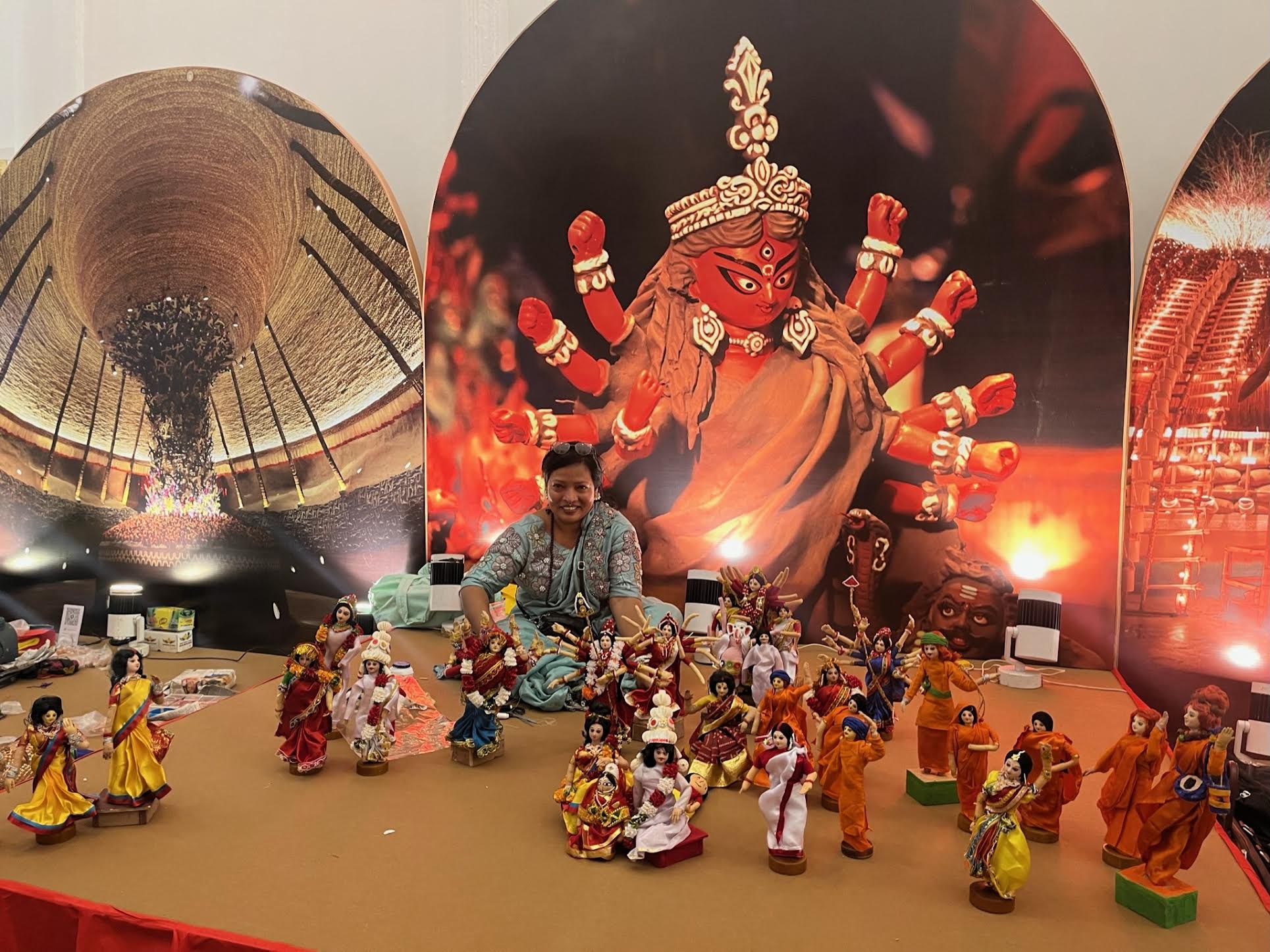
Over October Break, three students—Lavanya Manickam ’25, Bianca Niyonzima ’27, and Zerah Ruiz ’25—and two professors—Professor Himadeep Muppidi and Professor Candice Lowe Swift—traveled to Kolkata, India with Vassar Club of South Asia (VCSA). They were able to experience Durga Puja, a widely celebrated Hindu festival where artists and communities put together pandals, temporarily decorated shrines in honor of the Hindu goddess Durga. Growing up in India, I experienced the electric environment of Durga Puja and the various ways it is celebrated throughout the country, all while incorporating artistic expression as an intrinsic part of the festival. I was curious to interact with fellow students and understand how their unique perspectives informed their time in Kolkata and the various pandals they visited. After multiple frantic emails and venturing through every common space in a crowded Davison House, I interviewed Manickam, Niyonzima and Ruiz to discuss their travels.
The days leading up to the trip were chaotic. Each student had come across the opportunity in distinct ways. This semester, Manickam is a student in Professor Muppidi’s POLI 262: “India, China and the State of Post-coloniality” class, where he shared the application via Moodle. Ruiz has a friend in the same class who told her about the trip, so she asked Professor Muppidi if she could apply and was permitted to do so. Niyonzima, on the other hand, explained, “The opportunity kind of just fell into my lap. I was just looking for work-study jobs.” She ended up landing one as a research assistant for Professor Candice Lowe Swift, who was going on the trip. “I did not assume that I was going to come with her… She said ‘Let’s try and see if we can get you some funding to go to India,’ and I was like ‘I would love to!’”
After gaining approval for the trip, the students began sending emails to procure travel and accommodation funding. Manickam shared that various parts of the Vassar community played a role in this process. “Vassar Club of South Asia, which were alumnae/i in South Asia, funded a lot of it. And we also applied to EPI [Engaged Pluralism Initiative], which gave us money. We also got the Academic Enrichment Fund from the Dean of Studies. And I think the Center for Career Education, the Office of Religious and Spiritual Life [and Contemplative Practices], and also the department of International Studies contributed,” Manickam said. With all the logistics figured out and plans confirmed, Manickam, Ruiz and Niyonzima flew out to celebrate Durga Puja with the rest of Kolkata.
Once they landed, they were immediately immersed in the festival and able to visit many pandals. The diversity in the pandals stuck out to them, especially Ruiz, who was fascinated with the various depictions of the goddess Durga. “There were pandals where Durga was the center, and also, the ones that were made by Mass Art had themes of epic foods. And then there is one that was about the destruction of historical art sites. There were so many beautiful yet tragic things [depicted in the pandals].” Manickam agreed and added that the intricate details of each pandal amazed her. She reflected on a pandal that touched her which honored Bangladeshi immigrants in the community. “Apparently, when you migrate, you take a little bit of clay from the earth where you are from with you, so [the artist] used the clay from the migrants in the artwork itself. We think America is so great, but look at what these small communities are doing on their own. It was the most genuine community engagement.”
Another interesting aspect of this trip was the chance to interact with the international Vassar community. Many alumnae/i in South Asia and India were also present for the program and spent a lot of time with the three current students. Niyonzima, being the youngest on the trip, said, “I was talking to all these grownups and just being able to find camaraderie and friendship with them based on the fact that…they used to go to the school I went to.” She went on to say that her favorite part was hearing about what Vassar was like in the past and comparing it to her current experience. Ruiz added that she appreciated the warmth of the alumnae/i who were native to Kolkata and their promise that as a Brewer, she would always have a home in Kolkata.
Coming home from the trip and still processing the rich culture and art they had crammed into an intensive four days, I asked about how this trip served them, and in turn, our community as a whole. Manickam expressed an interest in bringing students and scholars she met to Poughkeepsie, increasing the number of global perspectives on campus. Niyonzima and Ruiz emphasized the importance of Vassar facilitating more of these international trips and the unique role it has in broadening students’ horizons. Niyonzima even mentioned how these trips can help diminish the persistence of the infamous “Vassar bubble.” “To have other kids have the opportunity to go on international trips and meet new people and have all these new perspectives would be ideal. Hopefully, we start a trend of students being able to do this.” Ruiz, who never saw herself traveling during her time at Vassar due to her family’s concerns with safety while traveling, spoke of how having a school-sanctioned trip changed that. “I was really thankful that [her family’s] initial reaction was, ‘This is a great opportunity, you should go!’ because I was going with Vassar, and I was going with Vassar students and professors. Having more trips through Vassar can let students who would not have otherwise traveled before know that traveling is a possibility.”