

Gus and I are the only ones to show up for the Pilsen field trip. It is a Friday, no class, and our study abroad program offered an expense-paid tour of the city. “If you’re in, I’m in,” says my teacher to me and Gus. “This way, we get extra lunch.”
The train takes an hour and a half. I sleep most of the way. I have this thing about vehicles and drowsiness. As we are pulling into the station, I wake gently and realize my mouth has been open. Embarrassing. Gus is telling our teacher about quadball. He is a national champion. She is fascinated.
“I have a tournament tomorrow,” he is saying. He joined a team as soon as he moved abroad.
I ask if he can understand his teammates and he says no, showing me texts in a group chat, all in Czech. Thank God for Google Translate.
I am nearing the end of my semester in Prague and panic has settled within me. I have this list—museums and cafes and restaurants I want to see—and I am running out of days. I originally planned to spend the full academic year abroad, but I was nervous about graduating on time. Plus, I was more homesick than I had anticipated. During Thanksgiving Break, my dad and sisters paid a visit, substituting goulash and apple mousse for turkey and pie. Their updates from home reminded me where I belong.
My list included a trip to Pilsen. Pilsner Urquell is to the Czech Republic kind of like what the bald eagle is to America—a symbol of patriotism and unity. It is everywhere. In bars, it is served in a special glass mug embossed with its recognizable drop-cap logo. In souvenir shops, there are dedicated sections for Pilsner-themed undies.
We meet our tour guide, Ava, at the station. She is loud and at least six-foot-five. My teacher introduces us: Gus, who is a national champion of “Harry Potter,” and also Charlotte. Ava has a thousand questions for Gus about quadball. I listen and feel a little sad that I do not have a hobby I so desperately enjoy that I would seek it out in another country. Like my roommate, who purchased a second hand guitar within the first week of moving in because of how badly she needed to play. Or my classmate and her international Jumping ® Fitness subscription.
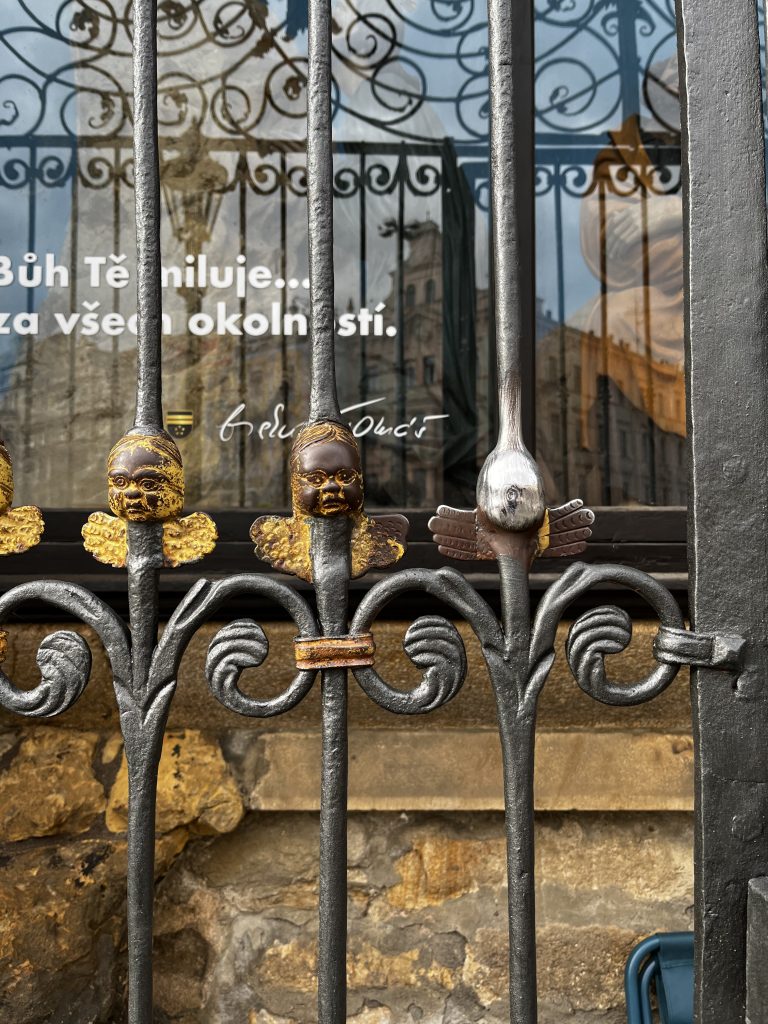
Ava escorts us through the city. We pass the second-largest synagogue in Europe, a beautiful Romantic-meets-neo-Renaissance building with two red onion domes, and the JK Tyl theater, which is hosting a musical about Billy Elliot. Once we reach the St. Bartholomew Cathedral, Ava beckons us toward the gate, as if she is about to reveal a great secret. The gate is decorated with a series of baby angel heads, one polished to a shiny, silver blob. Rubbing the angel’s head is supposed to bring luck. “I see many school children here before math tests,” she explains.
We enter the cathedral and climb the bell tower. The staircase is almost too tight to walk through. Dizzying. I count 301 steps. Why they did not make it an even 300, I do not know. Ava tells me that all medieval spiral staircases, if they were built by someone intelligent, follow a clockwise direction. This way, invaders would have a difficult time using their swords, because the pillar would get in the way—unless, of course, the invaders were left-handed.
Pressing my forehead against the protective gate, I gaze down at the Republic Square. It was first paved in the 14th century. At this point, I am familiar with my bewilderment over the Czech Republic’s age. Everywhere I go has some centuries-old history—even my classrooms are in a medieval castle adjacent to a 10th century fort. Quite different from home, which is constantly tearing itself down and reinventing.
The view is gorgeous. The orange roofs. The small people perusing the seasonal Christmas market, like ants flocking to crumbs. I feel a little emotional, though the tears in my eyes are from the winter wind. There are so many people besides me doing things right now and it is beautiful.
After lunch, we begin the main part of our tour: the brewery. Gus and I store our coats in a locker, then immediately regret it. Cold. Damp. Our first stop is the bottle factory. Ava knows everyone, seems to love everyone—is certainly loved by everyone. Her cheerful voice reaches across the open lobby, hitting the ears of the desk clerk and triggering a bright smile.
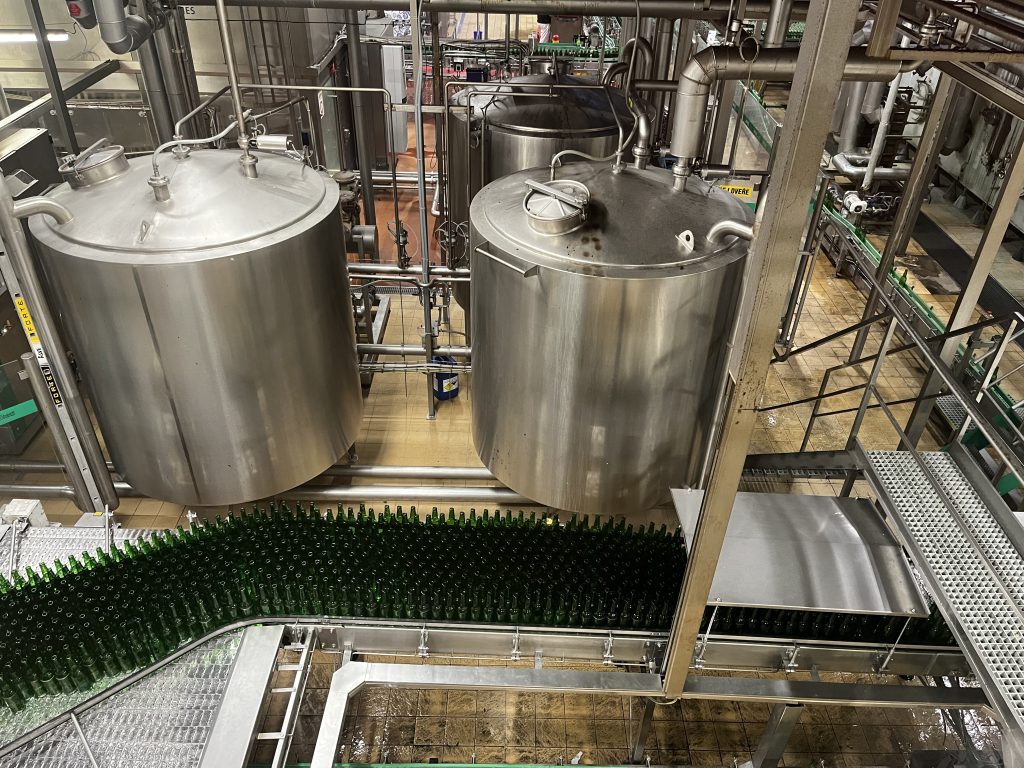
From an observation deck, Gus and I watch hundreds of bottles pass along a conveyor belt for quality inspection. Slinking and clinking together, they look like a mechanical sea anemone. Something is amiss—workers are flying around the room from one table to another, messing with knobs and buttons. It is like that episode of “I Love Lucy,” the one with the chocolate factory, but in real life.
Pilsner comes in green bottles which, technically, is wrong, says Ava. All other beer companies sell their beer in brown bottles to prevent photooxidation. “But green looks better,” she shrugs, and anyway, we should really only drink from the tap, that is the real stuff. I do not believe in sommeliers, but hearing Ava talk about flavor is oddly touching. All that passion in her voice. When she teaches me how to sample the unfiltered beer—examine the color, smell it, hold the carbonation on my tongue and search for that taste of caramel—I obey without mocking.
The underground cellars are covered floor-to-ceiling with moisture. One particularly slippery day, Ava was guiding a large group, and one of her clients, an elderly man in a wheelchair, sped down the ramp at the speed of a rollercoaster. “Don’t worry, he loved it,” she assures me and Gus.
Everything about the brewing process follows tradition, including the barrels in which the beer is stored. In fact, the Czech Republic is one of the only places in Europe to maintain the craft of coopering, or the hand-manufacturing of barrels. Ava lets me plunge my hands into a barrel of barley. The cereal slides through my fingers delightfully, and my skin comes out softer than before, due to the presence of lysine, which encourages the production of collagen. She also tricks me and Gus into tasting the ground hops, which leave a bitterness in the back of my throat for several minutes.
Perhaps my biggest takeaway from the field trip was that, for a country so proud of its beer, the Czech Republic does well in accommodating those who do not like or abstain from alcohol. The “Mliko pour” contains mostly foam, with just a sliver of beer at the bottom. And in 2020, nonalcoholic beers comprised 7.3 percent of the country’s yearly beer production. For a country as small as the Czech Republic, beer brewing is an art form, a means of both preserving and uplifting culture; however a person engages in that culture is a matter of choice.
As the rosy light of sunset gushes over the brewery, our group walks to the train. I fall asleep, as I do. When I awake, Ava is gone. Like I had imagined her. I regret not telling her goodbye. In my purse, I cram two tinfoil-wrapped chicken breasts—that “extra lunch” to which my teacher earlier alluded—and wish Gus luck for his tournament. Bizarre day.