
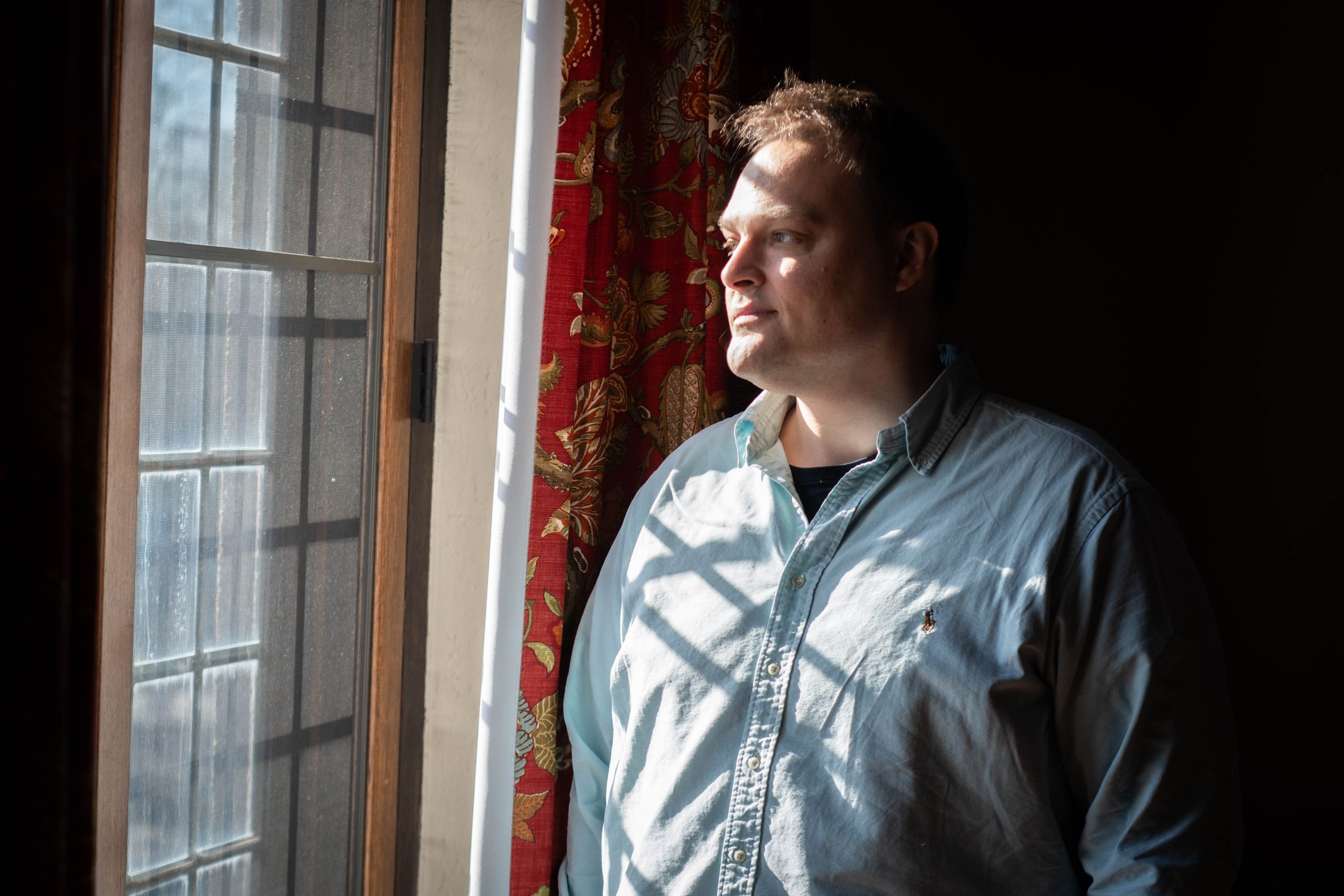
Eloquence comes easily for Garth Greenwell, Vassar’s 2024 Writer-in-Residence. He seems to know what he wants to say immediately, yet speaks with incredible mindfulness, sans “um”s or “like”s. This fluidity should come as no surprise, considering the pivotal role poetry has played in the American author’s life. Of his forthcoming novel “Small Rain,” from which he read two excerpts on Feb. 7, he said, “This is my defense of the humanities, I guess.”
The reading took place at 6 p.m. in the Sanders Classroom auditorium. I went with my friend Eliza, who somehow knows every person in the English department. We were delighted by how identically all of the attending professors were dressed.
Professor Amitava Kumar delivered a lovely introduction, informing us that Greenwell is the author of two books of fiction and a recipient of the Vursell Award for prose style, as well as a Guggenheim Fellowship. Then he sat down in the row in front of mine, produced a little notebook from his jacket pocket and began to sketch Greenwell as he spoke.
Greenwell, being quite tall, had to crouch over the microphone. He stood perfectly still, but every so often, rubbed his forehead, as if summoning thought as one would a genie from a bottle. The first excerpt he read was a lengthy close reading of two poems: “Stranger’s Child,” by George Oppen, and “Ode on a Grecian Urn,” by John Keats. For several pages, Greenwell analyzed Oppen’s use of the word “sparkle.” The goal, he explained, was to demonstrate that poetry analysis is bottomless, citing literary critic Helen Vindler as an idol. “The point is the ‘too-much-ness.’ One of the things I love about novels is they’re so heterogeneous. I want to see how much random crap you can throw into a novel for it to still hold.”
The room was silent as he read, except for when I dropped my pen and it rolled down the aisle. Greenwell spoke with a delicious cadence, never stuttering, never breaking his rhythm. His words blended into one another, then broke apart in staccato.
“Process” was the largest topic of the Q&A session that followed Greenwell’s reading. The author said that he writes scenes sentence by sentence, without knowing what the real drama of the content will be. Generally, he finds the process difficult to explain. “I don’t trust what any writer says when they talk about their work. We’re so good at lying to ourselves,” he said. When it comes to inspiration, he commented: “So much of me is nihilistic. Because of that, all I care about is how people make meaning.”
The first time I was able to speak with Greenwell was in line waiting for my copy of “Cleanness” to be signed. The second time I was able to speak with Greenwell was in the parlor of the Alumnae House that following morning. He was carrying a floral tote bag that he is certain is from a bookstore in Brooklyn, but is uncertain how he acquired it. In it was Kumar’s latest book, “My Beloved Life,” which I found really sweet.
Greenwell initially went to school for music, inspired by his high school choir teacher, who introduced him to opera. “That just radically changed my life, changed my sense of what the world could be, what the world could contain,” he explained. Though he switched majors his junior year of college, opera has remained an important part of his life, weaving its way into his work: “[Opera] was my first experience of narrative. My second book has a very strange structure; I think of it like a song cycle, like a Schubert,” he said.
After graduate school, Greenwell began to teach ninth and 10th-grade English. He described teaching as one of the most extraordinary privileges a writer can dream of having. “[Teaching] is a big part of what led me to become interested in stories and narratives and in other people, in characters…I think a novelist’s job is to be interested in people.” Reflecting on his years teaching, he remembered, with disdain, how his work was dismissed by colleagues and family. “I would just see the light go out of their eyes. And then, if a minute or two later I said, oh, but you know, I’m also doing a Ph.D. at Harvard, the light would come back.”
Accepting this binary of reactions was difficult, but critical for Greenwell. Though he told me he does not believe in advice, he wants the aspiring artist to know that to be an artist is to fail. “In the eyes of the world, you’re going to look like a failure,” he said. “But it wasn’t failure because every morning I was waking up and I was working on my art.” It was not until he left his Ph.D. program that Greenwell felt as though he became a writer.
After a few years teaching in Ann Arbor, Michigan, Greenwell accepted a teaching position in Bulgaria in 2009. In the four years he lived in Sofia, he and his students fought to establish the first high school Gay-Straight-Alliance in the Balkans, which finally came to fruition the year after he left. “Bulgaria had only very recently joined the EU, so there were really inspiring people who were, I mean, really putting their wellbeing on the line to advance human rights.”
While his first two novels, “What Belongs to You” and “Cleanness,” appear autobiographical—both relayed from the perspective of a gay American teacher living in Sofia—Greenwell strongly insists that the narrator is not him. Rather, he repurposes his lived experiences in the same way that a sculptor might repurpose found materials. “If an artist sees a hubcap on the street and picks it up and takes it to her studio and paints it, or hammers it, puts dents in it and then puts it inside a frame—it’s not exactly a hubcap anymore,” he explained. “Small Rain,” set entirely in an American hospital, is also inspired by real events, but is completely fictitious. “I did have this experience of going through a medical crisis and I needed to think about it,” Greenwell said, “And fiction is the way I think about things.”
In addition to thinking about his health crisis, “Small Rain” was also a way for Greenwell to think about his longtime partner. He alluded to his upbringing in rural Kentucky, where he was part of the first generation of his family to be raised away from a tobacco farm, having skewed his perception of relationships: “I have found myself for the past 10 years now in a kind of relationship that was for me just literally unimaginable for much of my life.” This “kind of relationship,” he elaborated, is largely structured around the mundane. “Over the last few years, the last thing I did before sleeping was hug my partner. And the first thing I did on waking was hug my partner. That is a profound thing. And that, too, is something I need art in order to think about.”
Profundity—particularly profundity created from “daily life”—is what Greenwell cares most about. “Human beings are meaning-making animals. So far as we know, maybe we’re the only meaning-making animals,” he said as our interview concluded. “Maybe dolphins make meaning too. But our purpose is to make meaning.”