
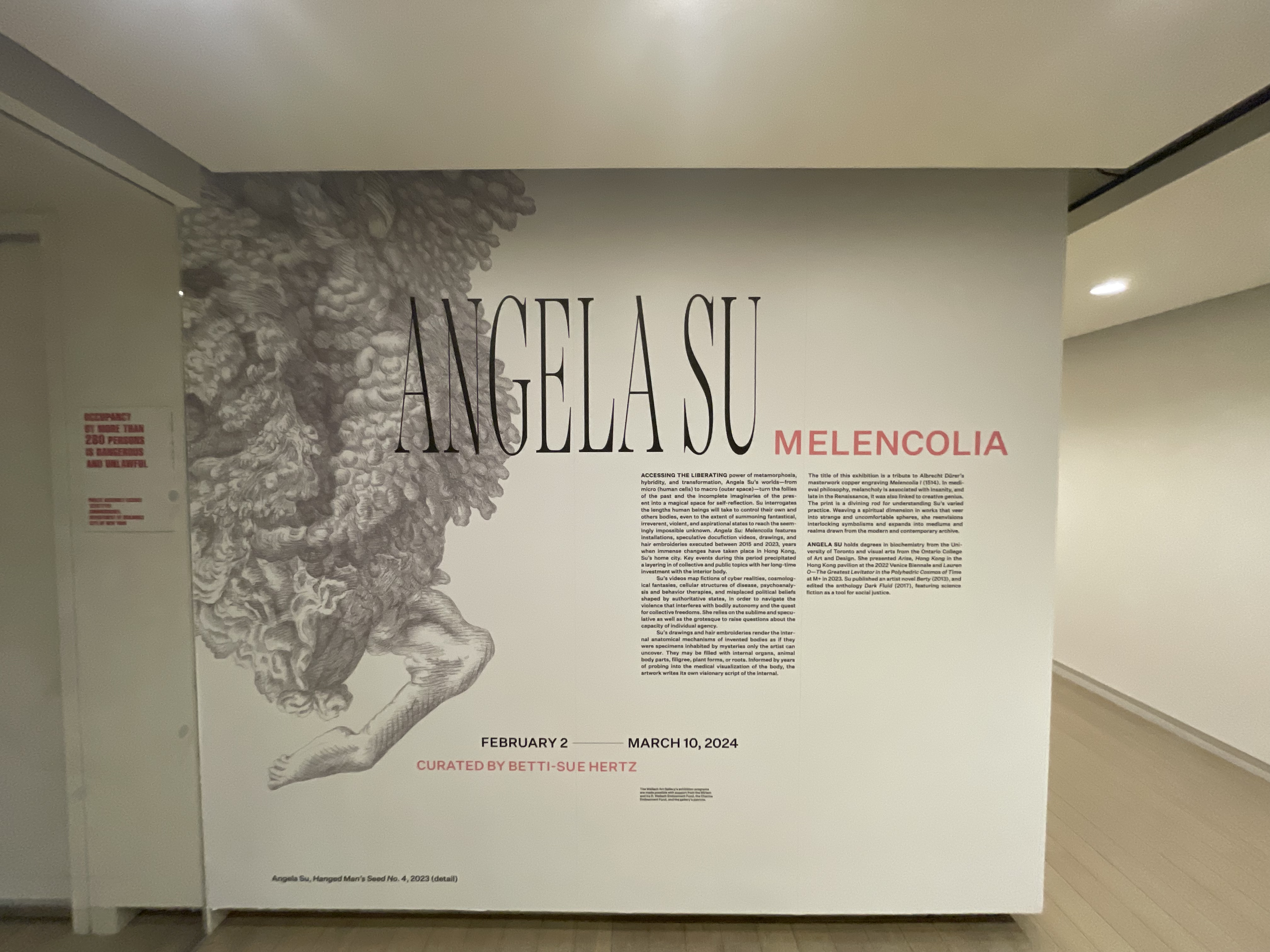
On a brisk spring break afternoon during an excursion to Manhattan’s Morningside Heights neighborhood, a moment of artistic serendipity presented itself. I was meeting a friend and feeling like an urban flâneur. I was relaxed, ambling absently through the cityscape and seeking intellectual enrichment. I did a quick Google search for “free open art museum” and yielded an immediate (and nearby) return. I found The Wallach Art Gallery, checking off both the free and open categories. According to their website, the Wallach serves as both a laboratory and a forum organized by Columbia University’s Art History department. I immediately got the gist—experimental, eclectic, compelling, and entirely up my alley. I set off, briefly taking note of the featured exhibit: Angela Su’s “Melencolia.”
My friend and I soon stepped into Columbia’s Lenfest Center for the Arts, a towering Modernist edifice of expansive glass paneling and white geometry. I entered its central elevator and ascended to the sixth floor for the Wallach Art Gallery. A sensory cacophony immediately enveloped me. The clicking of a metronome wound unremittingly through the space. Three films played simultaneously to overdubbed narration, creating a dense syllabic salad. Bright LED spotlights underscored polygonal sculptures, ranging from dodecahedrons to latticed pyramids, as though a massive Dungeons & Dragons dice pouch had spilled onto the gallery floor.
I am still struggling to find a cogent starting point to unpack the madness that is Su’s exhibit, “Melencolia.” Su is a Hong Kong-based visual artist and biochemist who elides scientific rationality and esoteric mysticism throughout her creations, drawing often-jarring parallels between the proven and the fringe. Through elaborate performance and genuine biomedical ethos, her work blurs the sanctified lines of epistemology, weaponizing art to unravel the seeming stability of what is “truth” and “fact.” As her first independent show in the Western Hemisphere, “Melencolia” is a collection of Su’s films, tapestries and sketches rendered from 2014 to 2023, epitomizing a career examining medicine through occult perspectives.
The exhibition is named after Albrecht Dürer’s 1514 engraving “Melencolia I,” an exploration of the philosophy of creativity and the artist’s social role within the emerging German Renaissance. Dürer synthesized worlds of medieval scholastic cosmicism and classical geometry in his engraving through the symbolic use of lambs, comets and calipers, postulating the artist as an intermediary between the scientific and the divine. His choice of the name “Melencolia I” references melancholy, historically one of four “temperaments,” a pseudoscientific theory asserting that personality is reflected by complexion and bodily fluids. Melancholic individuals were strongly associated with artistry, and viewed as both predisposed to genius and insanity. Su invokes Dürer’s work and melancholic duality to assert her career as tenuously balancing between cabbalistic insight and inscrutability, more than confirmed through actually experiencing the exhibit itself.
The first leg of my journey through Su’s intellectual and artistic consciousness was the 2019 film “Cosmic Call,” among the most enigmatic and jarring pieces within the gallery—and fittingly, the closest to the entrance. Su begins her theoretical musings by introducing a trademark of her work: historical fiction. She invents Aureus, a comet whose passage over Earth’s atmosphere in the medieval period profoundly impacted cosmological history. From this false basis, Su constructs an elaborate metaphor where massive astronomical phenomena passing spectral bodies are compared to microbial germ clusters infecting human bodies; Su’s naming of the comet “Aureus” is derived from Staphylococcus aureus, a form of bacteria. “Cosmic Call” weaves an elaborate thematic exploration of traditional Chinese medicine’s spiritual and holistic approaches as being subverted by a philosophy of biomedical rationality originating from Western practice. Su’s response is to divine cosmological approaches, conflating the microbial world of bacteria with spectral movement unfolding among the cosmos.
The heady comparison of astrological and epidemiological science intertwined with sociotechnical implications is to this point explored through Su’s narration and a slideshow of still images, evoking a (particularly existential) documentary. Yet suddenly we smash cut to a cryptic title card, introducing the next sequence as footage of Su being voluntarily injected with “various deadly diseases” as a protest against encroaching Western biomedical imaginaries. A scene is staged: Su is cuffed to a chair, entirely still in the middle of a dark and barren room. Two nurses in stark-white scrubs brandishing hypodermic needles approach from either side, disinfect the arm, and inject her in unison, evoking a squeamish cringe from me and my friend. The nurses recede into the background, and Su bolts up, unshackles herself from the chair and quadrupedally prowls the set on her steel limbs, deliriously scampering back and forth until the film abruptly ends. My expectations were now both set and entirely shattered. Su’s first film had incomprehensibly blended truth with fiction, documentary exposition with narrative diegesis and video essay with cryptic performance art.
As we briefly composed ourselves and set off to unearth the exhibit’s other curiosities, a pattern emerged. Su’s film repertoire entwines obscure historical facts with invented protagonists, furthering the viewer’s inability to assess the truth of her narratives. This trend is best evidenced in 2022’s “The Magnificent Levitation of Lauren O,” which follows the induction of its eponymous fictional heroine into anarchic cells amid the American hippie movement. “Lauren O” pulls from the fictitious events of real-life groups, such as the anti-imperialist Weather Underground and the shadowy New Age Esalen Institute, in tandem with invented ones, such as Laden Raven (comically described as a “troupe of Marxist vaudeville performers”). Su uses the character of Lauren and her liminal historical existence to explore the central theme of levitation, both as a transgression of natural physical laws and a spiritual movement toward divinity. In light of this thematic duality, Lauren’s eventual supernatural act of levitation represents both a radical political defiance and religious ascension. Of course, the film ends with another performance piece—Su grapples onto a floating disco ball and coils around with the crooked limbs and spindly agility of an arachnid. The ball eventually dissipates and Su seems to levitate, invisibly hoisted within a barren padded cell enshrouded in shadows.
Su’s earliest film, 2015’s “Mesures et Démesures,” was the source of the ambient metronome I had heard upon entering the gallery. “Mesures” explicitly examines mental illness by utilizing historical footage of a male psychiatric patient ambling naked through a stark room, the incessantly ticking metronome scoring the man’s absent movements. As the viewer experiences this banal footage, we are drawn in as voyeurs, inadvertently replicating the lurid dehumanization of psychiatric observation. Su seems to chide our complicity in the othering of disabled populations, exacerbated by having “Mesures et Démesures” screened in a distant—yet always visible—corner of the gallery. Wandering eyes are continuously invited back to the film by the metronome’s even meter, which almost seems to beg attendees to lose themselves in the benign violence of spectatorship.
My friend and I left the gallery bewildered yet enthralled, continuously recalling cryptic moments from the gallery to analyze in conspiratorial detail. We glibly half-joked that Morningside Heights did not look quite the same as when we had entered the Wallach Art Gallery, our tastes in art and basic understanding of reality irrevocably altered. Su’s work is so thematically dense, her artistic vision so singular, that it is irrefutably essential viewing for anyone interested in performance art. Su is a provocateur and an auteur, and her work wavers somewhere between eminently fascinating and eminently overwrought. Although the “Melencolia” exhibit has since closed, I recommend looking into Su’s art nonetheless. She invites audiences into a vast intellectual labyrinth, then challenges them to find the artistic understanding at its center. I still do not know if I have made it there yet.