
It is the Saturday before St. Patrick’s Day, and half of the people in The Metropolitan Museum of Art are dressed in green. I am here to see an exhibition called “Indian Skies.” Co-curated by Navina Najat Haidar and John Guy, the three-room show features over 120 pieces of Indian court art from the 16th through the 19th centuries obtained from the late British painter and art collector Howard Hodgkin. I cannot help but wonder what the royals of the Mughal, Deccani, Rajput and Pahari empires would think of their fine watercolor paintings now on display for a bunch of young children in plastic shamrock headbands.
As I walk through the collection, trailed by a green, hand-holding chain of kindergarteners, I notice that flat perspective—where shapes of the same size sit on the surface instead of gradually diminishing into the background—prevails across centuries. “A Fly Infested Feast,” made sometime between 1740 and 1750 by an unknown artist, is one example. The brush drawing depicts an assembly of Brahmins—members of the highest caste within Hindu society—seated within a perimeter of tall grass, eating from plates made of leaves. Flies that look like tiny black arrows fill the empty space. They gather more densely around the Brahmins, their pointed ends angled as if to strike, creating swirling, busy movement. It is unclear if the flies are attacking the Brahmins or simply attracted to their food—they flood into the thatched structure where one man is pouring soup into a stack of bowls, and another man is holding out his hands for a serving. The flies only dispel in the top right corner of the enclosure where two senior priests and a young prince sit. The three of them eat from silver platters, uninterrupted as three attending boys shield them from the flies. Outside the grassy fence, a group of men watch with disdain.
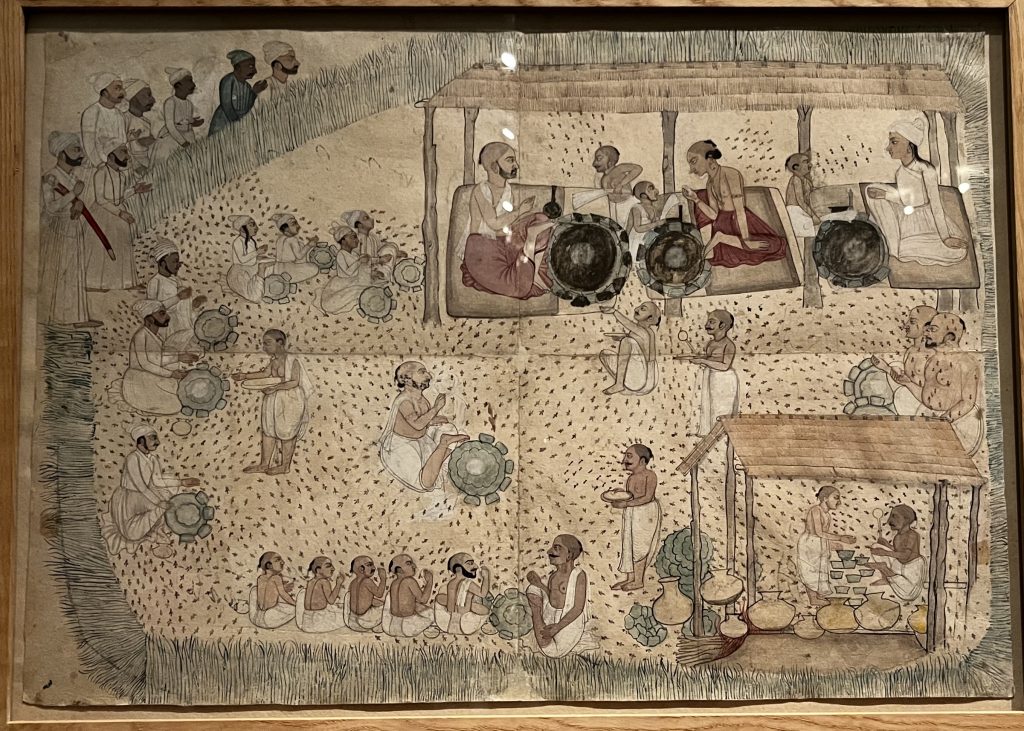
While the piece lacks a vanishing point, our eyes are directed nonetheless to the two senior priests, their bright red pants contrasting against the muted whites, greens and beiges of the rest of the painting. This is quite intentional—“A Fly Infested Feast,” according to its accompanying description, was most probably created to mock the selfish priesthood within Brahmanism.
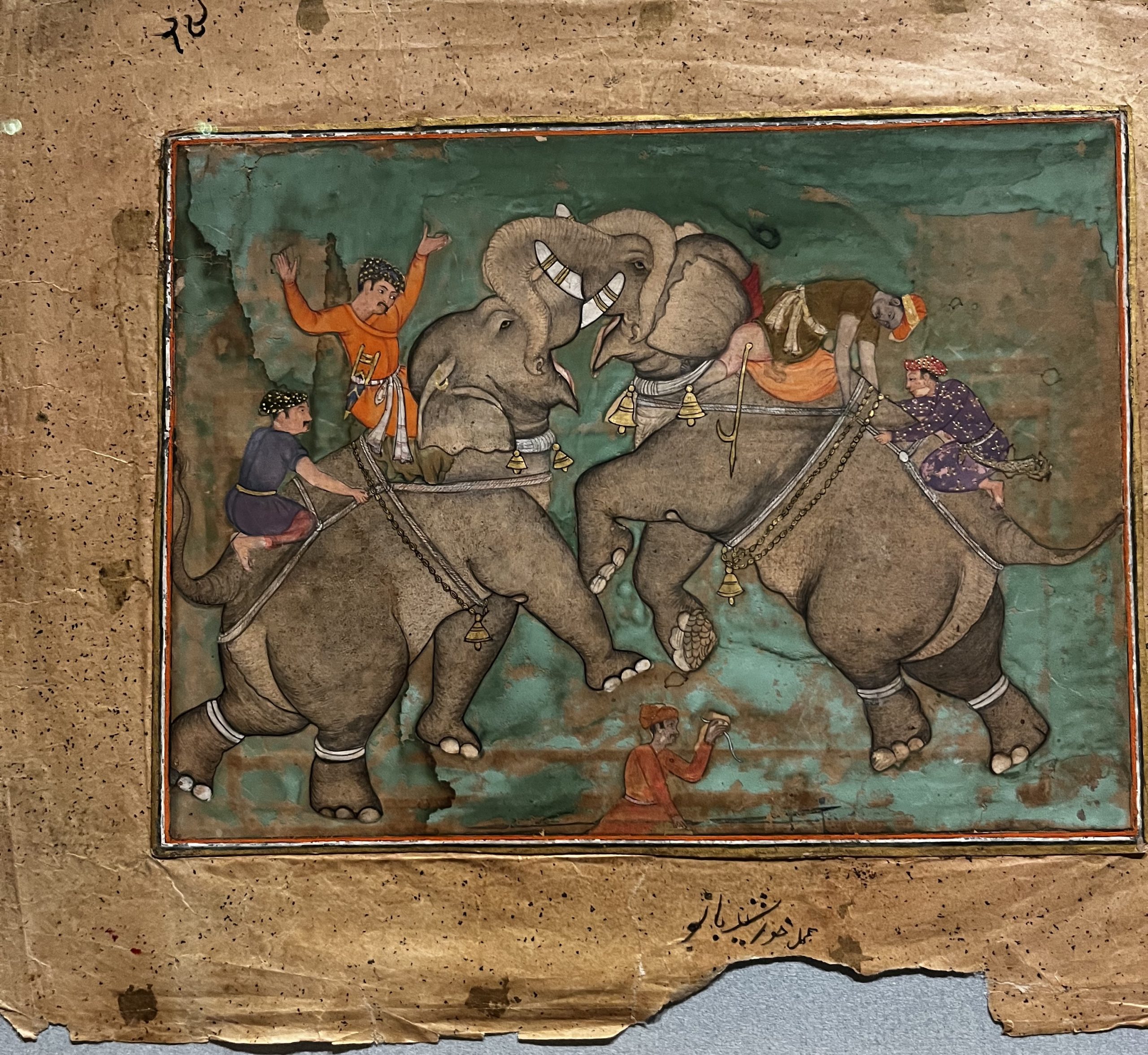
Color is similarly important in “Elephants Fighting,” which was painted by a woman named Khurshid Banu for the court of the Mughal empire, one of the longest-ruling, richest Muslim empires in India. The painting depicts two elephants locked by their trunks, mouths wide, leaping towards each other. An invisible vertical line between their clashing trunks separates the piece into two halves that are symmetrical in color. The elephants themselves are fairly identical—gray skin decorated with bells, bracelets, earrings, tusk rings and waist chains set with gold. On the left elephant, a mahout, or elephant tender, donned in navy grips the stringed saddle. Another mahout wearing a brilliant orange robe takes the front, raising his arms above his head. On the right elephant, a matching navy-dressed mahout climbs up the rear while his frontman adjusts the saddle. Though the orange blanket on which the frontman sits is less vivid than the left mahout’s robe, the seated man beneath the leaping elephants rebalances the orange distribution. Positioned somewhat off-center, his clothing drags more orange pigment to the duller half. Even the teal background wash is symmetrical, the empty space mirrored on a diagonal.
Rather than pulling our eyes to a specific component of the scene, as in “A Fly Infested Feast,” color in “Elephants Fighting” pushes our eyes to the middle. There are many details to explore—the sequins on the mahouts’ hats, the ripples in the elephants’ tails, the string between the fingers of the seated man—but our gaze always returns to the elephants’ faces tangled together.
There were several portraits on display too. My favorite was “A Court Beauty” by the painter Chokha commissioned for the Rajput palace in the early 19th century. Instead of watercolor, Chokha used gouache, a paint much more resistant to fading, resulting in fantastic color. The subject, a royal woman covered in silver and gold jewelry, carelessly raises clasped hands above her head. Her hips sway to one side. Is she leisurely stretching, or is she dancing? Facing the four-foot painting, I imitate her movement, as if I am following an aerobics video. A green kindergartener looks at me, and I immediately stop.
Like the figures in “A Fly Infested Feast” and “Elephants Fighting,” the royal woman is in profile. Her one eye takes up nearly a quarter of her face and stares into the distance, its lid drooping with boredom. A small baby, also sporting layers of sumptuous jewelry, stands next to her, waiting to be held. It is probably my favorite piece in the exhibit, if only for its vibrance. The woman’s blood-orange skirt fans around her ankles, dozens of teensy-tiny pleats swooping upward. The deep sky boasts two small clouds that hide under the ruffled painted frame. The wash of yellow on the cotton canvas is like a continuation of the wall on which it is hanging, as if the art cannot be entirely divided from life.
I leave “Indian Skies” only because I am hungry. It takes me a few minutes to readjust to New York. In the late afternoon sun, a veteran and his saxophone pace up and down The Met’s promenade. For the rest of my day, I think about color and splendor and where it exists outside of a frame.
I implore anyone and everyone to visit “Indian Skies.” The exhibition is running through June 9.