
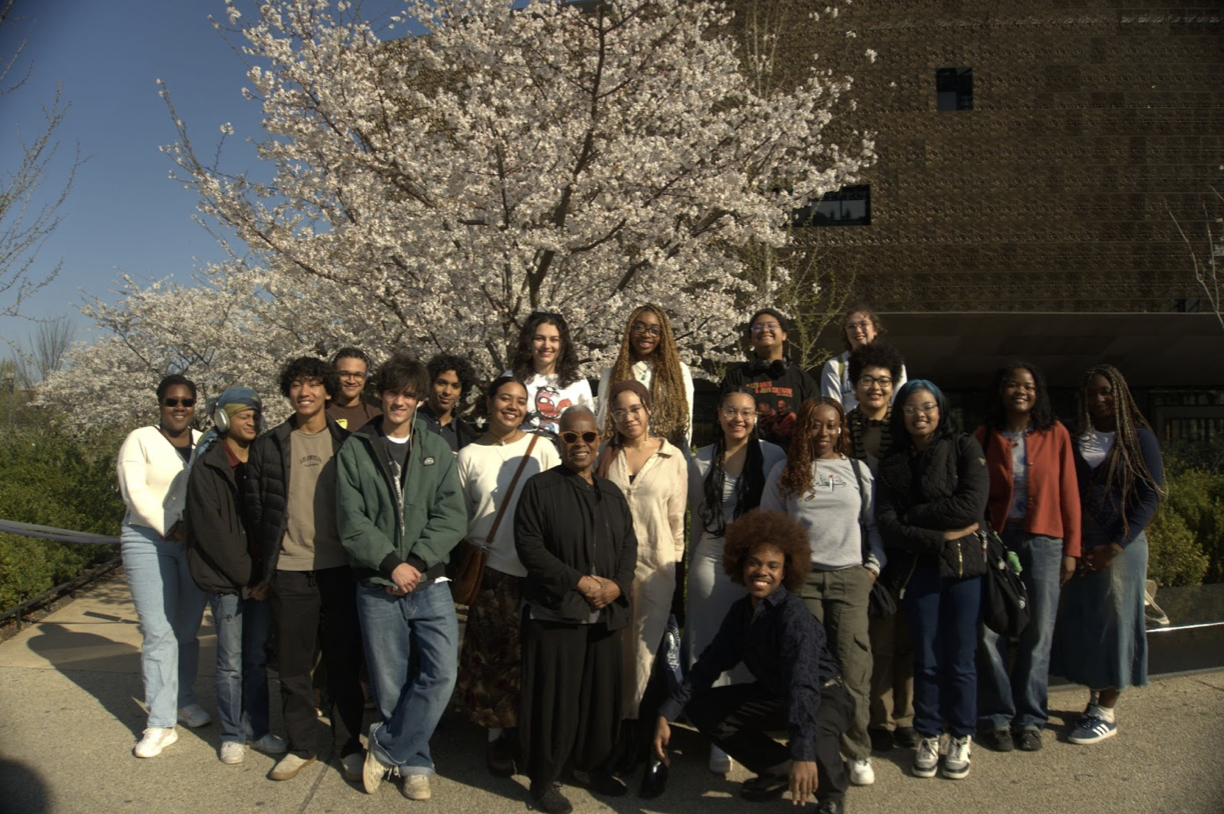
Last weekend, a group of students had the pleasure of visiting the National Museum of African American History and Culture (NMAAHC) in Washington, D.C. to see their visiting exhibition: “Afrofuturism: A History of Black Futures.” The trip—initiated by student interest—united the Africana Studies Program and Music Department for two days of travel and one day to experience the museum, connect with alumni and explore the Washington metropolitan area. The trip was predominantly attended by students of Associate Professor Tamyka Jordon-Conlin’s AFRS 210: “Afrofuturism” class, as well as Africana Studies’ Program Director Diane Harriford and Administrative Assistant Primavera Ward.
The NMAAHC is gorgeous. The building itself is a truly remarkable architectural feat that stuns and welcomes visitors to a site of healing. The visitor experience is enhanced profoundly by design details such as the entire building’s exterior lattice which can be modulated to control sunlight and transparency. It is wonderful to walk into a place of change. Our group worked down from the fourth floor to the first for the “Afrofuturism” exhibit. In each collection, we all found pieces that felt tragic to leave behind in the interest of time, and we learned by lunchtime that one day in the museum might never be enough. After a meal of soul food and African American cuisine from Sweet Home Café, we lugged our sated selves to “Afrofuturism: A History of Black Futures.” The exhibition was immediately recognizable to students of Jordon-Conlin’s AFRS 210: “Afrofuturism” and AFRS 202: “Black Music” as a collage of the classwork. Walking into the exhibit, the voices of Afrofuturist scholars Ytasha Womack, Mark Dery and Alondra Nelson greeted us as they had in the first class meetings. The exhibit’s main hall was enshrined with mesmerizing, authentic outfits from Nona Hendryx, George Clinton, Chadwick Boseman and others. Sonically, visitors heard a rotating soundtrack of Afrofuturist music that assured us the groggy bus ride had brought us to exactly where we needed to be. Original costumes and equipment from the likes of Parliament-Funkadelic, Sun Ra, Janelle Monae, Black Panther, Flying Lotus and Outkast artfully offered throughlines of Afrofuturist history from the 1970s until present day. Core tenets of Afrofuturism like Black liberation, non-linear temporality, mythmaking and identity play were brightly on display around every corner. The exhibition was beautiful and, set within the context of the larger museum, offered salient ways to examine Afrofuturism’s legacy while incorporating Afrofuturism’s influence on larger contemporary social movements, art, music and more. Examples of Afrofuturism’s contributions to the Black Lives Matter movement, African architecture and contemporary fashion were especially provocative.
The trip arrived at a poignant intersection for the Africana Studies Program at Vassar. The program can point to a history of supporting students to explore Africana learning opportunities off campus. Whether it be the New Dimensions in Education Summer Trip in 1971 that brought Africana Studies students to 10 different countries on the African continent, or opportunities through Vassar’s former relationship with the Urban Center in Poughkeepsie, having Africana Studies students interact with the world around them through the lens of the program has always been integral. This trip has reestablished that tradition again. The Africana Studies Program is on the verge of realizing its own future with its recently redesigned major and correlate requirements. It is currently waiting for relocation from its transitory home of Old Laundry Building as soon as new construction begins this summer. Yet, the exhibit in Washington made it entirely clear why Afrofuturism is important both to students at Vassar and broader social change. The trip embodied an Afrofuturist directive itself. Students began to build futures with fellow alumnae/i of the African American Alumnae/i of Vassar College, and counteracted archival gaps in the college’s records of the program by creating multimedia accounts of the trip. Students initiated the documentation of the program through reflection papers, interviews, articles, photographs and recordings of oral history.
Ultimately, the “Afrofuturism: A History of Black Futures” exhibit and greater museum provoked students to question how catalysts of Afrofuturism became so effective in instigating social change. How does ownership of the way in which history is kept and recorded affect how we can imagine alternative futures? The Washington trip presented a bright exhibition of brilliance and joy among the persistent rainy weather of the nation’s capital, but it challenged all involved to question what futures are on the horizon for Africana Studies, and how we can imagine those futures together. There is a lot to look forward to in the Africana Studies Program, and for our Afro futures at Vassar, so just know there has never been a better time to be an Afrofuturist.