

At around 10:30 a.m. on Friday, April 5th, a 4.8 magnitude earthquake hit Lebanon, New Jersey, with effects felt as far south as Maryland and as far north as Maine, according to NBC News. Earthquakes in New York are extremely uncommon, and Friday’s earthquake was among one of the most intense ever recorded in the state’s region. Vassar students expressed a mixture of different reactions to this practically unheard-of event.
Senior Natalia Fay stated, “I have never experienced an earthquake before, so I thought it was a cart on the floor above me or a very loud truck going by the [Frances Lehman Loeb Art Center], but then no one else knew what was happening.” Fay added that she is from New Jersey, which very rarely experiences seismic activity.
Other students from the northeast, for whom earthquake contact is limited, expressed similar confusion. Eliza Gilbert ’25 had just woken up when the earthquake hit Vassar. “By the time I’d completed my wake-up tasks—a few minutes of despair followed by some forehead-pressed-to-the-window time—it was 10:23. I laid on my back for a moment to gather myself before launching into Morning Phone Time. At that moment, TH 88 began to rumble,” she wrote in an email correspondence. She added, “When the rumbling continued, I assumed that I must be the problem, that I was rumbling—obviously, this was a complicated cardiac event.” Kathleen Langston ’26 noted: “I’m from New York City, and I’ve never experienced an earthquake before, and when it happened I was in the Deece. I was with a friend from California and I thought she was messing with me. I thought she was jiggling the table.”
Impressions of the earthquake varied widely across locations, with some students barely registering the event, and others feeling relatively strong movement. In a written correspondence to The Miscellany News, Harrison Phipps ’26 recounted: “I was eating breakfast at a big table in the Deece when it suddenly started wobbling, quite noticeably, from side to side. I could also feel the ground vibrating.”
Grace Miller ’24 noted: “I didn’t notice the earthquake was happening at all, I only found out that anything had happened when I went into the library and people were talking about how the building had been shaking.” Miller mentioned that she had been giving an admissions tour, so she had been walking outside for the duration of the earthquake.
Sophomore Sadie Hammarhead echoed Miller’s perceptions of the event, saying, “I was in the shower and I did not feel the earthquake. I almost thought everyone was pulling a prank on me. I felt like it was a big joke that I just wasn’t let in on.”
“I’m glad I was able to experience [the earthquake] and I feel bad for all the people who didn’t,” reported Maggie Greenberg ’26.
Scientists were quick to respond to the seismic event, with the U.S. Geological Survey (USGS) recording the activity almost instantaneously. On its website, the USGS mentions that: “Earthquakes in the eastern US are infrequent but not unexpected. Since 1950, 40 other earthquakes of magnitude 3 and larger have occurred within 250 km of [this] earthquake. In that time range, the April 5, 2024, earthquake is the largest.”
Closer to home, the Vassar administration was also quick to respond to the earthquake. Around half an hour after its impact, Gary Hulbert, Emergency Management Sergeant, sent out an email to the entire Vassar community. In his email, Hulbert stated that the campus had not experienced any safety issues and that Facilities Operations would be checking buildings around campus to ensure that there was no damage.
The Earth Science Department at Vassar also provided helpful information regarding the seismic event. In an Instagram Reel uploaded to the official Vassar College Instagram page, Professor of Earth Science Jill Schneiderman said: “[The earthquake] occurred at a depth of seven kilometers beneath the earth’s surface. That’s why it was felt so strongly.”
In a written correspondence to The Miscellany News, Professor Schneiderman explained the readings on Vassar’s seismograph, which they published on the College’s Instagram. “Seismographs are instruments used to record the motion of the Earth during an earthquake… A seismogram is the recording of the ground shaking at the specific location of the instrument.” She further explained that the horizontal axis on a seismograph represents time passed, while the vertical axis represents how much the earth moves, usually in millimeters. During times when no earthquake is occurring, there is usually just a straight horizontal line, barring any local disturbances.
Schneiderman also noted that there was another, less common scale of understanding earthquake intensity that could be used to contextualize the recent earthquake in terms of how people felt the intensity: “A different scale that people might not be familiar with is the Mercalli intensity scale, which is different from the Richter magnitude. The Richter magnitude of 4.8 records how much energy was released as a result of the movement, but the intensity scale measures what people felt.”
Aftershocks are always a possibility after an earthquake, and many smaller earthquakes were felt throughout the region on the evening of April 5. According to CBS News, the magnitude of the most widely felt aftershock was 3.8, felt around 6 p.m. on Friday.
The aftershock was not felt as widely as the initial earthquake. When asked about the aftershock, both Greenberg and Hammarhead noted that they did not feel anything around the time that the strongest aftershocks were reported.
On the other hand, some students such as Anusha Subedi ’25 did notice an aftershock. “By the time the aftershock was done, I was by my kitchen door. I ran from my living room to the kitchen door,” she said. “It felt like PTSD, because in Nepal we have bigger earthquakes, so it felt like it was going to be the same scenario.” Lucy Gundel ’25 said,“What was even more surprising [than the earthquake] to me was that there was an aftershock later that day that I felt, but many didn’t.”
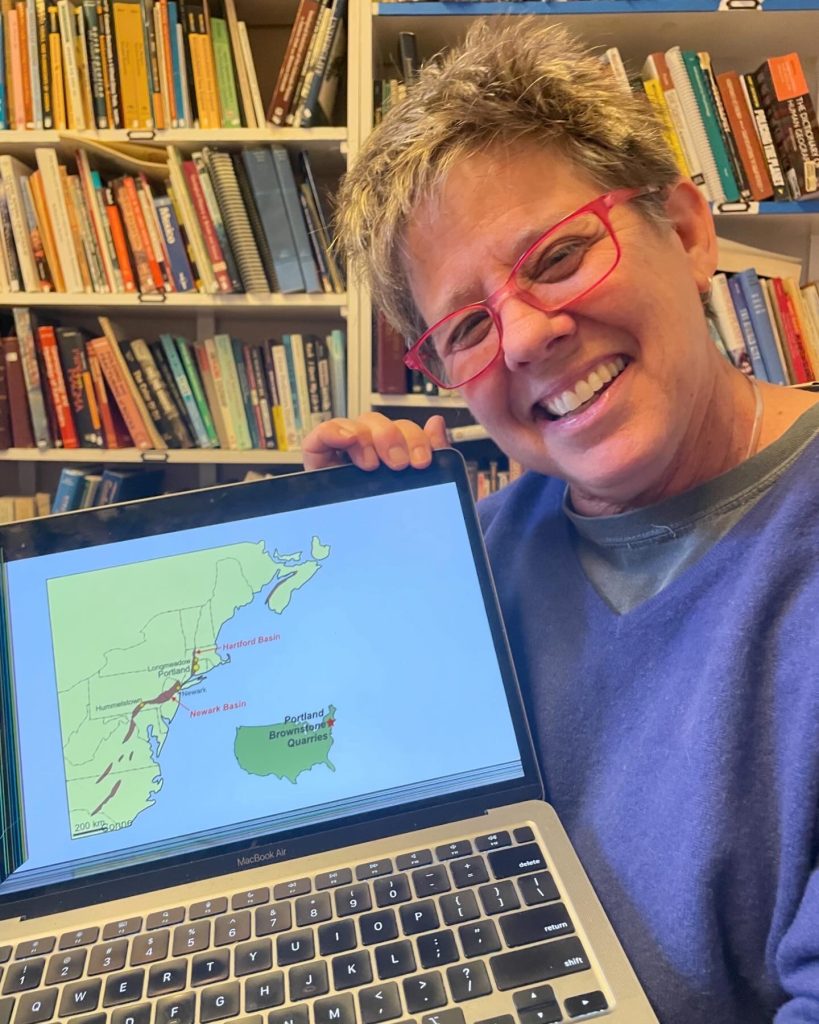
Despite the fact that many students on campus have never experienced a geologic event of this scale before, Schneiderman noted that this type of earthquake is not particularly surprising in this area. “The April 5, 2024 magnitude 4.8 earthquake in New Jersey occurred along a fault [line] that is at least 250 million years old (not that old in terms of geologic time),” she wrote. “Earthquakes in the eastern U.S. are infrequent but unsurprising.”
Additional reporting by Clara Alger, Charlotte Robertson, Maryam Bacchus and Makenna Monaghan.
Gods trying to tell us Something ! everyone needs to repent it’s Gods way of warnings !
Last weeks’ news not breaking news!!!!! 👎👎👎