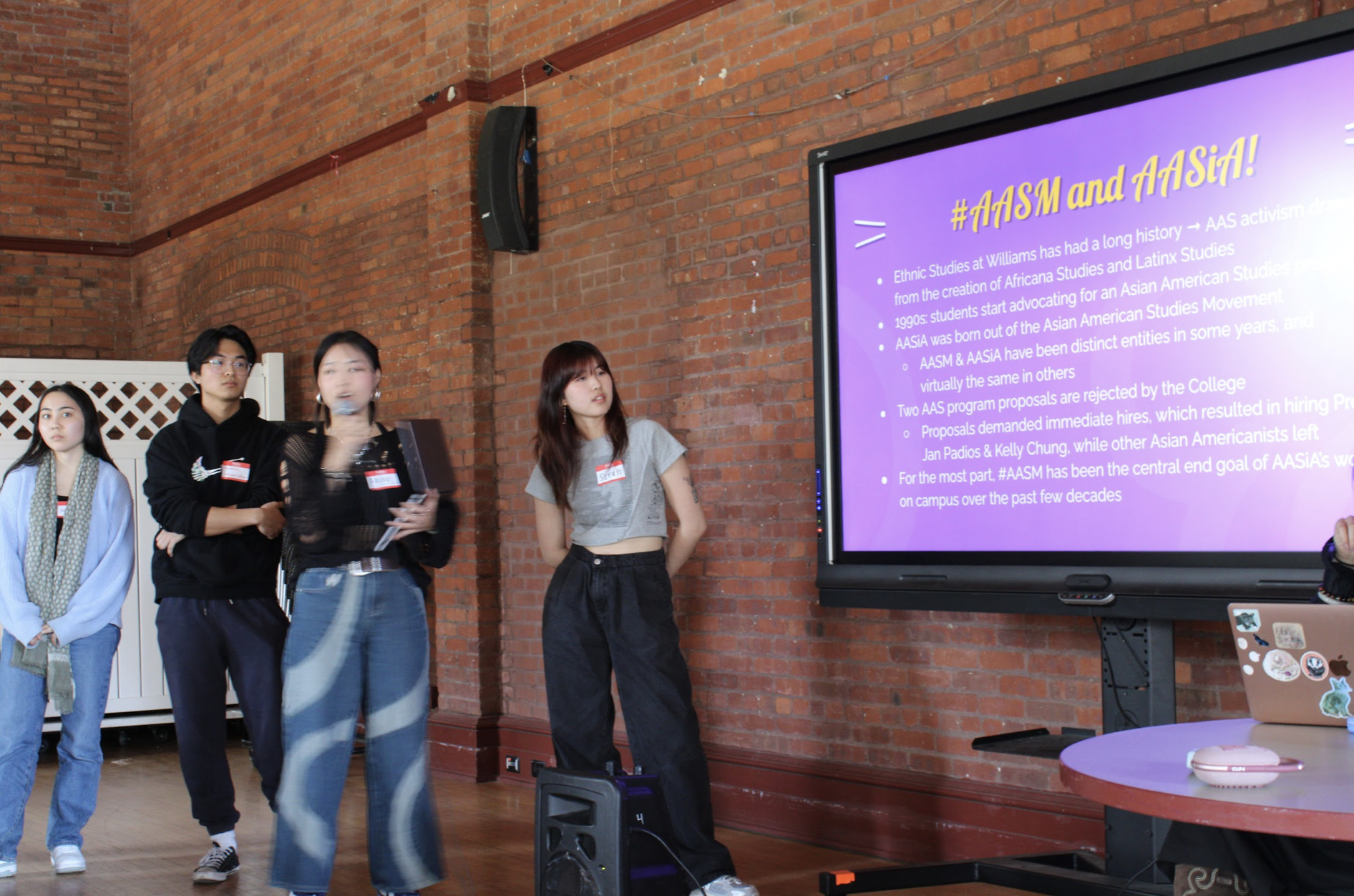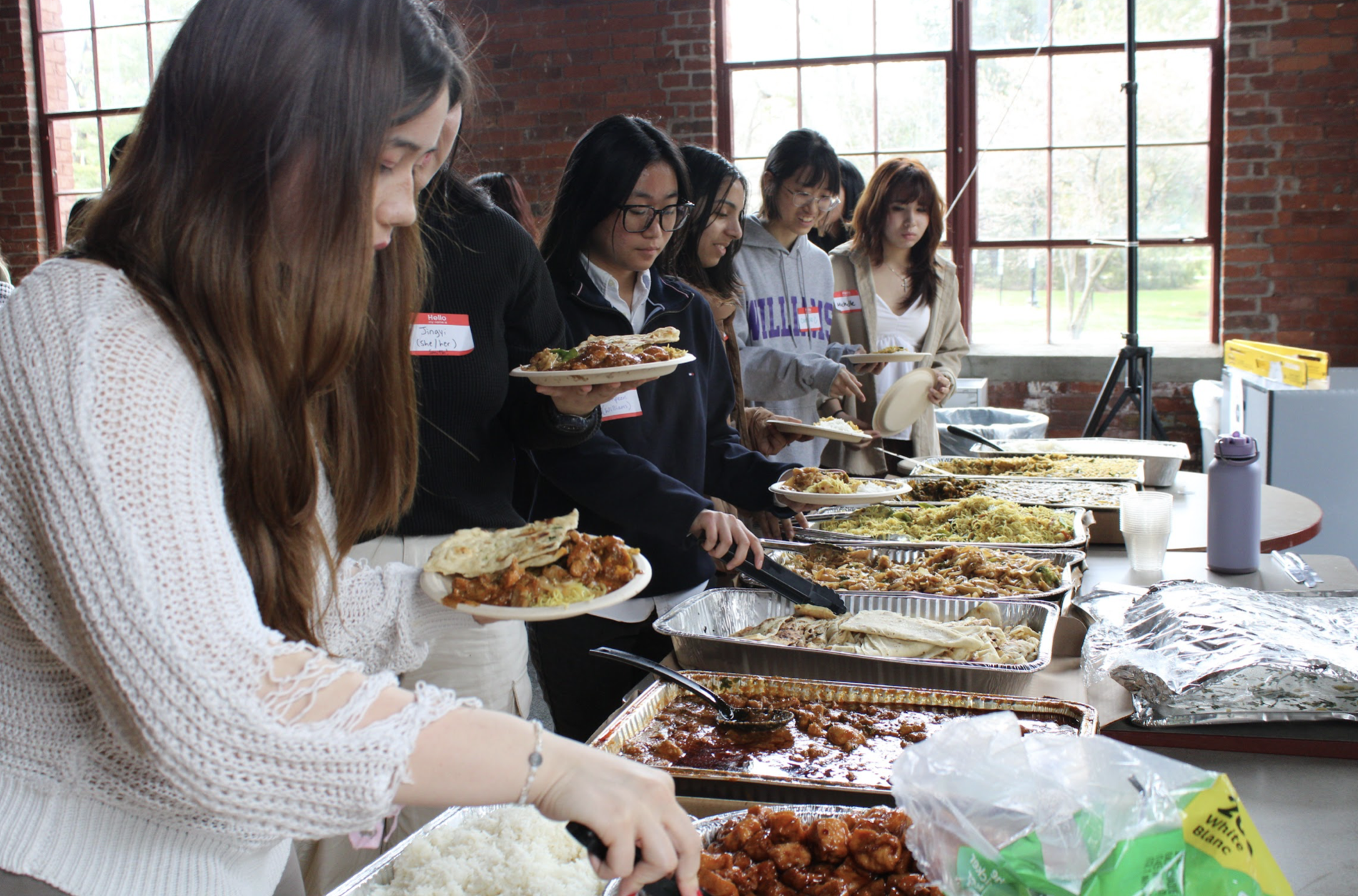
Over the weekend of April 6th to April 7th, Vassar student organizers hosted an intercollegiate conference titled “Activating Asian America” to foster discussion and build a coalition across campuses. In her opening remarks, one of the organizers, Jillian Lin ’25, noted, “In the words we’re now familiar with, it is a conference that seeks to bring together Asian/American students from private liberal arts institutions in the Northeast with shared visions of political and community organizing.” She went on to say, “It’s a convening rather than a conference, and it is a creative, grassroots endeavor.”
The conference had 45 participants and included representatives from eight schools besides Vassar, including Barnard in New York City, Smith in Massachusetts and Swarthmore in Pennsylvania.
Organizers Lin and Lavanya Manickam ’25 first started thinking about hosting a conference when they were first-years, inspired by upperclassmen’s ideas. They also took inspiration from finding archives that showed conferences happening at Vassar in the past. Now upperclassmen themselves, they started planning the event over Winter Break.
The organizers were explicit that the event was organized outside of the Asian Students’ Alliance (ASA). Though a few of the principal organizers are on the ASA executive board, others were not. Organizer Malia Weiss ’26 noted that she was inspired to get involved through taking several courses that focus on Asian American topics. She said, “I really appreciated the opportunity to be involved in this space and not have it just be an org space.” Lin specified, “In short, this was an event in collaboration with ASA and also Vassar’s Asian American Studies Working Group, but it really existed outside of any structural org space.”
Organizers reached out to other schools through professors, student contacts, and student organization leaders. Lin said in her remarks, “Our collective is gathered from Asian/American students interested in organizing, whether in official org spaces or not.”
Manickam said, “For the funding, we turned to the American Studies [Program] because a lot of the professors who inspired us and whose knowledge we brought into the event were from the American Studies [Program].” Participants were also encouraged to secure funding from their own colleges for hotels and transportation.
The conference included five workshops: on Saturday, they held two workshops, titled “Asian/American, Asian America, and Education” and “Art, Imagination and the Archive,” in addition to school introductions. Sunday included three workshops, titled “Asian/American Activism and Movement for Palestine: Interrogating the (Neo)liberal Arts Institution,” “Communities of Care – Organizing for Sustainability” and “Movement Sustainability and Legacy.”
These workshops were structured around presentations, readings, art projects and, most importantly, discussion. Though the conference was led by a few student organizers, Manickam said, “We wanted it to be a grassroots space, not where we were learning from someone but learning with someone.”
For example, Sunday’s “Asian/American Activism and Movement for Palestine” workshop involved a reading and discussion of Viet Thanh Nguyen’s article, “Palestine Is in Asia: An Asian American Argument for Solidarity.” The conference organizers used the article as a jumping-off point for discussion on how to refer to, and challenge, Nguyen’s language on expansive Asian American identity alongside expansive solidarity for Palestine. In addition to group conversation, Barnard also presented on their campus climate surrounding the current conflict.
Organizer Minkyo Han ’25 noted that one challenge of an event like this was that the attendees were all in different stages of political and academic organizing and activism at their own schools. Weiss pointed out that this was a benefit, saying, “It was also one of the biggest strengths…that we were all at different stages and in different places.” Building on this idea, Lin said of the conference, “A lot of intellectual labor went into it and [the] careful framing of these conversations [to] bring out that strength. Like, how do you foster conversation so that people are actively learning from one another in their very, very different contexts?”
An important aspect of these conversations was the connections made between participants. The organizers commented on the fact that it felt sad to say goodbye, even after just spending two days together. Weiss said, “I think those connections are an important part of what I’m going to get out, or I have gotten out of it and what I would hope and I think participants also got out of [the conference].” Manickam added, “People were holding each other very carefully and intentionally, and there was a lot of trust and vulnerability there.”
Those bonds were especially important when it came to breaking the news on Sunday that Avery Kim ’26 had passed away. As a valued member of the Vassar community, the loss of Kim left a profound impact on the conference’s attendees and the school as a whole. Organizers described the difficulty they faced in holding space for this loss during the conference, saying they debated whether or not to continue with the event at all. Ultimately, they made a conscious decision to inform the participants and acknowledge his passing. “We felt it was important to make that clear to the conference as we kept going and really holding it with us, especially as we talked about community and using care as a way to…build powerful relationships that make organizing work more sustainable,” Lin said.
As the conference wrapped up, participants discussed accountability and longevity in the “Movement Sustainability and Legacy” workshop. They created a directory of contacts so that participants could stay in contact past the moment of the conference. Manickam and Lin hope that first-years especially can remain points of contact, as turnover is a big obstacle for student organizers. Manickam said, “It felt very much like a starting point of something that’s going to expand beyond the moment of the conference.”
Lin spoke on the importance of having a record of the conference outside of their own group, explaining, “Even in our problematizing the institution, this is still very important that we have this on the record as a way to connect us to both a past archive of resources and to present organizers and people interested in connecting to us through this work and this article.” She also hopes future students will be able to find a record of their work and this conference.
To wrap up the interview, Manickam concluded, “This work does not exist in isolation, and we will always be down to connect.”