

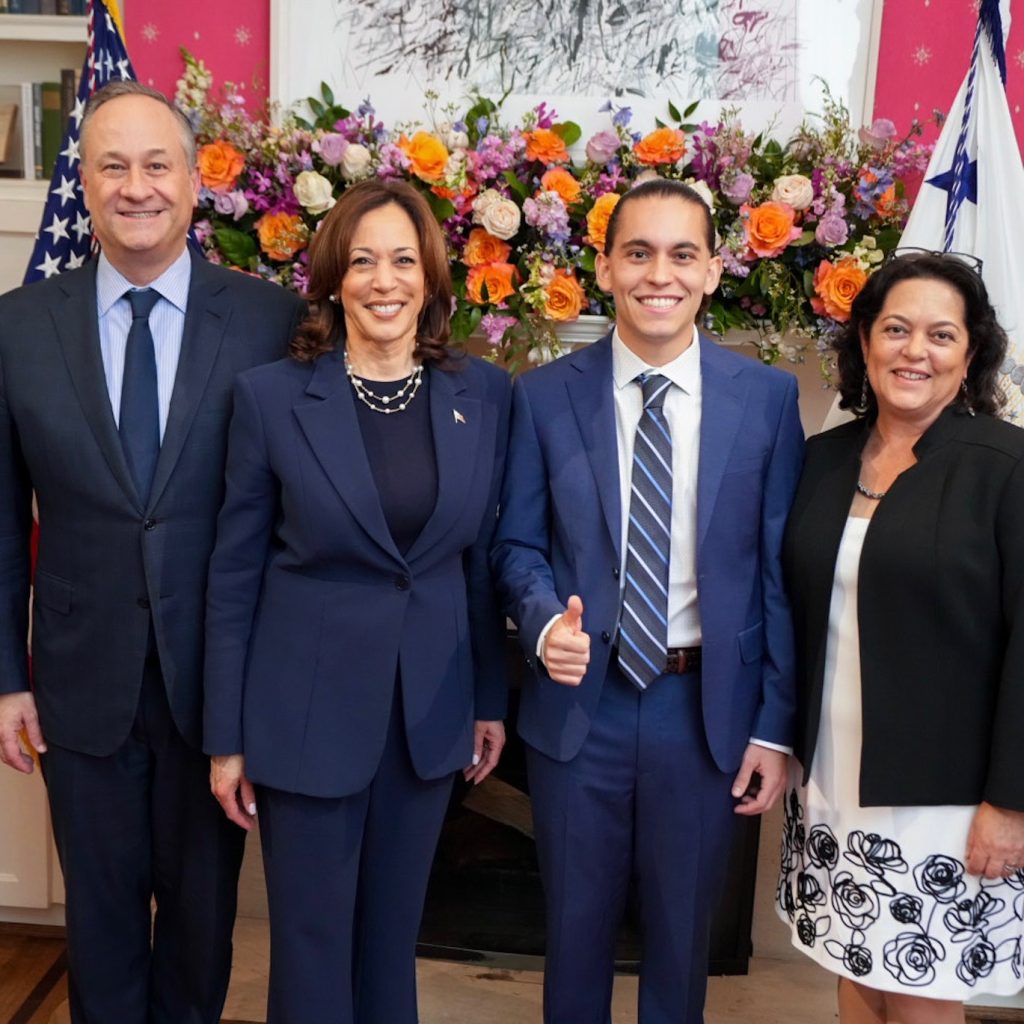
On Aug. 21, Vassar alumnus and former Vassar Student Association President Carlos Eduardo Espina ’20 spoke at the 2024 Democratic National Convention (DNC) in Chicago. “Buenas noches, mi gente,” he addressed the enthusiastic crowd. “If two decades ago, when my parents immigrated to College Station, Texas, you told them that one day their son would reach 14 million followers on social media, graduate law school and speak at the Democratic National Convention, they might not believe you.”
Espina was one of five social media influencers to secure a powerful speaking slot at the DNC this year—indicative of the Democratic Party’s attempt to adapt to a changing culture of news consumption that exists outside of “traditional” sources of information. “Ever since Biden took office, his administration’s been trying to make inroads with content creators because they recognize the influence and reach they have,” Espina said in an interview with The Miscellany News. Forging relationships with social media influencers, Espina added, allows for political administrations to verify content shared in videos. “Back in 2021 [the Biden administration] started doing briefings…for content creators, especially on very important topics like Covid and the war in Ukraine and Russia. They start[ed] inviting content creators to these meetings…just so they had correct information.”
Espina’s relationship with the White House began in January 2024, when he was approached by the White House digital communications team. He has since met with immigration advisors, President Joe Biden, First Lady Jill Biden and Vice President and DNC presidential nominee Kamala Harris. In mid-June, he posted a TikTok video with President Biden announcing a new immigration policy aimed at keeping American families of citizens and noncitizens together. Unlike his other content, the video was filmed in English. Espina provided Spanish subtitles. After describing the new policy, the two men embraced. “Thank you for what you do. You inspire a lot of young people,” said President Biden. “I never thought I’d hear that from the President,” Espina responded.

In the first week of August, Espina was invited to speak at the DNC. In the days that followed, his comments on social media flooded with positivity: “Amigo que orgullo y muchas felicitaciones por este inmenso LOGRO!!!!!!!!!! [Friend, I’m so proud of you and many congratulations for this immense ACHIEVEMENT!!!!!!!!!!]” read one; “Orgullo latino gracias por aportar en beneficio de los emigrantes!!! [Latino pride thanks for contributing to the benefit of immigrants!!!]” exclaimed another.
Espina is most active on TikTok, where he has amassed over 10 million followers. He created his account shortly after graduating from Vassar in 2020 with a degree in political science and Latin American studies; initially, he was filming videos for a nonprofit organization, but soon switched to making his own content. “It really just started as a hobby,” he said. Espina credits his rapid fame to a deficit in Spanish-spoken American political commentary online: “There was almost no one doing anything in my niche, which was Spanish content for people here in the U.S.,” he explained. “My first big boom was during the 2020 election,” he continued. “I went viral a lot of times analyzing each candidate’s proposals and breaking down the debates between Trump and Biden.”
Since beginning his account, much of Espina’s content has shifted to focus on immigration. “Immigration is kind of what I have more knowledge on, both firsthand and also actual formal studies in,” he said.
Espina was born in Uruguay and spent the first five years of his life there; however, both his parents had lived in the United States for years prior. “It is a little bit of a complicated story,” he said. “My dad’s from Uruguay. [He] moved to the U.S. in the ’80s during the dictatorship over there,” he explained. “My mom, at that point, was living in Mexico. My dad was traveling and met my mom in the early 1990s, and, well, they fell in love, and she moved to the U.S. with him… Unfortunately, in 1997, she was deported to Mexico.” Eventually, Espina and his parents all gained legal citizenship and moved to Texas.
“The United States—as long as it’s a great nation, people are going to want to come here,” Espina told The Miscellany News. “No one crosses the desert or crosses the Rio Grande river or…all these other routes migrants take, unless they have no other choice.”
According to a survey conducted by the Statista Research Department in July, immigration is the second-most important issue for American voters this coming election. Espina praised the Harris administration’s approach to immigration in his DNC speech but emphasized bipartisanship and unity. To a symphony of cheers, he declared: “To be pro-immigrant is to be pro-America!” Notably, he referenced Ronald Reagan’s 1986 Immigration Reform and Control Act, which granted amnesty to approximately three million undocumented immigrants.
“Obviously [mentioning Reagan] was very intentional,” Espina explained. “Ronald Reagan’s the main Republican dude everyone looks up to.” He continued: “He talked about creating an open border. He talked about not having any fences, let alone any walls at the border. How can we move back towards that? The reality is any of these solutions that I’m proposing are not possible unless you have some degree of bipartisan support.”
Highlighting the necessity of compromise, Espina explained: “If you look through a history about immigration and how it relates to the United States, it’s in pendulum swings.” He added: “I think we’re stuck in that moment where we’re at the height of anti-immigration sentiments, which, if history repeats itself, will at some point have to shift backwards.”
As for Espina’s personal opinions on immigration policy, he supports a revitalized immigration system with an expanded visa process and amnesty for undocumented individuals who meet certain requirements, such as residing in the United States for a particular period of time and having a clean criminal record. “If we want to decrease border crossings…the best way to do that is create legal pathways for people to be able to come,” he said.
With less than two months until election day, both Harris and Trump are attempting to appeal to the young voting demographic, which is predicted to be key in winning the presidential election. Addressing the Vassar student body specifically, Espina said: “Make the most of your education… A lot of stuff that I’m doing right now, even the stuff for my speech I gave at the DNC, is all stuff that I learned in my Latin American politics class.” Addressing young people as a whole, he stressed the importance of voting: “I say this as someone who works in the immigrant community, day in and day out. If you have the ability to vote, meaning you’re a U.S. citizen, you’re of age—you should exercise that. Whoever it’s going to be for.”
What a fascinating and uplifting story this is. Thanks for all the details.
All alum can be proud of Carlos Eduardo Espinosa ‘20