
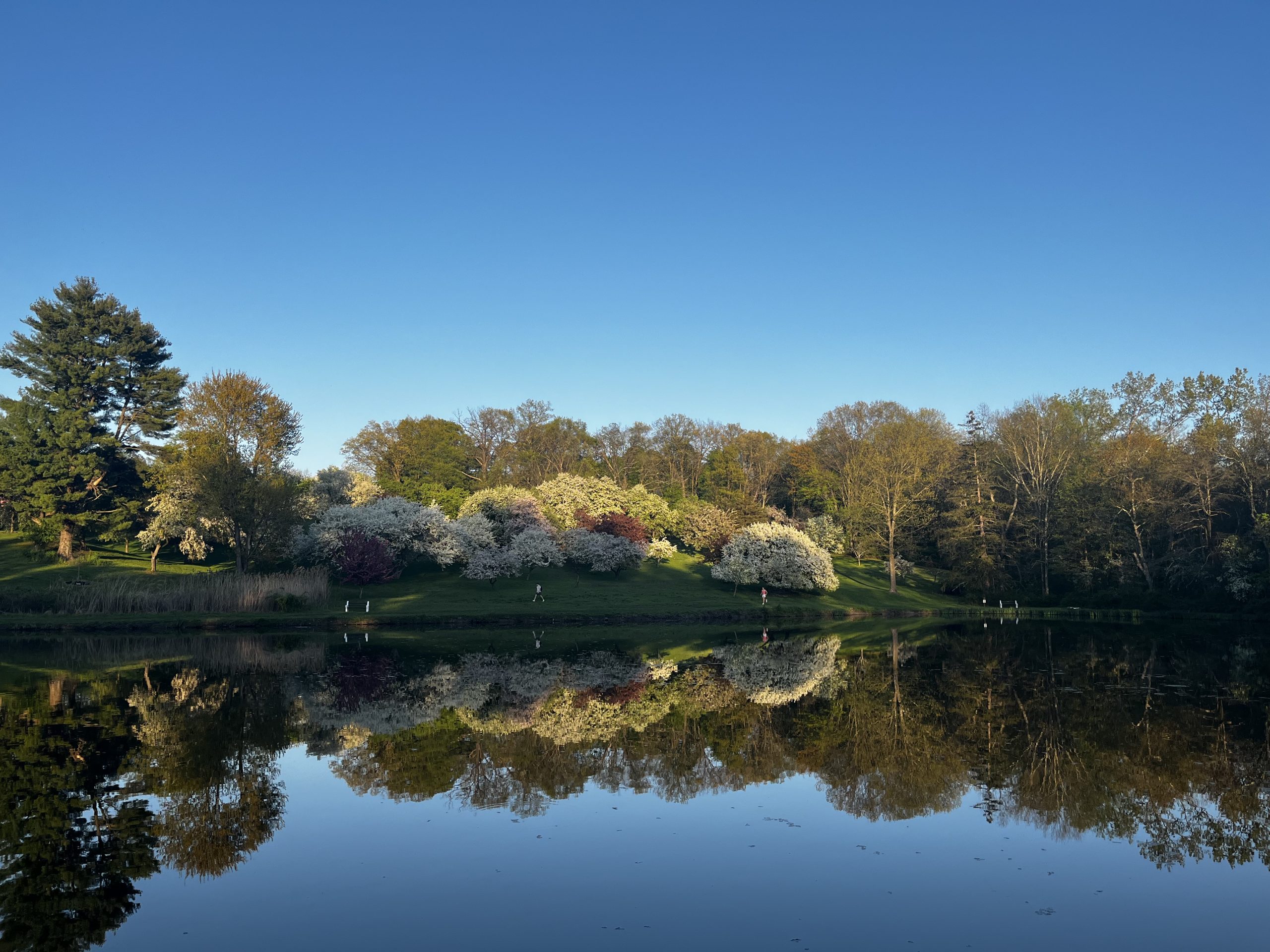
Sunset Lake has been a favorite campus spot since its construction in 1913. The man-made body of water situated between CommencementHill and Sunset Hill was originally created to be an ice rink. In the 1940s, it became the meeting point for Vassar students and male visitors; in 1969, it was the ground for student environmental activism. It is the home of spring goslings, the site of Founder’s Day fireworks, an education resource and an ideal location for stargazing.
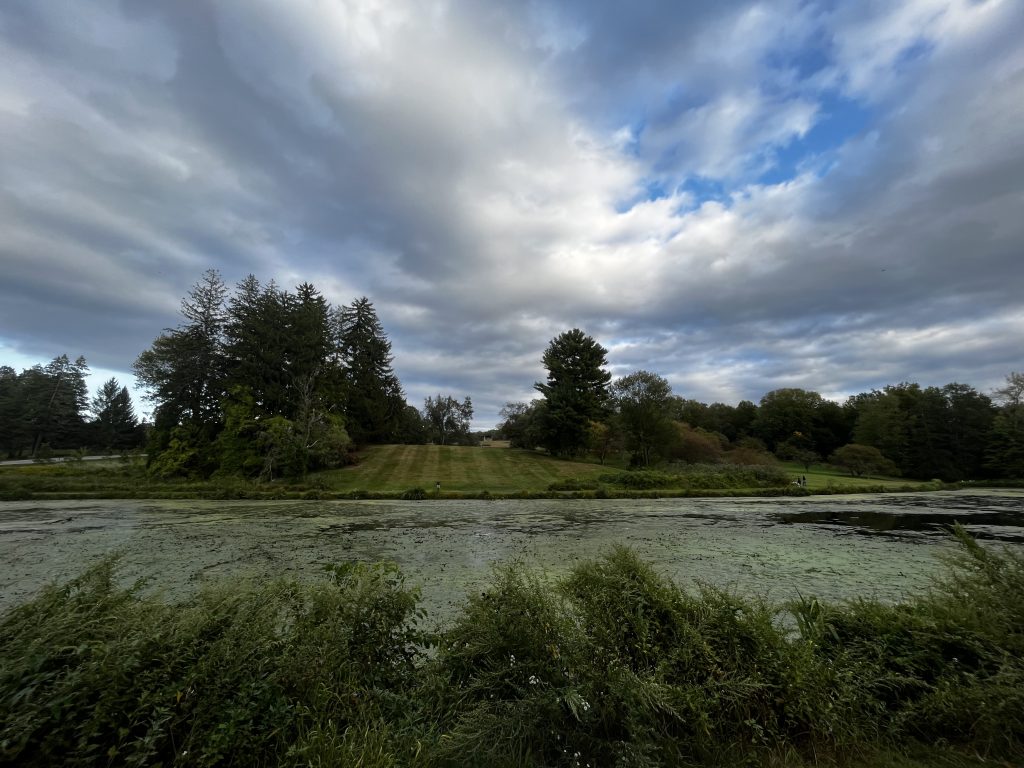
But returning students familiar with Sunset Lake will have noticed that its surface, usually clear enough to reflect the surrounding trees, reeds and sky, looks different this semester. It is covered in algae and invasive water chestnuts.
Biology Professor Myra Hughey explained in an interview with The Miscellany News that this summer’s weather, which was particularly hot and rainy, increased nutrient runoff in the Casperkill, the 11.6-mile creek that winds from Peach Hill Park into the lake and eventually, the Hudson River. “This is going to add a lot of nitrogen and phosphorus to the system, and that’s going to foster the growth of this algae and all kinds of plants in general,” she said.
Another factor, and a threat to water quality region-wide, is the infiltration of road salt. Hughey has been testing the water quality of Sunset Lake, specifically its salinity levels, with her students for years. “I would say this year is really exceptional. I’ve never seen it this terrible looking,” she said. “It surprised me. I think it surprised a lot of other people.”
Algal blooms and water chestnuts harm the lake in multiple ways. Sitting on top of the water’s surface, they shade everything below, preventing vegetation rooted in the substrate from growing. Additionally, the decomposition process of algae and water chestnut gobbles up dissolved oxygen (DO) in the water. “Fish and other aquatic animals and plants die because the algae is using all the oxygen,” said Earth Science and Environmental Studies Professor Deon Knights in an interview.
Knights, whose research focuses on water quality issues in coastal zones, measured levels of DO in various samples from Sunset Lake last weekend. Following up via email, he wrote that healthy bodies of water should have a DO concentration between 80 percent and 120 percent, or somewhere between 6.5 and 8 parts per million (ppm). In three out of four sample locations, Knights found that the lake had significantly reduced levels of DO: Off the bridge, a concentration of 55 percent, or 5.2 ppm; at the edge below Commencement Hill, 7.9 percent, or 0.69 ppm; and near the dam, a concentration of 60 percent, or 5.3 ppm. Near Sunset Hill, Knights found there to be a much higher concentration of DO: 141 percent, or 12 ppm. Interestingly, this sample was taken from a site only slightly shallower than that near the dam, demonstrating a remarkable inconsistency of DO across the lake, regardless of depth.
Further exacerbating the depletion of DO is the fact that the fountain in the middle of the lake, which helps to oxygenate the water, is out of commission. According to Dean Jaeger, Grounds Manager, and Maxine Coleman, Assistant Vice President for Facilities Operations, the fountain broke over summer break. Repair is underway.
The water quality of Sunset Lake has important consequences for the rest of the area. At the lakes’ dam, the Casperkill joins the Fontynkill and gushes into the Preserve. In an email correspondence, Director of the Preserve Keri VanCamp wrote, “The land surrounding the [stream] on the Preserve is composed of healthy riparian buffers and functioning wetlands which help to clean the water.” But as the quality of water passing through the dam declines, these natural filters struggle to keep up, and organisms that are sensitive to environmental conditions die. “The water only supports organisms that tolerate poor conditions. That leads to a drop in biodiversity in the stream,” VanCamp explained.
VanCamp wrote that increasing the width of the riparian buffer around the lake by planting more trees and shrubbery can help protect the Preserve. But altogether preventing growth on the lake’s surface is impossible. “There’s not a whole lot that we can do about what’s happening upstream from us,” Hughey explained. “We can notify the town and the city about it and kind of encourage them to take legal measures to clean up the watershed…but the biggest thing that we [can] do is just getting all that stuff out of there and maintaining it.”
According to Jaeger and Coleman, cleaning the algae and water chestnuts from Sunset Lake is a complicated process. To dredge the lake, Facilities Operations must first measure and test the sediment to determine how much must be removed, they explained in an email correspondence. “Part of the testing is to determine if the silt that is dredged can be reused on campus,” they wrote. They added: “This will be a significant project and is not immediate or quick as town permitting from authorities with jurisdiction is a process that unto itself can take a year.”
The summer of 2024 was the hottest on record worldwide, according to data from the Copernicus Climate Change Service. New York Governor Kathy Hochel declared multiple state-wide Disaster Emergencies this summer due to excessive rainstorms and consequential flood risks. But these extreme weather headlines are all-too-familiar; before this year, 2023 saw the hottest summer in 2,000 years. The water quality of Sunset Lake is everything but an isolated incident or a fluke—it is directly related to the onset of global warming.
Jaeger and Coleman pointed out that the growth over Sunset Lake has a terminal lifespan: “As soon as the cold weather sets in the algae in the lake will die,” they wrote. Still, it is a problem to be reckoned with—a miniature model demonstrating the effects of climate change on our campus.