
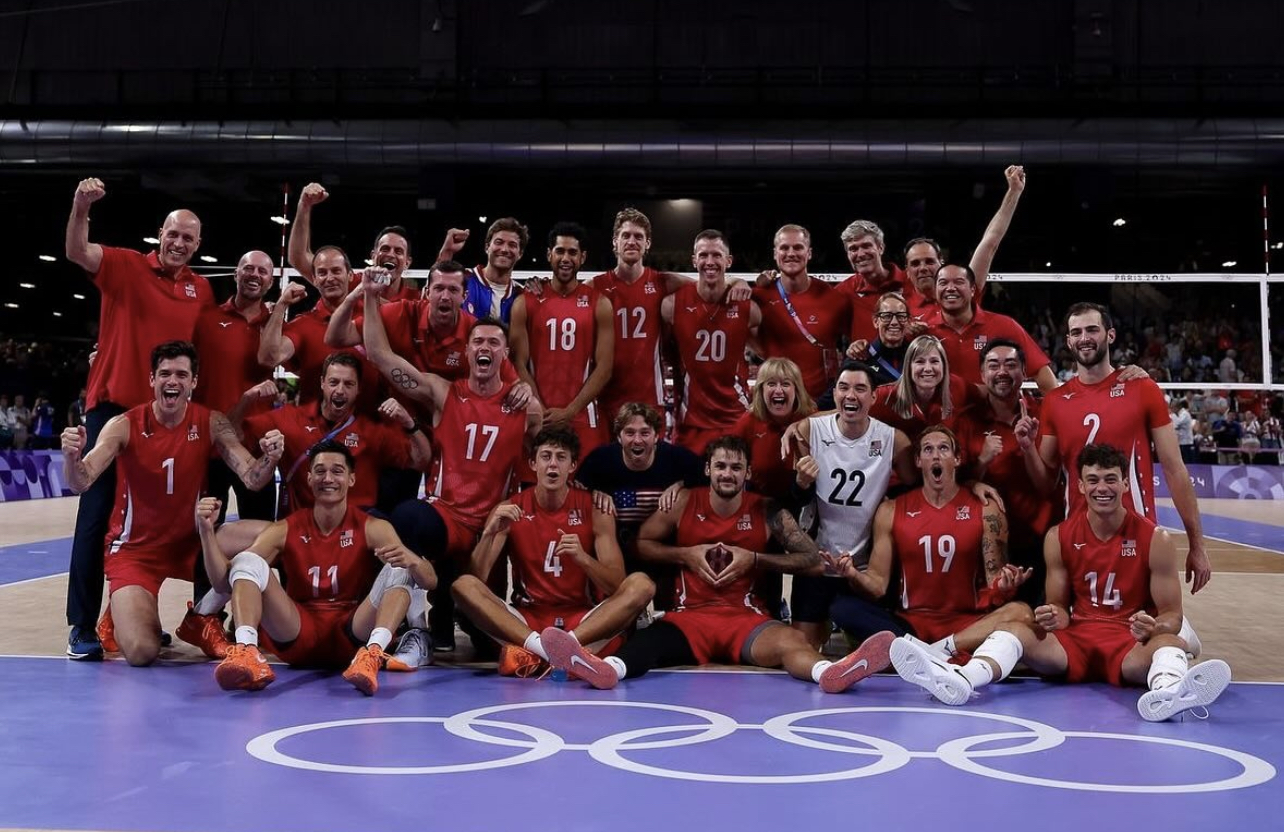
Matt Knigge worried it was all about to fall apart. The cold winter months had arrived in Lüneburg, a German town about 300 kilometers from Berlin, and he had just torn two ligaments in his ankle shortly after signing the best contract of his career and impressing during his first stint with the U.S. Men’s National Team. Knigge, who graduated from Vassar in 2018, was now a long way from Division III competition. But he understood that opportunity is fleeting, and underdog journeys can always come to a screeching halt.
Both Berlin Recycling Volleys, the team Knigge had just signed with, and the national team were watching him closely. And they wanted to see him moving dynamically across the court—sealing blocks, crushing attacks and ripping serves—not mending a hurt ankle. While the ink had dried on Knigge’s contract, professional volleyball deals are a far cry from the fully guaranteed money given in leagues like the NBA. If Knigge was not performing at full capacity in the months before the season, Berlin, the German Bundesliga’s perennial kings, could cancel the contract.
With five weeks until his current team, SVG Lüneburg, was set to face off against Berlin, Knigge knew he needed to rise to the occasion. How he finished his first professional season in the Bundesliga was shaping up to be one of the most crucial stretches of his career.
Knigge returned in time to play against Berlin and, shortly after, had what he described as the best match of his professional career in the semifinals of the European Volleyball Confederation Cup, a tournament played by some of the best clubs in Europe. Lüneburg was a set away from elimination but won four straight sets, including a winner-takes-all tie-breaking set, to advance to the championship.
At the time, Knigge’s return to play was his latest unlikely feat. He was once a high school prospect denied by Division I programs, once a Division III standout ready to give up volleyball for a Fulbright Scholarship and once a professional athlete worried about his next contract.
He would soon outdo himself again.
The Start of an Unexpected Summer
After his professional season ended, Knigge returned to Anaheim, California to train with the national team for a second summer. He hoped to prove he still belonged among the best players in the country. Before arriving in Anaheim, Knigge had been named to the 30-man roster of American players contending to represent the U.S. at the 2024 Volleyball Nations League (VNL), an annual summer tournament where international programs compete for a VNL championship and world ranking points.
With the Paris Olympics only a few months away, Knigge and the rest of the less experienced players were given the opportunity to play in Week 1 of VNL in Antalya, Turkey against some of the best teams in the world while the Olympic roster trained in Southern California.
“I had a personal awakening in terms of my volleyball career, and played probably the best volleyball in my life in terms of serving, attacking and also blocking, like the stars align[ing],” Knigge told The Miscellany News. “Just all of a sudden I’m playing a level of volleyball I never really even knew I had.”
Though he had excelled in Antalya, Knigge said he did not anticipate any sort of promotion from the secondary squad and was looking forward to what he thought was going to be a week off. But when Knigge landed in Los Angeles and turned on his U.S. SIM card, he had a message waiting for him: an invitation to practice with the recently selected Olympians.
Instead of on his anticipated vacation, Knigge was practicing with the Olympic team less than 24 hours after he landed in LA. That same day, Knigge was told he would be traveling with the team to VNL Week 2 in Ottawa. His role was to help the team practice, to be a completely rested force when they needed to simulate match-like competition. Once again, he rose to a daunting task.
“I was serving probably the best I’d ever served in life,” Knigge said. “I was probably the number one server in the men’s gym that summer. It was an out of body experience where just everything I was doing was working. It was unreal.”
Knigge got to dress for one match in Ottawa but did not see the court. He headed home, satisfied with his two weeks of VNL.
An Olympic Opportunity
A few weeks of training with the secondary squad passed. Then one morning, while he was brushing his teeth, Knigge received a call that would ultimately bring him closer to the Olympics than any Vassar athlete had ever been.
“It’s unusual to get a call,” Knigge said. “I stop brushing my teeth and pick up the phone, and [the coach] sounds frantic. He’s like, ‘How quickly can you get into the gym?’”
“I live like 15-20 minutes away from the gym. And I say, ‘10 minutes. Why? What’s up?’”
“[The coach] says, ‘We have two middles down. Get down here as soon as you can.’”
“Instantly, my heart rate goes from 50 beats a minute to 100 beats a minute,” Knigge said. “I spit out the toothpaste, like in a movie.”
Knigge scrambled, and about half an hour later, he got to the gym.
“I run into the gym, court shoes in hand, and there’s the Olympic 12, minus the two hurt guys, standing around, essentially waiting for me so that they can resume practice,” Knigge said.
Without any warm-up, Knigge jumped into practice. Once again, he reached new heights.
“I quite literally had the best training I’ve ever had in my life,” Knigge said of what he described as an unparalleled adrenaline rush. “[I’m] jumping the highest I’ve ever jumped, hitting the ball the hardest I’ve ever hit. Every shot I was hitting was working.”
With one of the Olympic middle blockers still nursing an injury, Knigge was told at the end of that week that his summer would have at least one more trip: pre-Olympics prep in Poland. Once it was time for the team to leave for Paris, Knigge would head back stateside.
That was the plan until Knigge was approached on the bus during the Olympic squad’s last day in Poland by the team’s head coach, John Speraw.
“[Speraw] comes up to me, stops, pulls his AirPods out, and in the most nonchalant tone, looks at me and says, ‘We’ve decided we’re going to take you to Paris.’”
Speraw might have been nonchalant, but four-time Olympian Matt Anderson and three-time Olympian Micah Christenson, who were seated near Knigge, were not.
“They’ve both got the biggest grins on their face,” Knigge said. “The look on my face, I’m sure, said it all. In the last five days, let alone the entire summer, I couldn’t have projected any of this coming true.”
Ultimately, three-time Olympian David Smith was cleared to play ahead of the Olympics’ opening match, and Knigge was never activated to the 12-man roster.
Getting so close to being an Olympian and part of a medal-winning team is unbelievable, bittersweet and motivating all at the same time, Knigge said.
“To look back on the last year and quite honestly, the last eight years of volleyball I’ve had, to consider the fact that I would even be in the running, or to still be at the Olympics with the US Men’s National Team is an incredible opportunity,” Knigge said. “I’ve already beaten the odds.”
Still, Knigge’s goal is unabashedly clear: to be a 2028 LA Olympian. And with three of the four middle blockers who were Paris Olympians likely retiring, it is certainly a feasible goal to set.
“You have to set a high bar for yourself,” Knigge said of his mindset. “It’s like in pole vault. If you always just keep clearing the bar, you’ll never realistically know what your max is. So you just have to keep raising the bar, and you can’t be scared to sometimes set the bar too high and see if you fail.”
“And so, until you fail, who knows where the limit is?”
Knigge is certainly still searching for his.