
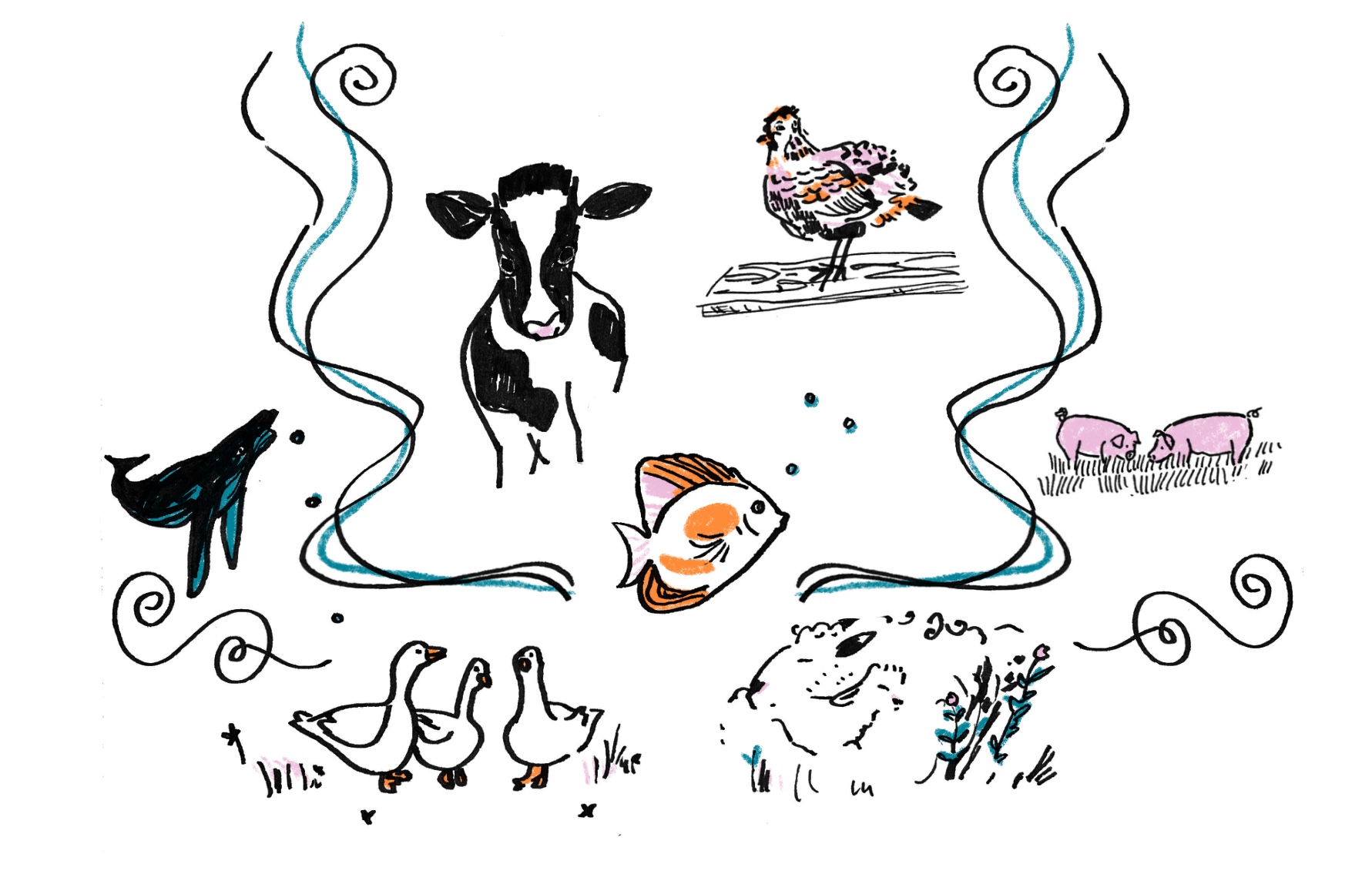
It has been a year since I became a vegetarian, and when family or friends ask why, my response often seems too nonchalant or indifferent for my liking. Simply stating that it is because I care for animal rights seems to be half-hearted—one can be a meat-eater and still care for animals, after all. And though I do not have quasi-mystical reason like in Han Kang’s “The Vegetarian” where the protagonist suddenly converts to vegetarianism because of a dream, there are justifications for vegetarianism that resound across society—or at least should. Prominent among these justifications is Martha Nussbaum’s Capabilities Approach in her work “Justice for Animals: Our Collective Responsibility.”
Nussbaum’s Capabilities Approach relies on a basic theory of injustice. Beings (human and non-human) are striving for significance through meaningful activities like movement, communication and social bonding. Injustice is when this striving is blocked or interfered wrongfully, by malice or neglect, say. This notion of significant striving means that animals have sentience—a subjective view on the world, not just an automatic gravitation to pleasures and the avoidance of harms but rather the perceptual awareness and emotional understanding that imbues this striving with personal meaning. For example, Cnidarians (corals, jellyfish, sea anemones) and Porifera (sponges) do not exhibit sentience.
So, when animals are wrongfully thwarted in their striving for a flourishing life, injustice occurs. Importantly, this thwarting is not merely harm. An illness, storm, or competing with another animal for food can negatively affect an animal’s life, but we would not consider that an injustice—this is more of an impediment. Rather, this thwarting needs to have some sense of wrongdoing either as a deliberate or negligent act. Human life is everywhere, from habitat invasion to the invention of factory farming—the pervasiveness of human power means that humans have a responsibility to treat these domains ethically and with care. Nussbaum argues that humans are all collectively responsible for supporting the life-activities with those creatures with whom we share the planet by stopping our wrongful interference so that all sentient creatures have a chance at striving for a flourishing life.
Some utilitarians like Jeremy Bentham will say that killing an animal can be humane if done painlessly and morally acceptable if for some useful human purpose that is not sadistic or for pure amusement. However, as R.M. Hare and Peter Singer will respond, most meat-eating today is grounded in pain-inflicting practices like factory farming and slaughterhouses. Factory farming is grossly inhumane—animals bred, confined and mutilated in industrial production facilities with little concern for their well-being. Animals here are denied any chance at this Nussbaumian notion of striving for a flourishing life—they cannot freely move, enjoy fresh air, or have the autonomy to live as active, sentient animals. They are treated simply as products to gain a profit from, exhibiting the sheer instrumental use of another sentient being. Zoe Giles ’25 became a vegetarian in the 6th grade after learning about the horrors of a slaughterhouse. She stated, “Now I don’t even like meat. I can’t get over the concept of eating meat.” The ethical horrors are additionally underscored by the greenhouse gas emissions produced by factory farms.
However, shifting to an animal-free diet is not feasible for everyone. Some require the nutrients from meat for their health. Nussbaum herself eats fish, and though she has an interesting justification on why fish are not considered sentient beings, she more prominently states that the problem with eating meat is when we use the animal as a mere means and do not respect their dignity. Acknowledging that the world is represented to animals in a certain way and that animals move about the world and strive for meaning and significance is something we ought to recognize. Humane farming is one step forward in this respect. Importantly, animal-free diets also come with their own class and economic considerations. Products from humane farming or meat alternatives can be more costly. It is easy to say that ought entails can, however the reality of the financial burdens of a vegetarian diet is one that should not be ignored and is a reflection not on the individual but of our structural problems with society. As Ellie Sheik ’25 commented, “I don’t think we have to cut out meat, I just think eating less of it is healthier for us and healthier for the planet.”
Like Sheik, I do not wish nor do I think it fathomable for everyone to become a vegetarian. For myself, I have come to learn that simply stating “animal rights”—a culmination of Nussbaum’s Capabilities Approach and the brutalities of factory farming—for the reason that I am a vegetarian seems only to be part of it. Perhaps here is the other: The diverse world of non-human beings is one that evokes a child-like wonder not inwardly self-attached but outwardly directed. That is, to see another animal moving about the world in their own way and sense of meaning takes me out of my own worries. And this sense of wonder is ethically attuned. My attention is rapt in something other than myself, and I garner a sense of respect and understanding for animals whose perception and sense of significance I may not understand—surely, I do not need to understand and pathologically anthropomorphize an animal’s form of life in order to have compassion for them. Franz Kafka, a vegetarian, stated when looking at a fish in an aquarium, “Now at last I can look at you in peace; I don’t eat you anymore.” Kafka’s comment is silly and a bit sardonic in its own right, but perhaps revealing in something at its core for vegetarians too.
Thank you for this insightful article. But you may not be aware that Vassar College has been practicing a cruel slaughter of deer in the Vassar Preserve over the last 14 years, resulting in the deaths of 285 deer. It is monstrous, twisted, and full of distortions justifying it. The college does everything possible to hide it from students and alumni, as I’ve learned by speaking with many of them. The deer are baited in with corn for weeks in December and then shot in cold bood in January using high-powered night scope rifles while they are feeding on corn. It’s all done while students are gone. Go to Save Our Deer: Science Over Slaughter on Facebook to learn more.