
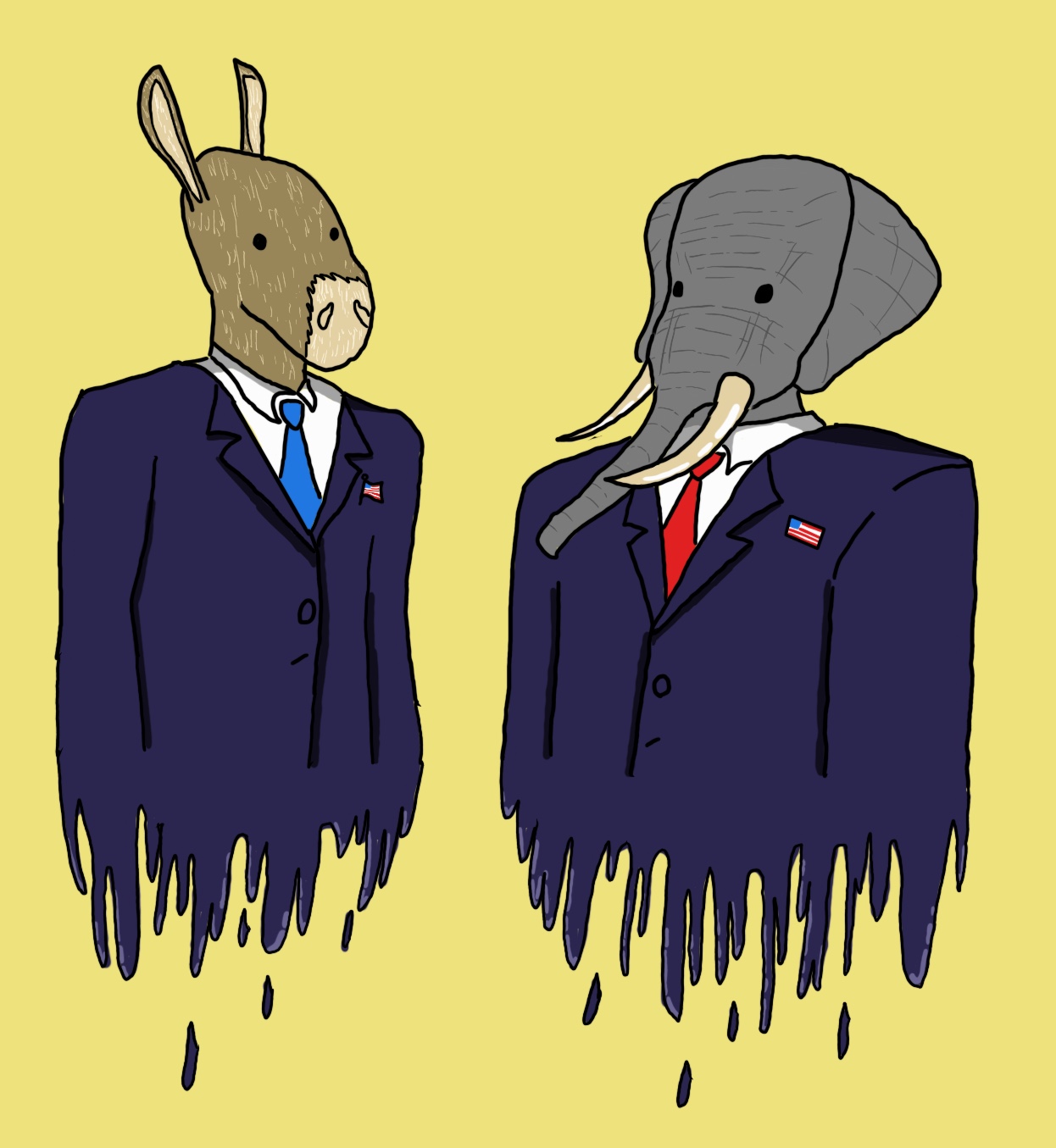
As this next cycle of elections comes near, we are once again reminded of how limited our options are. American polarization is generally emphasized through a binary divide: liberal and conservative, Democrat or Republican. However, Americans can actually be divided into nine distinct categories, according to the 2021 political typology of the Pew Research Center.
Dissatisfaction with the two-party system is at an all-time high of 63 percent, per a 2023 Gallup poll, and the plurality of Americans, 42 percent, consider themselves Independents. This division is evident of what we need to do: break up the major parties as they stand.
This is nothing new to American discourse, and people have long wanted for the political establishment of the two-party system to be abolished. For an increasingly flawed democracy, per the Economist Intelligence Unit, this diversity of thought cannot be ignored. Having a representative democracy means representing the complexities of the electorate, so people should not be left voting for the better option, but rather their best option.
However, not even then are there remotely viable options because of the two major parties’ duopoly and the historical precedent of voting. I think that many people vote based on party loyalty and not so much on their personal ideology. Of course, it would be near impossible to have a perfect candidate who fits their constituents to a tee, but I would generally advise against voting for a candidate purely based on their political allegiance.
That is why a potential solution, though a long-term vision, might be through not expanding on the already existent minor parties directly, but rather abolishing the two-party system from within and splitting the parties along their factions into various groups that could form coalitions with those already existent minor parties. Either that, or no parties at all: where politicians would not be constrained to party discipline and could have a different opinion on every issue.
The Democratic and Republican Parties are already hyper-factioned. While for issues like reproductive rights and gun control, there are fairly general agreements along party lines, there is less of a consensus on the subject of, for example, military aid and the defense budget—particularly to how it pertains to Israel, arguably the issue that may determine the outcome of this election.
In April, 58 members of the House of Representatives—37 Democrats and 21 Republicans—voted against the Israeli aid bill, largely representing the ideological fringes of both parties. While the Democratic opposition was in condemnation of Israel’s decimation of Gaza, where there are reasonable grounds to believe that the legal threshold of genocide has been met, as reported by Special Rapporteur Francesca Albanese to the United Nations Human Rights Council, Republican opposition is based on the growing isolationism spearheaded by former President Donald Trump. Despite the majority of Americans supporting an arms embargo on Israel, according to a June poll from CBS, this unequivocal aid has not ceased, and violence has further spread throughout the Middle East.
When the majority of Americans feel like they are living paycheck to paycheck, according to a MarketWatch survey, taxes should be going into social programs for their well-being, not enabling a bombing campaign that is among the deadliest and most destructive in recent history which shows the compromising effects of militarism on our welfare, per the Institute for Policy Studies. Unfortunately, only 35 percent of the people surveyed by Gallup think that the United States is spending too much on national defense and military purposes. However, even that 35 percent is not adequately represented at the federal level, as military spending bills continue to pass with ease.
Furthermore, why have the Libertarian and Green Parties—the third and fourth largest parties respectively—not made any noteworthy progress in building local coalitions or running in state elections, but they do continue to field perennial candidates every four years? This attempt to challenge the duopoly has only done one obvious thing: siphon votes from a disaffected electorate.
While nominating candidates can lead to public funding and a preferable option for upset voters, I see an apparent lack of transparency from candidates in what their intentions are. The presidency is only a piece of the puzzle, and this election alone will not challenge the two-party system enough. However, it could be used as a starting point to mobilize people at the grassroots.
As much as I would like for alternative candidates to have a real chance at winning the election, the fear that a vote can be “wasted” if not cast for a Democrat or a Republican creates a self-perpetuating cycle, leading to the American public overwhelmingly voting for the two major parties.
I empathize with those who plan to abandon the Democratic ticket due to the Biden Administration’s policy on Gaza and Kamala Harris’ unwillingness to pivot in support of an arms embargo on Israel.
However, I have a few questions to consider for those who are stuck or conflicted: Do you fully recognize where your vote is counted and the extent of reasons you are doing it? Are you voting in a swing state where the winner will come down to a few thousand votes? Are you a single-issue voter, or is it more than that? Remember: Drastic electoral reform will not come out of the results of this election, so consider that before you cast your ballot.
Escaping the binary of political parties is inextricably linked to electoral reform, and our need for proportional representation and ranked-choice voting is essential to maintaining the remanence of democracy. Regardless of the result this November, it is not your fault. It is the fault of the system. The political establishment is responsible for staying up with the people, not the other way around.