
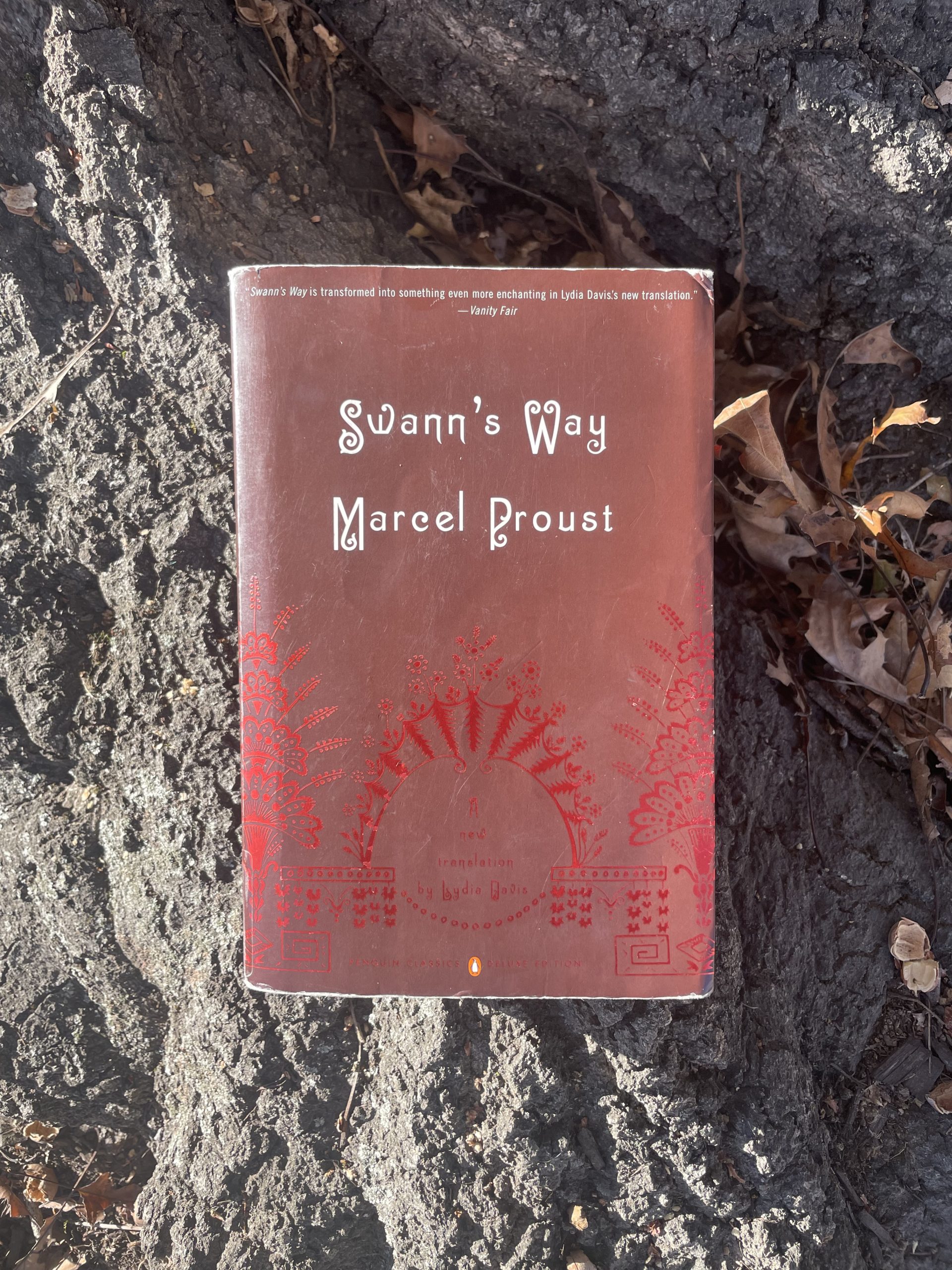
Over the summer, I read “Minima Moralia: Reflections from Damaged Life” by Theodor Adorno for my senior thesis. The first of 153 numbered passages is titled “For Marcel Proust.” A month after finishing “Minima Moralia,” I began volume one of Proust’s seven-part novel “In Search of Lost Time,” entitled “Swann’s Way.” I looked forward to absorbing some fiction which, even prior to thesis reading, had long been on my to-do list.
The thesis seminar course is led by Associate Professor of Philosophy Christopher Raymond. During The Miscellany News’ last Editorial Board meeting, Features Editor Caris Lee ’25, a fellow student in the seminar, mentioned that Professor Raymond had a unique connection to Proust: He spent one of his summers before graduate school working in a bread store while reading all seven volumes of the novel. The convergences between my academic work, non-academic reading, newspaper writing and personal connections seemed all too intertwined, and I later sought out Professor Raymond for some casual literary conversation before starting this piece.
“Swann’s Way” is about a variety of topics deftly woven together: romance, childhood, remembrance, musical motifs, class society, sensory experience, late 19th-century French bourgeois social customs and more. In one respect, the complete seven volumes form one Künstlerroman, or a narrative about an artist’s process to maturity. The importance of aesthetic experience is given prominence through the novel’s encyclopedic references to various works of art, forcing the reader to self-reflectively examine their own unfolding understanding of “Swann’s Way” as an artwork incorporated into our routine. It consistently invites us to consider the importance of the books, paintings, poems and more that we engage with.
[SPOILERS AHEAD]
The title “In Search of Lost Time” immediately cues us into the centrality of nostalgic remembrance. Our nameless narrator in “Swann’s Way” has a singular memory of his childhood home in the countryside before the taste of a madeleine cake revives this world once more, after which he divulges this milieu’s related events and characters. While discussing the novel, Professor Raymond and I noted the irony of engaging with work that thoroughly describes memories despite being ourselves unable to recall the book’s various details, whether it be multiple years or mere weeks after reading it for him and me respectively. At the volume’s end, the narrator remarks, “The reality I had known no longer existed,” further noting how “…the remembrance of a particular form is but regret for a particular moment; and houses, roads, avenues are as fugitive, alas, as the years.” Why might readers and narrator alike latch onto highly specific moments without being able to construct a comprehensive account of the past, whether it relates to actual experience or that which is contained on pages?
Obviously, memory is never infallible. Writing things down is one potential remedy, but I wanted to understand how I knew the book was incredible without simultaneously being able to recall an outline of its complete events. Stylistically, the level of intense description provided by Proust makes it essentially impossible for totalizing comprehension. How could I even approach “Swann’s Way,” much less write about it for the newspaper?
With my thesis in mind, reconsulting Adorno’s philosophy gave me a starting point, which might have further complicated everything. Classic. In his “Short Commentaries on Proust,” Adorno describes how doing analytic justice to Proust’s work would require further interrogating the entanglement of detail, rather than laboriously approaching the whole of the novel’s structure. Instead, what is complete or total within Proust’s volumes are their highly particular moments: Unity in the work is identical to a reader’s passive capacity to lose themselves in detail “without restraint or reservation.” Time passes in these countless instances through which the book’s themes emerge, dissolve and reappear, whether it involves the narrator’s recollection or the examination of the titular Charles Swann, a friend of the former’s family. I was constantly rereading passages in an attempt to sort through these details, which often breezily flowed owing to the fluidity of their composition.
Adorno continues by asserting that Proust’s work captures the experience of having people who are decisive in our lives appear in them “as though appointed and dispensed by an unknown author,” crossing our paths as distinct yet shifting figures within particular moments. People change through time by the descriptive images we impose upon them in order to assert our own understanding; this is especially pertinent to the narrator’s recollections. If anything can be established about the novel’s structure, it is the fact that “Swann’s Way” proceeds by describing the path these constructed images might take in our lives. This felt especially relevant to senior year, a time frequently marked by revaluation of preconceptions, new self-understanding and random reconnection with others.
Oddly, but not without reason, interrogating Proust might then involve thinking about the images I imposed upon my own continual experience with text, the (potentially deceptive) appearances I retained from or ascribed to its inked words. I thought back to reading environments and contexts, the when and where of “Swann’s Way” during my own life: the quiet humming of a bus, dining hall silence, solitary bedrooms. The most salient moments of the book emerged both in those settings and through discussion with others. Walks through the Champs-Élysées, Françoise’s personality, the aching of Swann’s collapsed love, Bloch’s artistic friendship and the lighting of the narrator’s bedroom are among some of these prominent instances for myself.
As previously hinted, “Swann’s Way” had been engaging because, like any actual remembrance of past life, the passages that resonated could be carried within me to recreate a picture of the reading experience, even if this picture immediately began fading amidst a vast presentation of written datum. My reading and reality had come together here, both structurally and thematically. Picking up the book over October Break after putting it down in early September, I struggled to precisely recall where I had even left off.
This article’s account still feels traditionally incomplete, likely owing to its lack of content analysis or even a vague plot summary. Still, it seems that in order to understand something holistic about Proust, we have to start with the particularities elaborated between the book covers; our usual demand for clear systematicity is not always stylistically compatible with writing on this content.
Regardless, this reflection has gotten me closer to capturing what made the book memorable, even as these memories begin to fail me. As my daily routine’s actions slowly escape my mind into the future, summer 2024’s transition into this fall will remain colored by the impression of reading “Swann’s Way,” one point of reminiscence among an assemblage of minute, fleeting instants.
“ The only real voyage of discovery consists not in seeking new landscapes, but in having new EYES.”
Marcel Proust