
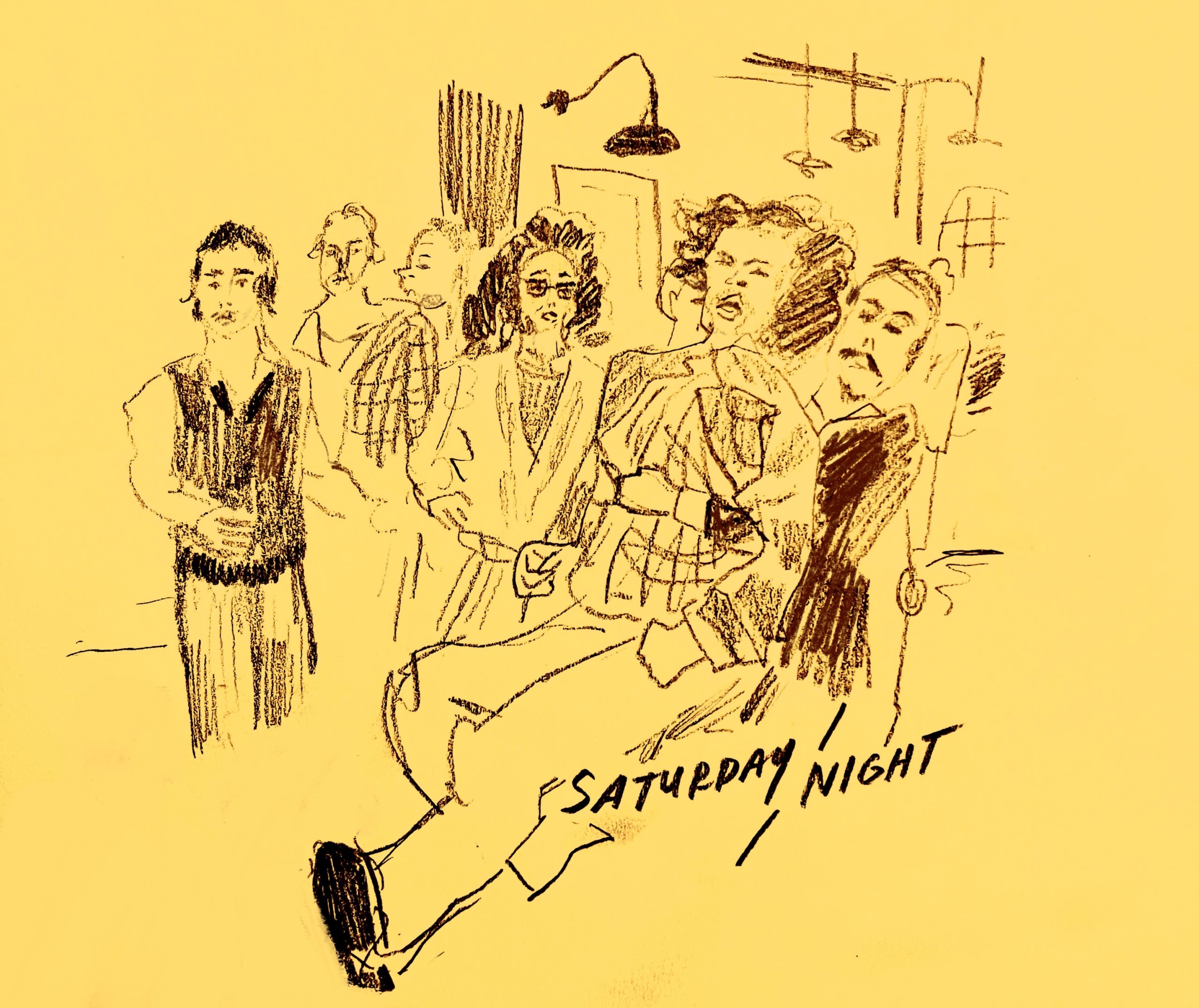
Before I begin breaking down Jason Reitman’s new movie “Saturday Night,” let me make one thing clear: I am a biased critic. I have, for as long as I can remember, watched “Saturday Night Live” (“SNL”) every week. Whether that means I stay up on Saturday and watch it live, get up on Sunday morning and tune in over breakfast or (the worst-case scenario) wait until the middle of the week, I never miss an episode. In fact, I have not missed an episode since my dad sat me and my brother down in front of the TV at an age one can only call “way too young” and made sure we were properly educated on the world of “SNL,” from Bill Hader’s Stefon to Will Ferrell and Cheri Oteri’s Spartan Cheerleaders and back again. I watched all of Lonely Island’s videos before learning to do basic algebra, and I memorized most of the Weekend Update host pairings before the state capitals. And I stand by that. Needless to say, I am a fan. So, when I found out that there was going to be a film dramatizing the 90 minutes leading up to the very first “SNL” broadcast, I was a little bit excited.
First and foremost, let us talk about the cast of characters involved in “SNL’s” first episode. The captain of the barely-floating ship is, of course, Lorne Michaels. He is synonymous with the show and is still the executive producer after 50 years. Most of the comedy legends we all know and love have been hand-picked or hand-rejected by Michaels personally. He is played by Gabriel LaBelle, who some might remember from Steven Spielberg’s semi-autobiographical film “The Fablemans.” Michaels is characterized nowadays as a mysterious, god-like, stalwart figure. In “Saturday Night,” however, he is as much a source of chaotic intensity as he is a problem solver. While he seems blindly confident in the value and necessity of his entertainment concept, he also carries a stress-inducing level of indecisiveness, creating an unending string of problems right behind them. As “SNL” enters its 50th year on air, there are rumblings of conversation around who will replace Michaels, when it will happen and if it is even possible for the show to go on without him. However, this film proves just how much weight his vision and belief carry, and the faith he had in a motley crew to have their finger on the creative and intellectual pulse of New York City.
The character that surprised me the most from “Saturday Night” was undoubtedly the portrayal of Rosie Shuster, played expertly by Rachel Sennot. Shuster was one of three female writers on the staff during the beginning of “SNL,” but her role aligned more with that of a circus’ ringmaster. Part of her characterization in the film is as Michaels’ wife. The two met in their childhood and grew closer, developing their relationship into a romantic partnership and a comedic writing team. By the time they were working on “SNL,” they had already been long separated, and Shuster famously was attached to Dan Akryod, one of the original stars of the “SNL” cast. The persisting tension of Shuster’s romantic loyalty has a small place in the film, but her significance goes far beyond that. While everything and everyone is crumbling, Shuster is focused, determined and keeps her head above the water. She is maternal and caring and does not allow her warmth to give anyone the opportunity to steamroll her. She is sharp and funny, and her mature calmness keeps her elevated from the unpredictability. Her ability to assure those around her injects her persona with the eerie feeling that she knows everything will work out, the same feeling the audience experiences, no matter how close the show feels to falling into failure.
The rest of the cast is just as strong as the leads. Dylan O’Brien’s Dan Akyrod, Cory Michael Smith’s Chevy Chase and Tommy Dewey’s Michael O’Donoghue perfectly capture the mixture of a distinct “boys club” attitude with the charm of ’70s-era comedy. They are each filled to the brim with ego but are aware that they need to prove themselves in this new, risky comedic format, so the lingering desperation undercuts some of their macho-leaning qualities. Matt Wood’s John Belushi is a surprisingly paradoxical presence. He was undoubtedly a scene-stealer while he was on the show, and holds a permanent place in the “SNL” Hall of Fame. In the film, however, he struggles with a deep insecurity and hesitance in his performance. He is overrun with a fight-or-flight response, and both fights and flights multiple times throughout the 90-minute chaos. I was unbelievably impressed with Lamorne Morris’ Garrett Morris, who delivered the most laugh-out-loud, unexpected moments of the entire film. He acted as an intellectual foil to the other male players of the cast and represented a more vulnerable side of becoming part of the risky and new “SNL.” The women, namely Ella Hunt’s Gilda Radner, Kim Matula’s Jane Curtin and Emily Fairn’s Laraine Newman are the heart of the film. They are the ones who actually seem like they are having fun and maintain a true sense of camaraderie in their dynamic and shared understanding of the position they find themselves in. They are the problem-solvers in a sea of deteriorating lunatics. It felt incredibly special to have a window into the minds of the original “SNL” greats and to see them struggle, slip up, compromise and laugh their way through the sketches and moments that would change the comedy world forever.
Each of the characters are geniuses in their own right and funny in their own fresh ways, and they come together to make a dysfunctional family that is so special it has lasted through 50 different iterations and will continue to do so. It has adapted, changed, grown and carved a place in entertainment history. While it is easy to assume that “SNL” and its creator would have had an easy, supportive path to doing so, this film showed that they climbed a difficult mountain, kicking, screaming and clawing their way to the top with an unwavering, gut feeling that “SNL” could become the behemoth of pop culture that we know it to be today. And that no amount of unnecessary llamas, fake blood explosions, Muppets, bumblebee costume issues, Milton Berles or broken lights can stop a good idea from coming to fruition. Sometimes, you just have to let it happen minute by minute and brick by brick.