
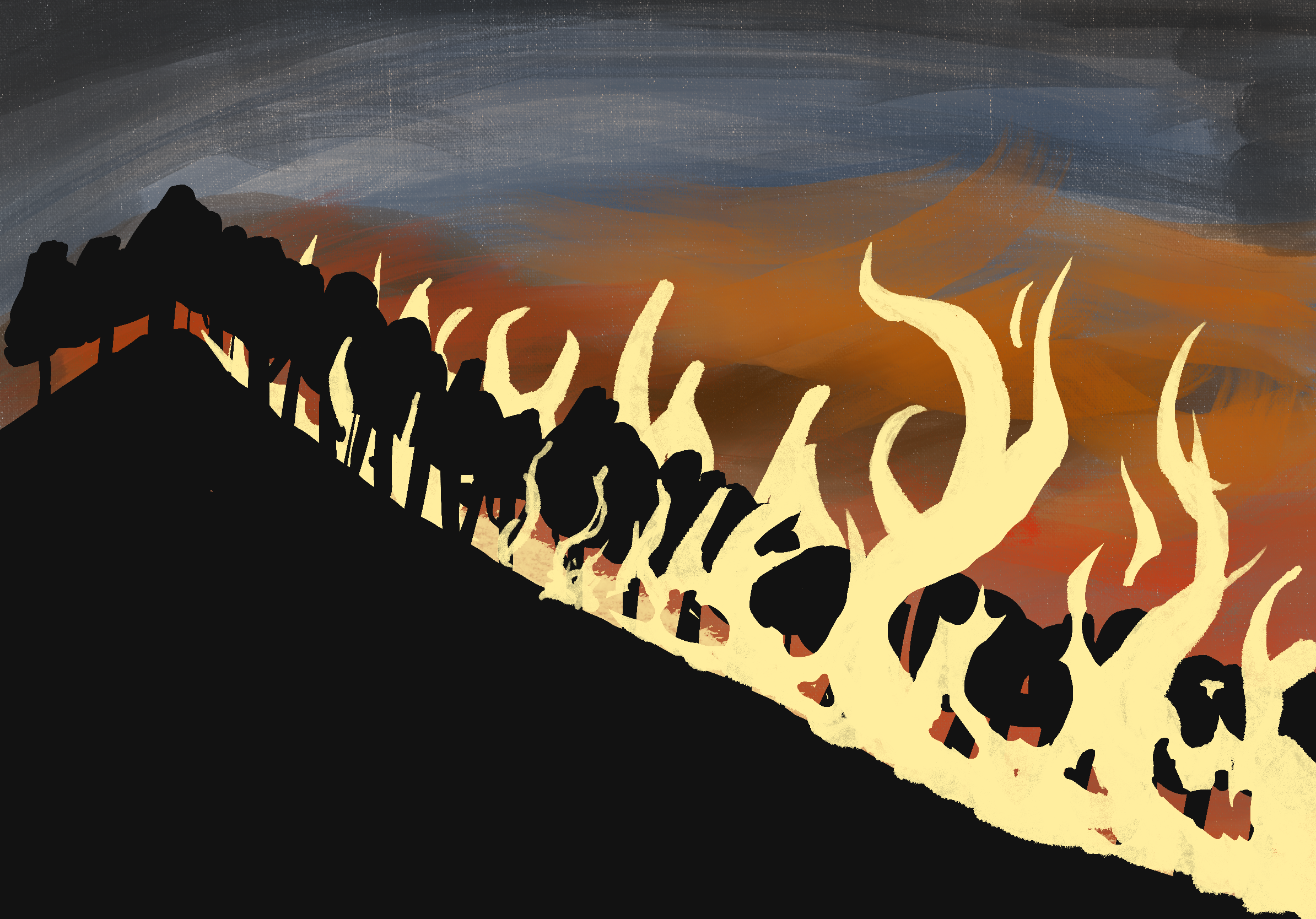
From Nov. 9 to Nov. 10, the New York State Department of Health issued an air quality alert for the Hudson Valley as several wildfires burned across the Northeast. These included a brush fire in Arlington, the Jennings Creek fire along the New York-New Jersey border and a brush fire in Brooklyn’s Prospect Park.
Students commented on the air quality on campus, which faced degradation due to the smoke from nearby wildfires. Denise Duran ’28 said, when she made her way outdoors on Sunday, Nov. 10, “Why does it smell like a barbecue?” She had thought the smoky air outside was fog but, once she realized what it was, she reported the smell was very bothersome. Another student, Heewon Ham ’28, specified that in the town of Dover, 40 minutes from Vassar College, the air quality was much better. Ham said, “Coming up from Dover, I couldn’t smell anything. When I came to campus, I was wondering why it was so empty. I stepped out of the car and was hit by the smog.”
The wildfires are much more prevalent due to a fierce drought that has forced the state of New York to implement new forest fire policies to help keep communities safe. The drought has drastically increased the wildfire risk in the Hudson Valley this year.
According to CBS News, 6.4 percent of New York is currently experiencing a moderate drought due to the lack of precipitation in the area. Additionally, CBS claims that while a drought is expected roughly every five to ten years in this specific area, the Lower Hudson Valley has been victim to them for the past two years as well.
Vassar College is taking action to ensure students’ safety by following the recommendations of the NY State Department of Environmental Conservation, including the administration of a burn ban to help reduce the risk of an accidental wildfire. Campus Response Center Lieutenant Salvatore Incorvaia reminded students via a Nov. 4 email of campus policies regarding open fires on school grounds. Additionally, the contained fire pits run by Campus Activities are prohibited from being used to reduce the risk on campus even further. Incorvaia wrote in the fire safety email, “With current weather conditions, any stray spark can start a blaze.” The communication noted that, “With the volume of dry leaves and evergreen needles on the ground, caution should be used with any type of open-flame, sparks, or combustion devices.”
If the conditions worsen and the state fire watch turns into a warning, a restriction of water use will have to be put in place, according to CBS News. CBS also recommends being mindful of water use and recycling water when possible.
Dr. Kenneth Foster, Director of Sustainability for Vassar College, is pointing to some larger changes in the world that are having a direct effect on the current drought in the Hudson Valley. “Although we can’t blame climate change for any specific drought, the science of climate change has shown persuasively that a warming climate is destabilizing weather patterns, leading to more common and more extreme periods of drought and flooding,” he explained.
He pointed to examples of other environmental safety concerns in the past few years, citing climate change as causing these phenomena to be more and more likely to occur and increasingly strong. Foster wrote, “For example, attribution analysis showed that climate change made the 2021 Pacific Northwest heat wave, a one in 1000-year event, both more likely and hotter than it would have been if carbon dioxide levels had remained what they were a century ago.” He stated that there are some ways we can fight climate change, which directly causes situations like the wildfire risk we see now. “The remedy is to support strong action by governments, business firms and others to curtail carbon emissions.”
Incorvaia pointed out some sources that could be beneficial for students to watch for updates, “This is one of the longest fall dry spells we’ve had in many years, coupled with windy conditions and leaf debris, it creates an increased opportunity for accidental fires. You can find the daily fire danger level on the New York State DEC Fire Danger Rating Map.”
Some students may be wondering how the air quality may affect their health in the near future. Margot Schinella, Director of Health Services at Vassar, explains, “Short-term health effects can include eye irritation, coughing, wheezing, difficulty breathing, and chest tightness.” She also expressed that students with underlying health conditions may experience more difficulties with the current conditions, “Individuals with underlying respiratory conditions such as asthma may be especially sensitive to changes in air quality and should consider limiting their outdoor exposure on poor air quality days. Poor air quality can worsen symptoms of asthma and other respiratory conditions.”
Schinella advises that staying informed regarding the air quality outdoors is the most important, writing, “There are many apps and tools that can be used for this purpose. For example, AirNow.gov by the U.S. Environmental Protection Agency and the U.S Forest Service provides air quality data and wildfire information based on your zip code. She says, “These helpful tools can assist students in making informed decisions about their participation in outdoor activities.”
Schinella also speaks to the importance of keeping yourself safe indoors if you are a member of one of the more vulnerable groups, “If you are sensitive to poor air quality, consider reducing your outdoor exposure, closing windows and using air purifiers in indoor spaces when possible. If air purifiers are not able to be used, consider wearing a mask when indoors.” Sometimes, there is no opportunity to avoid going outdoors. Schinella recommends in these circumstances, “If you are sensitive and must go outdoors, consider wearing a high quality mask such as a KN95. It is also helpful to shower after being outdoors in order to remove any particulates that could be harmful to your respiratory system.” She also reminded pet owners that their animals could be vulnerable to breathing difficulties, explaining, “Our pets can be sensitive too, so be sure to monitor this and limit their outdoor activity as well!”
The recent rainfall on Nov. 11 has helped to alleviate some of the more severe air quality issues, however, the lower Hudson Valley continues to experience moderate drought conditions, with wildfire risk continuing to be a concern.