
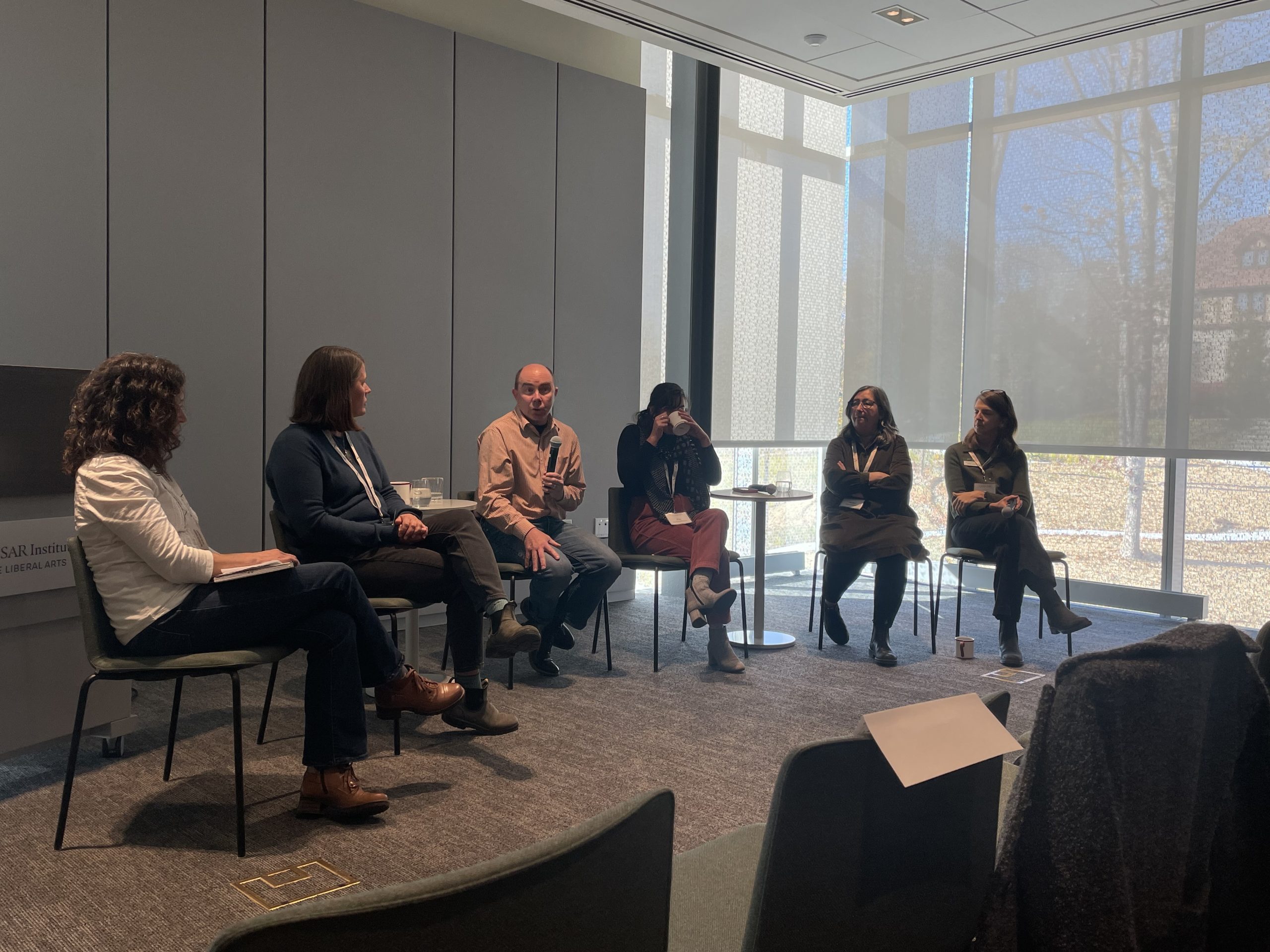
From Nov. 14 to 16, the Vassar Institute for the Liberal Arts hosted the first of its six Signature Programs planned throughout the year. This program, entitled “EcoVisions: Finding Your Place in Environmentalism,” was developed by The Preserve at Vassar, The Environmental Cooperative, The Office of Sustainability and the Political Science Department with the goal of highlighting actionable steps towards climate activism. Each day centered around a different theme: building decarbonization for a just energy transition, approaches to conservation and land management and environmental engagement. We managed to attend and recap the second and third day.
The second day’s events, “Approaches to Conservation and Land Management,” offered ample opportunity to hear about the work of leaders across the Hudson Valley and in New York City. The day launched with quick ten-minute snapshots of the scope and mission of the speakers’ conservancy missions. Beginning the round of speeches was Vassar’s own Keri VanCamp, Director of the Field Station and Ecological Preserve. VanCamp shared about her research classifying the diverse types of land on the Preserve and working to address invasive flora and fauna that threaten the land’s health.
Pia Ruisi-Besares, who is originally from Kingston, New York, discussed her time at Scenic Hudson where she works as the Director of Science, Climate and Stewardship. Scenic Hudson operates across a large, fragmented service area to conserve areas across the entire Hudson Valley. Ruisi-Besares distinguished her work from that of other land management programs by noting the difference between active and passive land management. “Most of our properties are managed passively, just by necessity, because we just don’t have the resources and capacity to do anything with them. Passive management is just protecting land from development and letting nature sort of take its course,” she said.
Another panelist with Vassar ties, Troy Weldy, shared his current mission as the president of the Columbia Land Conservancy. After graduating, Weldy spent time working at the Vassar Preserve. Since then, he has done a wide variety of work, from botanist to lobbyist, and even authored the New York Flora Atlas. While Weldy still has to actively fundraise to keep his staff of 20 employed, the group has protected around 40,000 acres of land in the county. Weldy brought up important facets of land management: helping educate the private landowner in good land stewardship, recognizing the affordable housing crisis in the fight to conserve lands and the importance of responsible solar sites in combating climate change.
Focusing on conservancy in urban areas, Helen Forgione described her work at the Natural Areas Conservancy, which is a nonprofit working in all five boroughs of New York City. Forgione has worked both inside and outside of government for over 25 years, having previously served as deputy director of the New York City Department of Environmental Protection’s Ecological Services Division. The Natural Areas Conservancy resembles the likes of the famous Central Park Conservancy, but instead of a one park focus, the group attends to many parks, natural areas and open spaces within the city. Some of the work they do involves categorizing and cataloging spaces and calculating the potential cost of what those areas in the city need to thrive. Using this information, the group developed a 25-year forest management framework, which has been adopted by the New York City Parks department as a management tool.
Forgione pushed back on conceptions of New York City’s environment as being entirely without green spaces. “Through some remote sensing work that we initially started with our organization, we found that 41 percent of New York City is in some sort of green space.” She drew attention to the biological diversity within these natural areas, just like the diversity amongst city residents. Additionally, she noted how the city is facing a lot of the same issues plaguing other environments: the loss of native species and impacts of an overabundance of deer.
With a broader focus on the larger Hudson Valley region, Laura Heady touched on what she does in her career as a Conservation and Land Use Program Coordinator for Hudson River Estuary Program. Working across jurisdictions within the New York State Department of Environmental Conservation, Heady took a moment to boast: “I like to brag: The Hudson Valley is the most biodiverse part of New York State.” With 260 municipalities to navigate, Heady helps municipalities at the planning board level make the best choices to align with their conservation and development goals. She points to a current reality—how conservation and planning boards just do not talk to each other—and how with the agency helping communities take an inventory of lands and develop smarter policies and plans, this problem can be addressed. The agency has helped more than 50 municipalities by taking an inventory of what they have and hopes to encourage these municipalities to use that knowledge in their planning.
After these overviews, audience members were able to ask questions of the experts. Topics ranged from changing ecological baselines to hunting practices and farmer’s attitudes towards invasive species. After lunch, a guided tour led to the Vassar Preserve, bringing Weldy back to his old stomping ground. “I’m looking forward to seeing the changes at the farm since I was last here in 1995,” he said. A legal hackathon was also hosted in the Institute for high schoolers from the area, an opportunity to exercise the skill of brainstorming, and helping demonstrate the accessibility of legal thinking.
Saturday morning, the third day, began with light refreshments and an informal display of student work. Attendees were able to approach a variety of posters and installations to get a first read before proceeding to the conference room for the first scheduled events.
Director of the Environmental Cooperative Jennifer Rubbo introduced President of the College Elizabeth Bradley, who gave a short address to open the program. Bradley expressed excitement regarding the decision to make EcoVisions the Institute’s inaugural program because the ideas presented align with the mission of the building itself, since it was largely constructed using recycled and green materials. She explained that the practical programming offered by the signature programs encourages students to extend their classroom beyond the walls of their academic buildings and noted that the Institute was placed in a liminal space outside of main campus where the Vassar community could hold space for different perspectives to interact.
The first event was a panel about climate justice moderated by Professor of Political Science Arpitha Kodiveri featuring climate lawyers Ashley Nemeth, Camila Bustos and YiYi Prue. Kodiveri explained that the three perspectives were especially important, as they are three young women from the Global South working with people in the Global South, arguably the areas most affected by climate change.
Nemeth’s work focuses on loss, damage and providing restitution to those who have been impacted by climate change. Over the past year, her work has centered on responsibility for effects on climate, particularly from oil companies. A significant challenge in her work is defining a metric to compensate since loss from climate change is ecological and personal, which often cannot be quantified. Nemeth posed the important question: What do we lose in culture and society when we lose ecologically? Because of the intersectional implications, she believes the legal field should and will recalibrate to understand how we can include climate conversations in everything we do, especially in other areas of the field that can be leveraged in favor of climate justice.
Bustos studies the question of climate migration and displacement, summarized as “What happens when someone has to move because of climate change?” Her passion for climate justice also came from looking at fossil fuels and how lawyers themselves have been facilitating the climate crisis by working for, and thus enabling, big oil companies.
Prue is an indigenous lawyer based in Bangladesh, whose work is motivated by her experience witnessing three of her neighbors’ houses demolished by the effect of a monsoon. She explained that she felt grateful to have her house intact but remained fearful after the event, and she became an activist to prevent this from happening to others. Prue emphasized that people often do not understand the effects of climate change until they experience it themselves.
Following the panel, the program broke for lunch where attendees were able to engage with students whose work was featured throughout the building. Students from several external schools, including Pace University and Marist College, were featured.
An exhibit by Mia Walker ’28—a comic strip-esque infographic dubbed a “climate explainer”—stood out amongst the abundance of research posters featured throughout the Institute. Walker’s work highlighted silvopasture, which is an ideal method of combining distinct components in an animal system (e.g. plants, other wildlife) in a way that is mutually beneficial. She became interested in the subject while taking Climate Fight with Associate Professor of Philosophy Jeffery Seidman, a course designed to help students locate themselves within the greater climate fight. Walker mentioned that taking the class opened her eyes to the rapid pace of climate change and inspired her to think about the different solutions that have the capacity to do the most to combat the climate crisis.
Attendees reconvened in the conference room after lunch for the keynote speech given by founder of Brown Girl Green and GreenJobsBoard Kristy Drutman. Upon taking the stage, Drutman’s exuberance illuminated the room, and she began with a check-in question. She asked the room how they were feeling given the interesting point in history and then led the crowd through a meditation exercise. Drutman asked the crowd to visualize a place in nature where they feel safe, and ask what they can do to protect it. She then explained her background in ecology and media and emphasized that she found her calling via storytelling.
The keynote conversation covered a wide range of topics including climate careers, the history of environmentalism (including its roots in racism), colonialism, American sentiment surrounding climate change and environmental justice. Drutman’s solutions to the climate crisis are largely inspired by equity and intersectionality, much like the work of the panelists earlier in the day. The speaker highlighted that when thinking about environmental justice, part of the focus of the conversations should be on how varying issues and voices are included in the conversations. She concluded by encouraging students to frame their steps towards environmental justice—and their paths in life—around who their community is and what brings them joy and hope.
The third day of the program highlighted the many ways to think about and take action towards climate justice, especially as undergraduate students. The speakers were thoughtfully selected, coming from diverse backgrounds with different motivations towards the same mission. Hearing stories from both the professionals and peers about the ways they have and are trying to initiate change was inspiring and left much food for thought.
The climate conversation is ongoing, but EcoVisions provided a solid starting point for the Vassar community to engage with others and make a plan for themselves.
I hope someone at this conference brought up the terrible baiting and killing of deer in the Vassar Preserve. It is kept out of the public eye as much as possible, with 285 deer needlessly shot with high-powered night scope rifles since 2010. Photos of the deer shot and tossed into plastic bins should have been shown at the conference.