
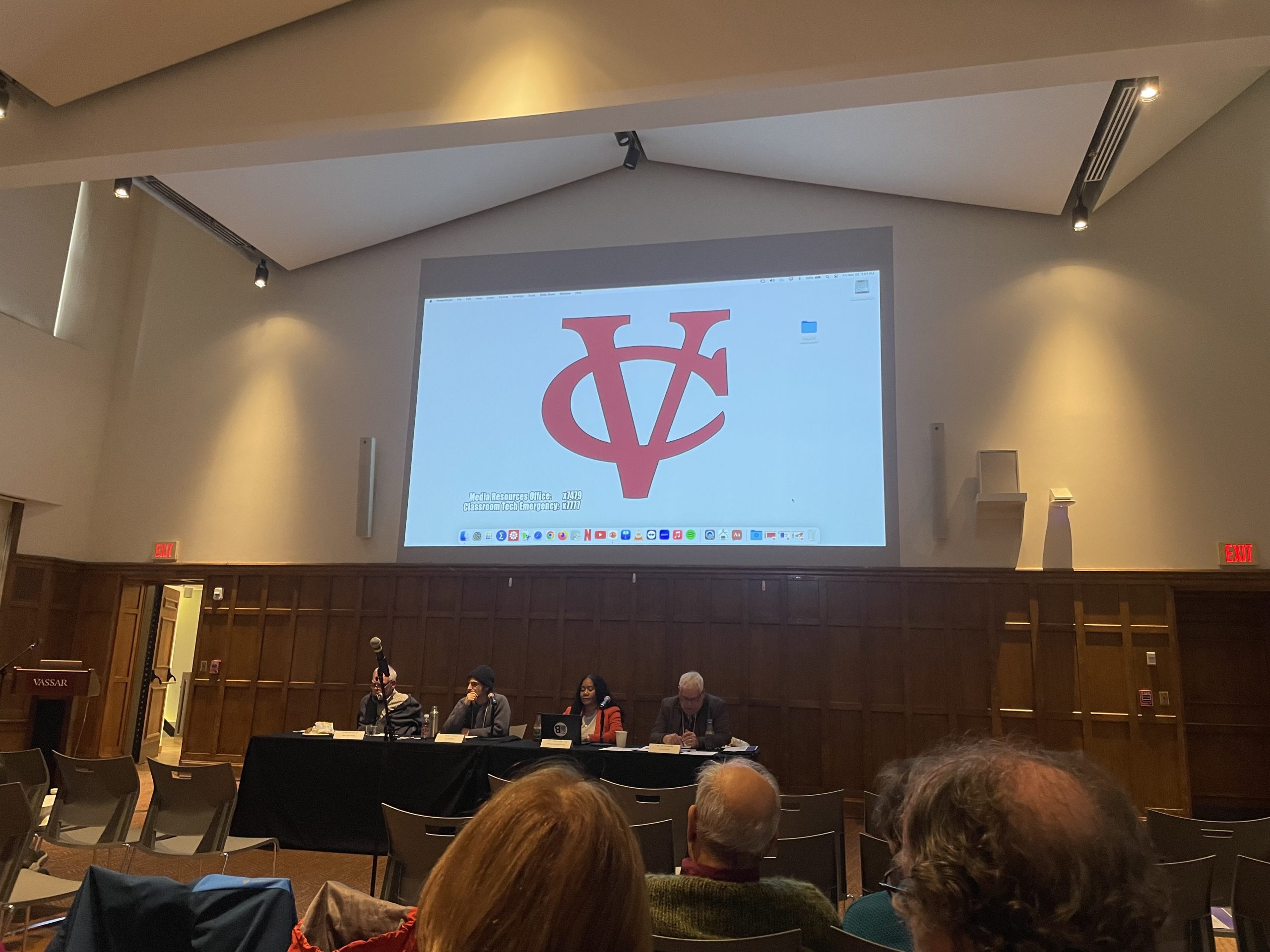
On Friday, Nov. 22, Vassar’s Political Science Department hosted the Conference on Decoding the Election (CODE), a full-day event that included professors from Vassar and other nearby colleges, local politicians, judges and lawyers. The event held panels on the three branches of government—executive, legislative and judicial—the future of democracy and Americans’ political behavior in the 2024 election.
CODE was organized by Political Science Research Assistant Michelle Itkin ’26 and Associate Professor of Political Science Taneisha Means. Itkin originally approached Means in November 2023 with the idea for a much smaller event of a few panels; Means then suggested an expansive, full-day conference. CODE took on new urgency following former President Donald Trump’s victory in the 2024 presidential election. Itkin noted, “It really ramped up in planning over the last two weeks, just because we had to pivot so much since the election actually happened, since this was not the outcome we were expecting.”
Itkin explained the reasons for holding the conference: “Vassar students are very intellectually curious about things like this, no matter what their actual major is. So I figured people would want a space to study and analyze and reflect on that outside of just the typical classroom setting.” Adam Murphy ’10, a civil rights lawyer who presented on CODE’s Judicial Branch panel, told The Miscellany News by email, “You have to understand an issue before identifying potential solutions. My hope, then, is that the event helps us identify the unique challenges ahead so that we can begin to brainstorm solutions that are tailored to those challenges.”
Throughout CODE, panelists focused time and again on the importance of local politics, especially in light of Republicans controlling all branches of the federal government starting in January 2025. In the Executive Branch panel, Professor of History Rebecca Edwards, currently on leave from Vassar while serving as the Poughkeepsie Town Supervisor, put it clearly: “We ignore the local at our peril.” She argued that focus on federal elections and a lack of local news sources leads to low voter turnout in local elections. Local politics, she emphasized, control an array of things that affect citizens’ day-to-day lives, from sewage to climate change.
Alfonso Lopez ’92, a seven-term member of the Virginia House of Delegates and the first Latino Democrat elected to the Virginia General Assembly, especially argued for centering local politics. In the Legislative Branch panel, Lopez contrasted the continued successes of Democrats like Virginia Senators Tim Kaine and Mark Warner with Vice President Kamala Harris’ failure to attract working-class minorities. “It’s about local politics, local issues,” Lopez said of Harris’ loss of Black and Latino voters compared to President Joe Biden’s performance in the 2020 election.
Lopez also asserted that Republicans’ strong hold on the federal government for at least the next two years—until the 2026 midterms—will require citizens to shift their attention to local elections and political activism. In an interview with The Miscellany News after the conference, Lopez expanded on this point: “It’s important that Vassar students not be discouraged,” he said. “The world needs Vassar students right now. The world needs Vassar students to get involved as actors, but more importantly, to think about running for office. And so, if I can reinforce that here as a part of my message, then that’s what I want to do.”
In her opening remarks, Itkin said she hoped the event would help tell people how to move forward from the election. “I think in terms of, like, individually, ‘What do I do now?’ I do feel a little bit better with, for example, Alfonso Lopez, who was giving us good advice about, like, ‘How do we as Vassar students get involved now with local politics?,’ ‘How do we change the climate of D.C. with phone banking?’” Itkin told The Miscellany News. “He was giving us concrete things that we actually can do to make change.” Patrick Cincotti ’28, who attended CODE, was also inspired by Lopez’s talk: “He emphasized changes at a state level and keeping it within your communities and how Vassar students are able to enact change.”
Members of the Judicial Branch panel discussed another importance of state politics. Douglas Keith, a senior counsel at the Brennan Center for Justice’s Judiciary Program, and Murphy both focused on how state courts can more expansively protect citizens’ rights than federal courts. Both referred to the common adage, “The U.S. Constitution is a floor”: States must at least guarantee the rights in the federal constitution but may give their citizens additional ones. Keith noted that since the U.S. Supreme Court is refusing to protect particular rights—such as the right to abortion or LGBTQ+ rights—they are bringing cases to state courts, where they feel they have a better chance of winning. As Murphy discussed, some of those cases involve prohibiting certain punishments. For instance, the Washington Supreme Court declared the death penalty unconstitutional in 2018 and, in 2024, the Massachusetts Supreme Judicial Court prohibited life without parole sentences for people under 21. Murphy told The Miscellany News, “I think many important legal challenges will come via state courts and state constitutions… State constitutions can and often do provide greater protections for people than the federal constitution. Lawyers and advocates who are looking to expand rights need to think hard about shifting at least some of our advocacy efforts from federal courts to state courts.”
“I think it went really well, and I was really happy with how it turned out,” Itkin said after the conference. Holding events like CODE at a college matters, she said, because whether or not young voters turn out in elections can make the difference in close races. She explained, “I think generally in American history, and today, and at Vassar, college-age students are generally thinking a lot about activism, but need to put all of that thought and care into actually turning out to vote.”
Additional reporting by Makenna Monaghan.