

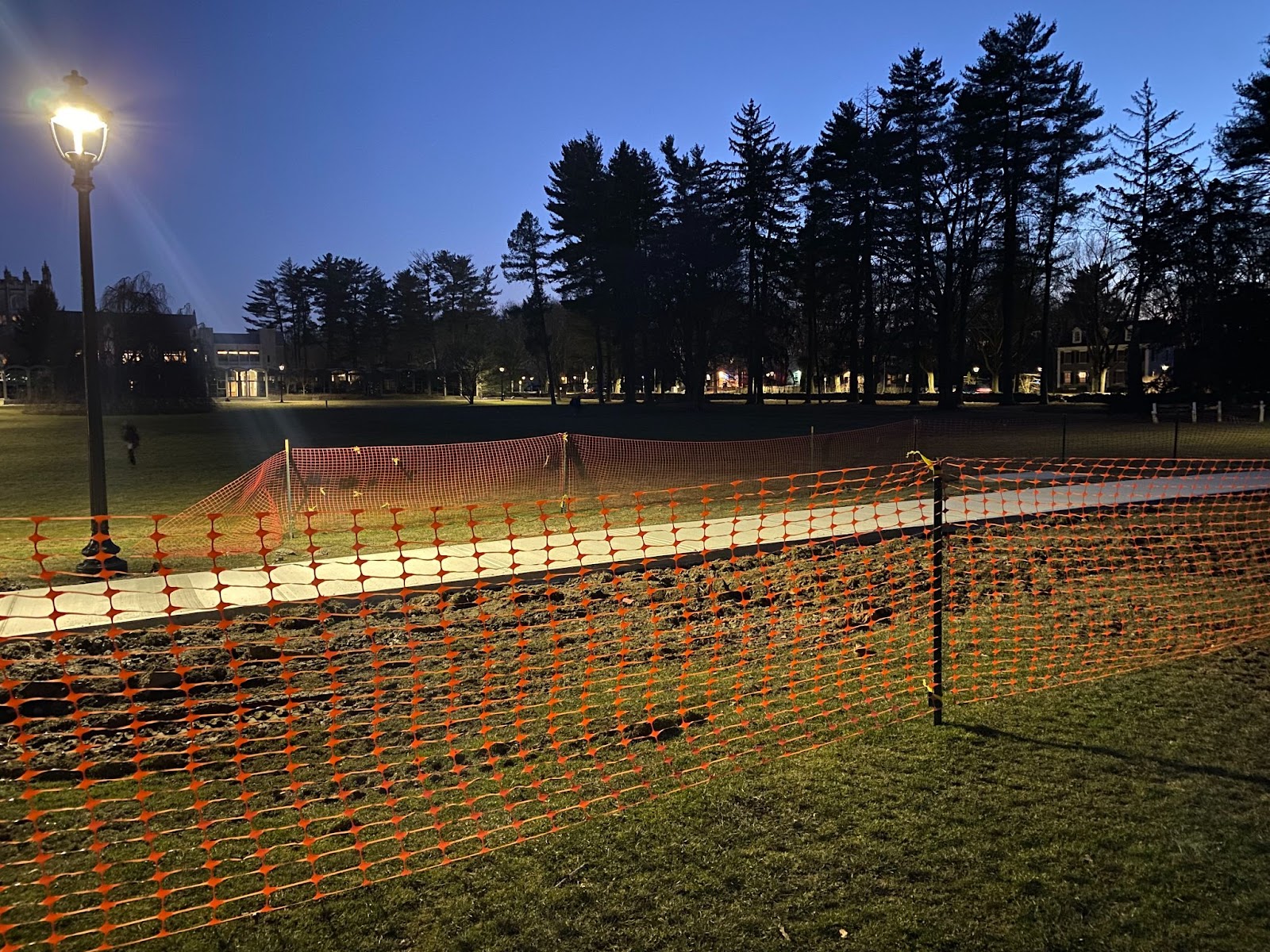
On Thursday, March 2, the Vassar student body received an email from Dean Jaeger, the Grounds Manager for Facilities Operations, detailing the reasoning and process for the removal of the large Dutch elm tree in front of Josselyn House. The email stated that the tree, which honors the Class of 1945, had succumbed to Dutch elm disease, and required removal. The tree was removed during spring break, and the sidewalk was redone around the site. The benches once beneath the tree were also removed, and a solemn memorial stone now marks where the tree once stood.
The American Phytopathology Society (society for the study of plant disease) states that the cause of Dutch elm disease is the Ophiostoma parasitic fungus, which can only reproduce in this particular species of tree. Elm bark beetles spread the fungi from one diseased tree to another, boring through the bark and tunneling through the wood to lay infected eggs. Spores from the fungus are dropped when the beetles feed. If an infection occurs during the summer months, it is likely to spread and kill the tree quickly, whereas during the colder season, the fungi cannot spread as fast and may only infect localized sections of the tree, allowing it to live a bit longer.
The Ophiostoma fungus causes the degradation of plant cell walls, as well as blocks the passage of water out to the tree’s extremities. Because of this, one of the earliest symptoms of Dutch elm disease is wilted leaves. Trees often become infected through root grafts, when the roots of trees planted close together naturally intertwine. For this reason, one method of disease management is ensuring that trees are planted farther apart; while infection is almost 100 percent certain between elms planted 20 feet apart or less, that likelihood drops significantly when the trees are planted 40 feet apart or more.
Dean Jaeger spoke to The Miscellany News about the reasoning behind the tree’s removal. “The recently-removed tree in front of Josselyn House was known to have Dutch elm disease for approximately four years,” Jaeger states. “Usually when more than 50% of a tree is infected and injections are no longer helping it, then it’s time to make a decision. In the case of the tree in front of Joss, it had some major storm damage, which contributed to the need for removal. The most important consideration for removing a tree is safety.”
Jaeger also spoke to the administrative aspect behind the tree’s removal: “When considering to remove a tree, we consult with an outside arborist and a small group of faculty and administrators. This group also assists with selecting an appropriate replacement when it’s necessary to remove a tree.” According to the Vassar Sustainability webpage, the Arborist committee is made up of Jaeger, Director of the Environmental Cooperative at the Vassar Barns Jen Rubbo and Associate Professor of Art History Yvonne Elet. Jaeger also touched on the impact of the tree’s loss. “We do our best to try to save and let our trees continue to grow, but that’s not always possible,” Jaeger said.
Following the announcement, students expressed their sadness over the loss of the Class of 1945 tree, a loss felt perhaps most acutely from those living in Josselyn House. One Joss resident, Kevin Seo ’25, stated: “I found out recently that the school administration is removing the tree and living in Joss specifically for two years, looking into Joss Beach that tree has always been there… I feel like that tree has become one of the more grounding features that defines Joss and Joss Beach.” On whether or not the removal of the tree felt like a significant loss, Seo remarked, “Yes, they do have a valid reason to remove the tree, but I will miss it. It’s more of a sentimental thing.”
Lily Tarrant ’25, another two-year Joss resident, echoed Seo’s statement. “I really just remember it as the big pretty tree that gave more life to Joss in the spring and fall,” Tarrant said. “And the slightly eerie baby swing that looked like it had seen some things. It was sad to hear they were removing it! But if it’s unhealthy then it makes sense, even though it’s sad. It will be missed.”
The Class of 1945 tree was loved by former Joss residents, as well. Shiloh Munsen ’23 described the joy the tree brought to students: “It felt like a point of community for Joss residents. On nice days, I could look out my window and see people lounging and doing work in its shade.” Munsen also mentioned a fond memory of the tree. She recalls, “It was the meeting point to get ready for the Brewer games during my first year at Vassar where I got to meet many other Joss residents and start to feel the Vassar sense of community.” Whether providing shelter for those studying or as a community meeting point, it is clear that the Class of ’45 tree was well-loved on campus.
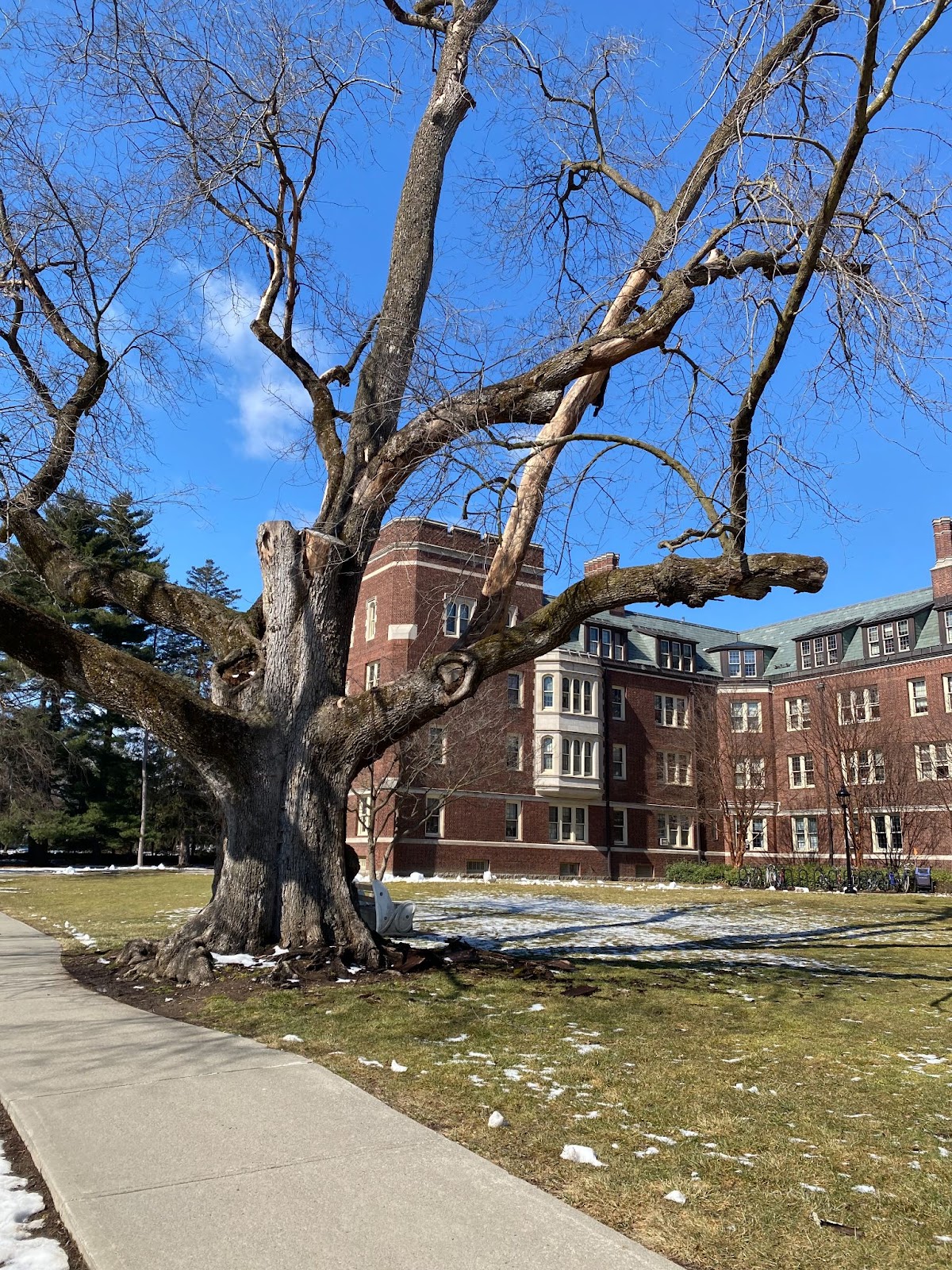
The Vassar Office for Sustainability has an official statement on tree removal, which seems especially poignant following this loss. The website states, “Since it is capable of more or less continuously producing new branches, leaves, and roots, a tree should be able to live forever.” The statement continues, “Most of our campus trees do indeed have very long lives, so we naturally tend to regard them as permanent. We find that perceived permanence comforting, and when a tree comes down we experience a disconcerting sense of sadness and loss.” Finally, the website provides a reminder of the gravity of these decisions: “Because our campus trees have such high ecological, emotional, and esthetic importance, it is the policy of the Arboretum Committee that a tree can be removed only if it has become a clear safety hazard, or it is too diseased or damaged to survive. Even then, the decision is not taken lightly.”
A tree resistant to Dutch elm will be planted in the Class of 1945 tree’s place, hopefully providing shade and shelter for the campus for decades to come without prompting worries about its health. Still, it is clear that the now-gone tree will be dearly missed by the student body. For those interested in paying their respects to the campus landmark, the tree’s temporary memorial will be available for viewing until further notice.
Recently, the Class of 2025 received an email from Associate Dean of the College for Campus Activities Dennis Macheska outlining the process for the selection of their own class tree. “We would like to know what type of tree you would like to represent your class and we also would like to know if you are interested in being part of the planning team for the planting and celebration of your class tree,” the email stated. The tree is due to be planted on Arbor Day, April 28, 2023. During the Class of 2025’s senior week, a time capsule will be buried there. A link to provide feedback on the selection of a class tree is included in the email.

Very nice and thoughtful reporting Madi! I’m glad you included the Arboretum Committee’s statement on tree removal, and also mentioned that the 1945 class tree will be replaced. Class trees are one of our oldest continuing traditions, the first one was planted by the class of 1868. I hope everyone in the class of 2025 will participate in choosing their tree and dedicating it on Arbor Day.
seems like an inside job to me.
It is as if a piece of our legacy has been lost, however, we Vassarians are resilient and the Class of 1945 was ever more so, the new tree will be a testament that fact.
What was done with the the tree after removal? I can envision several projects using the lumber.