According to radiometric dating, the Earth is 4.543 billion years old. Even as an earth science major myself, I find it hard to conceptualize just how much time that is. Though geologists have come up with countless different ways to help people come to terms with the sheer amount of time that the Earth has existed, I find that the most helpful one exists right on the Vassar campus.
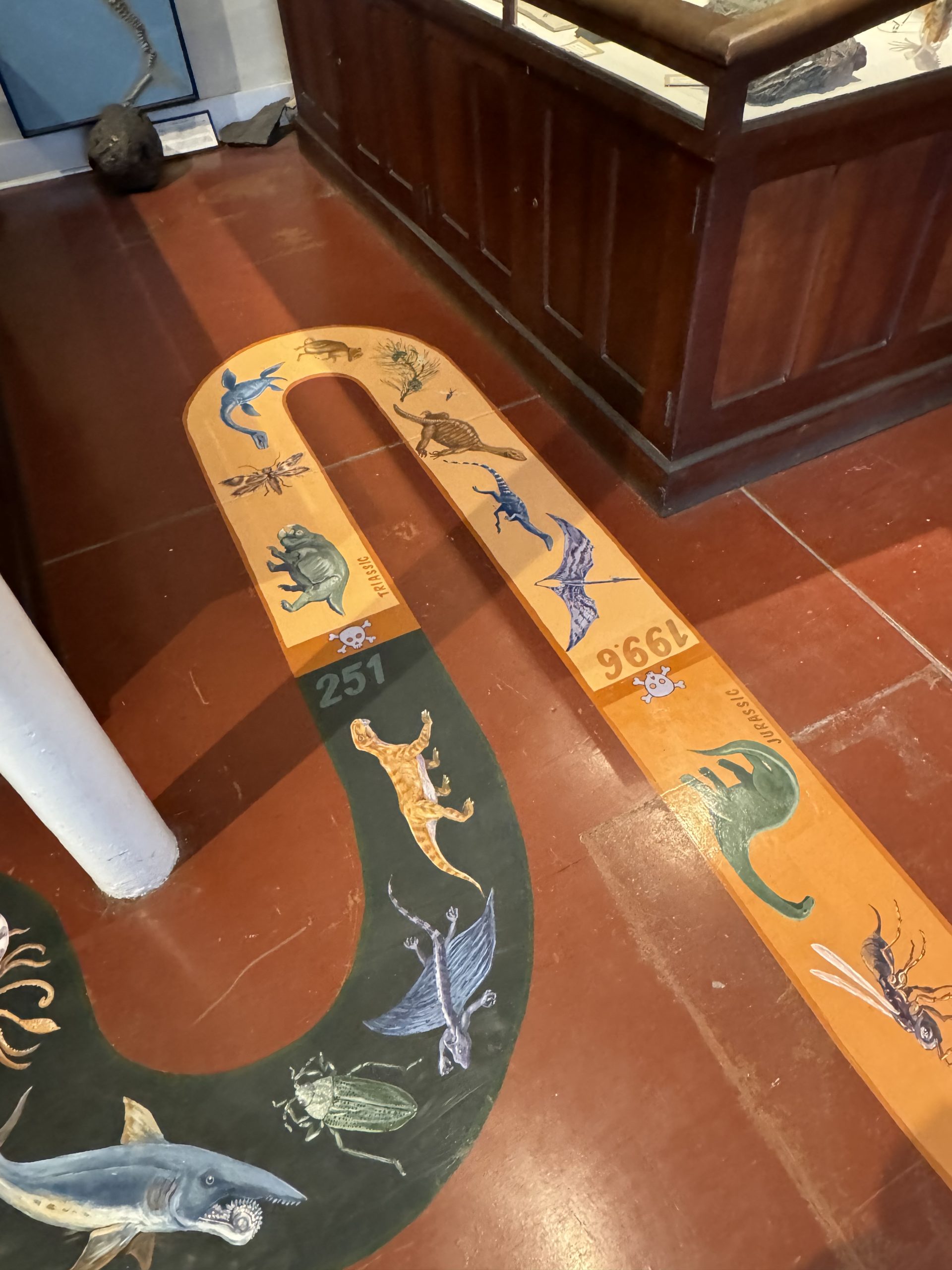
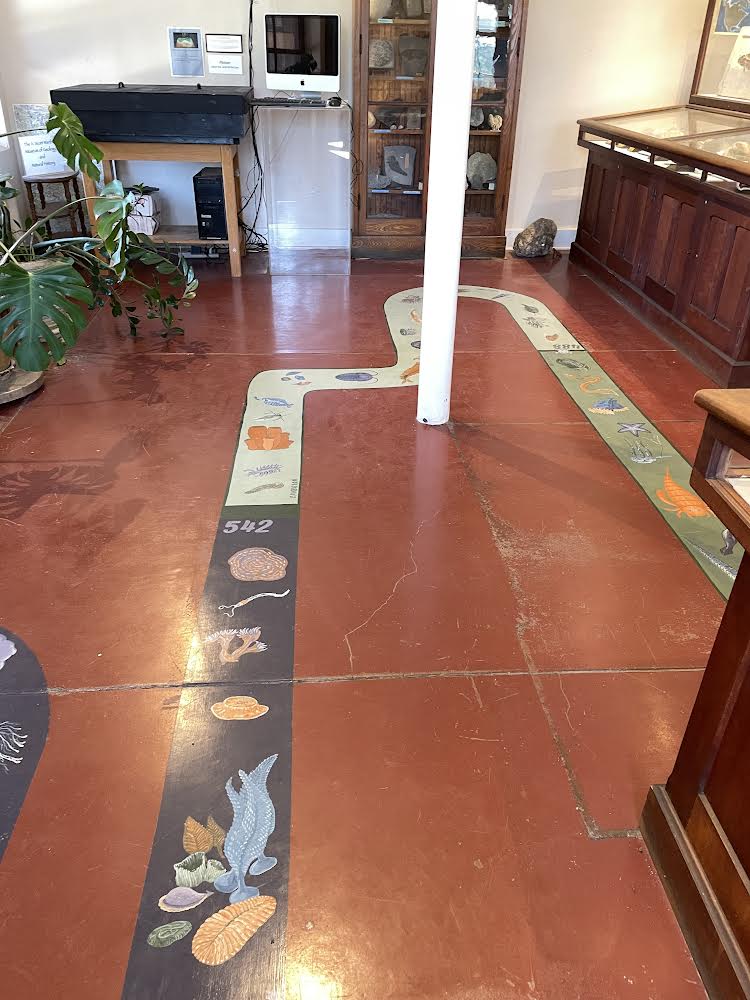
The universe begins at Vassar Lake, and the Earth starts at Rockefeller Hall. Then, upon stepping foot into the A. Scott Warthin Museum of Geology and Natural History located in Ely Hall, visitors are immediately whisked millions of years back in geologic time. The floor of the museum has been intricately painted with a visual metaphor for geologic time that allows people to clearly comprehend the vastness of time of life on Earth.
The timeline outlines the different geologic epochs that have existed on Earth, complete with hand-painted illustrations of over 200 organisms that existed in each era. The timeline provides viewers with a comprehensive guide to the history of the Earth, but in a way that is easily digestible.
This project initially began as a Science Illustration Independent Study last spring by Elise Poniatowski ’23. According to Rick Jones, Vassar’s own scientific illustrator, Poniatowski was inspired by a project done in the “Mass Extinctions” class taught by Assistant Professor of Earth Science Laura Haynes. The project consists of several posters on the back wall of the museum that provide a comprehensive guide to the Big Five Mass Extinctions. In fact, the colors of the posters inspired the color scheme used in the geologic timeline.
After Poniatowski graduated, the project was finished by Rick Jones with contributions from Carter Mucha ’23, Ayane Garrison ’24 and Professor of Geography Yu Zhou. Overall, it took about a year to fully complete, from March 2023 to March 2024.
When Jones took over the completion of the project, his goal was to tell the story of life on Earth. In addition to depicting the more commonly known extinct organisms, such as Tyrannosaurus rex, Jones took care to call attention to more overlooked animals, such as the first mammal to return to the sea, Pakicetus. Jones’ work also highlights various specimens in the museum’s collection, such as the Ichthyosaurus, effectively tying the museum together.
The timeline seamlessly integrates the Big Five Mass Extinctions into the story of life. Once the dinosaurs were wiped out, birds and small mammals filled the ecological niches left behind, a phenomena depicted in the timeline. “I’d like people to get a sense of how weird and wonderful life is,” says Jones, a goal that is undoubtedly achieved in this impressive artistic and educational feat.
As I discussed the process and inspiration behind Ely Hall’s own geologic timeline with Professor of Earth Science Jill Schneiderman, she mentioned that she saw a similar attraction at SUNY Geneseo and was excited by the teaching potential of a physical geologic timeline on Vassar’s campus.
I took a course with Professor Schneiderman last semester called “The Solid Earth: Physical Geology,” and while discussing the geologic timeline with her, she reminded me of the benefits of having a visual representation of geologic time. In American author John McPhee’s book, “Annals of the Former World,” he describes a classic metaphor for geologic time: “Geologists will sometimes use the calendar year as a unit to represent the time scale, and in such terms the Precambrian runs from New Year’s Day until well after Halloween. Dinosaurs appear in the middle of December and are gone the day after Christmas. The last ice sheet melts on December 31st at one minute before midnight, and the Roman Empire lasts five seconds.”
Though I have found this metaphor to be incredibly helpful in understanding the sheer scale of geologic time, others are more visual learners. This is where Vassar’s geologic timeline serves as an invaluable tool for teaching. Jones’ hard work allows students and museum visitors alike to walk through the history of life throughout geologic time, demonstrating how short the time that humans have inhabited the Earth is, especially in comparison to other organisms.
Professor Schneiderman mentioned how the project can be helpful in reminding us how briefly humans have existed in the grand scheme of life on Earth. “Rick’s visual metaphor, which is proportioned to reflect the amount of time that has gone by, allows us to walk through the history of life in geologic time. It shows us how short our duration is on the planet in comparison to every other living being,” she explained. Humans have acted like a geologic force that is disproportionate to the amount of time that we have been on Earth, and the timeline is helpful in reminding visitors to be humble about our existence.
Despite being discouraged by the disproportionate, detrimental effect of anthropogenic climate on Earth, I find that the geologic timeline acts as a beacon of hope in the midst of the current environmental crisis. I encourage you to take a step back in geologic time, reflect upon humanity’s impact on our planet and take solace in the fact that most of life on Earth has been through more than we can comprehend. No matter what happens to the climate, life finds a way to persist on Earth.